
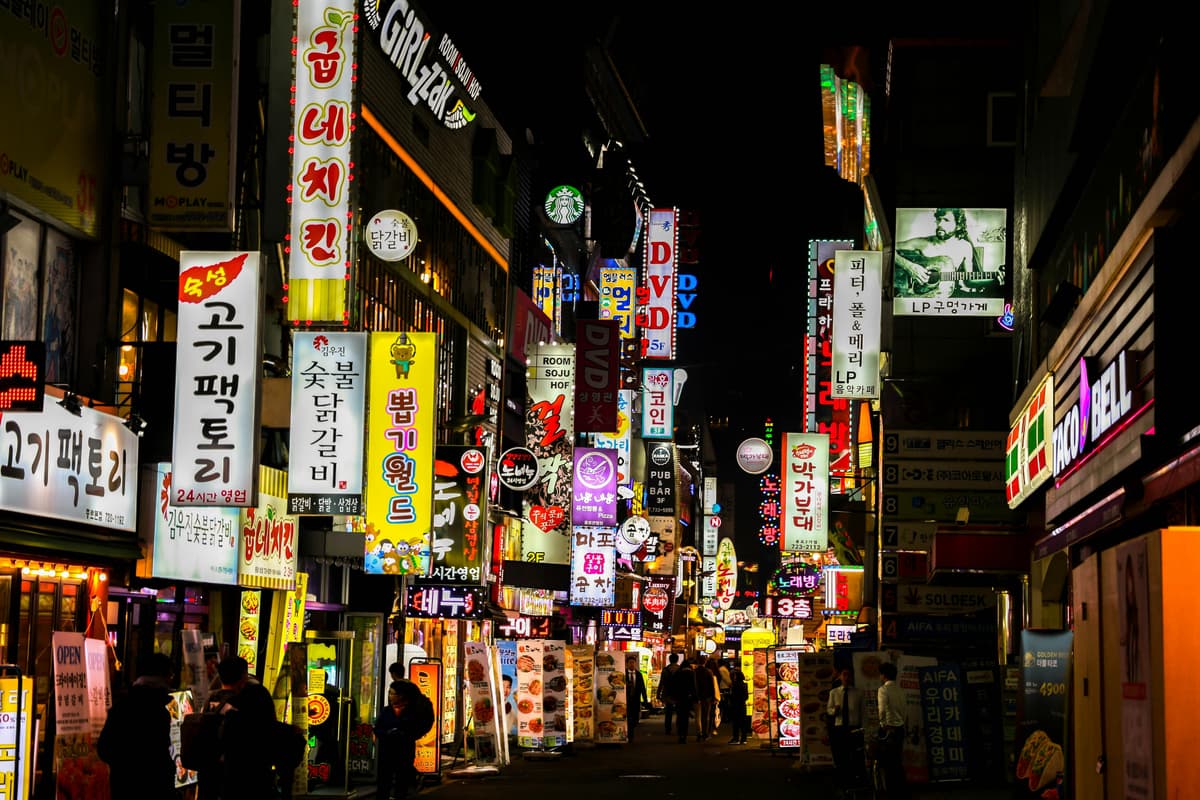
South Korea has become an increasingly attractive destination for global employers and talented job seekers alike. With its thriving economy, skilled workforce, and innovative industries, the country offers significant opportunities for business expansion. This article provides a comprehensive overview of hiring practices in South Korea, covering key legal considerations, minimum wage, employment contracts, payroll and taxes, and other essential aspects of the employment process. By understanding these key areas, American employers can confidently and compliantly build a successful team in this dynamic market.
Key Facts About Employment in South Korea
Information Category | Details |
|---|---|
Minimum Wage in South Korea | 10,320 KRW per hour, approximately 2,156,880 KRW monthly based on 209 working hours. |
Standard Workweek | 40 hours standard. |
Payroll Frequency | Monthly processing. |
Fiscal Year | Calendar year (January-December). |
Main Employment Laws | Labor Standards Act (LSA). |
Employment Contracts in South Korea
In South Korea, it is crucial to have a written employment contract in place to define the terms and conditions of employment. While different types of contracts are used, the following are the most common:
- Permanent Contracts: These are for an indefinite period and are the most common type of employment agreement.
- Fixed-Term Contracts: These contracts are for a specific duration, not exceeding two years. After two years, the employee is generally considered a permanent worker.
- Temporary Contracts: These are used for short-term or seasonal work.
A written employment contract is mandatory and must include: wages, contractual working hours, holidays, annual paid leave, place of employment, and other working conditions as required by Article 17 of the Labor Standards Act. Common practice may include a probationary period (often 3 months), but probation terms are not explicitly capped by law
- Job Title and Responsibilities: A clear description of the employee's role and duties.
- Salary and Payment Terms: The agreed-upon salary, including any allowances or bonuses, and the payment schedule.
- Working Hours: The standard working hours, as well as any provisions for overtime.
- Probation Period: If applicable, the duration of the probationary period, which cannot exceed three months.
- Notice Period: The required notice period for termination of the contract.
Payroll, Taxes, and Social Security in South Korea
Understanding payroll, tax, and social security is crucial. Contributions are required from both employers and employees.
Employer Contributions
The total cost for the employer for hiring an employee is around 10 to 30% on gross salary.
Contribution | Rate |
|---|---|
National Pension | 4.75% |
National Health Insurance | 3.545% - 3.595% |
Employment Insurance | 1.15% - 1.75% |
Worker Accident Compensation Insurance | 0.606% - 18.60% |
Resident Tax | 0.50% |
Long-Term Care Insurance | 0.4724% |
Employee Contributions
The employee contributes almost 10% to gross salary.
Contribution | Rate |
|---|---|
National Pension | 4.75% |
National Health Insurance | 3.60% |
Long-Term Care Insurance | 0.4724% |
Employment Insurance | 0.90% |
Income Tax in South Korea
South Korea uses a progressive income tax system (6% to 45%). A local income surtax also applies. Foreign employees with less than five years of residency may opt for a flat tax rate of 19% (20.90% with local tax)
Income Bracket (KRW) | Rate |
|---|---|
Below 14 million | 6% |
14 million – 50 million | 15% |
50 million – 88 million | 24% |
88 million – 150 million | 35% |
150 million – 300 million | 38% |
300 million – 500 million | 40% |
500 million – 1 billion | 42% |
Over 1 billion | 45% |
Compensation & Benefits in South Korea
Benefit | Description |
|---|---|
Health Insurance | Mandatory National Health Insurance (NHI) provides comprehensive coverage. The NHI covers illnesses, injuries, rehabilitation, and childbirth. |
Allowances | Various allowances, such as for meals and transportation, are common. |
Bonuses | While not mandatory, many companies offer bonuses, often tied to performance. There is no legal requirement for a 13th or 14th-month salary payment. |
Working Hours and Overtime in South Korea
Category | Description |
|---|---|
Overtime hours | Maximum 12 hours per week. |
Overtime Pay | 150% of the standard salary rate. |
Night Work Pay (after 10:00 PM) | 200% of the standard salary rate. |
Working on holidays | 150% of standard salary for the first 8 hours and an additional 50% for exceeding 8 hours. |
Flexible/Remote Work | Becoming more common but not legally mandated. |
Specific pay premiums for overtime, night work, and holidays are governed under LSA Article 56 and related regulations, but exact multipliers should be confirmed from official wage and hour policy documents.
Leave and Statutory Time Off in South Korea
Leave Type | Entitlement |
|---|---|
Paid Annual Leave | 11 days for the first year of employment, 15 days for years 2-3, then 1 day is added for every 2 years (max 25 days annually). |
Sick Leave | No statutory sick leave. The employer pays 60% of the average wage during medical treatment. |
Maternity Leave | 90 days of paid leave (120 for multiple births). 60 days are paid in full by the employer, and 30 days are paid by the Employment Insurance Fund (capped at 2.1 million KRW). For 120 days of multiple births, 75 days are paid by the employer and 45 days by insurance. |
Paternity Leave | 20 days of paid leave. |
Parental Leave | Up to one year of leave per parent for childcare, but can be extended to 1.5 years. |
The following are the key public holidays in South Korea:
- New Year's Day
- Seollal (Lunar New Year)
- Independence Movement Day
- Labor Day
- Children's Day
- Buddha's Birthday
- Memorial Day
- Liberation Day
- Chuseok (Korean Thanksgiving)
- National Foundation Day
- Hangeul Day
- Christmas Day
Hiring and Onboarding Process in South Korea
The process involves collecting necessary documents, registering employees for social insurance, and, for foreign hires, securing the appropriate work visa. New employees should be registered within 14 days of their commencement date. Using an Employer of Record (EOR) can simplify obtaining work permits for South Korea.
Termination & Notice Periods
Terminating an employee in South Korea is subject to strict regulations.
- Notice Requirements: A minimum of 30 days' notice is required for termination.
- Valid Reasons for Dismissal: Dismissal must be for a "just cause," such as a criminal offense, gross misconduct, or urgent business necessity.
- Severance Pay Basics: Employees who have worked for more than one year are entitled to severance pay, which is equivalent to 30 days of their average wage for each year of service.
Useful Resources
Other articles
Hiring in China
Hiring in Japan
Disclaimer: This article is provided for informational purposes only and should not be relied on as legal advice or used as a substitute for advice from qualified legal counsel.