Most payroll companies compete on features. Niural AI set out to compete on the layer underneath them.
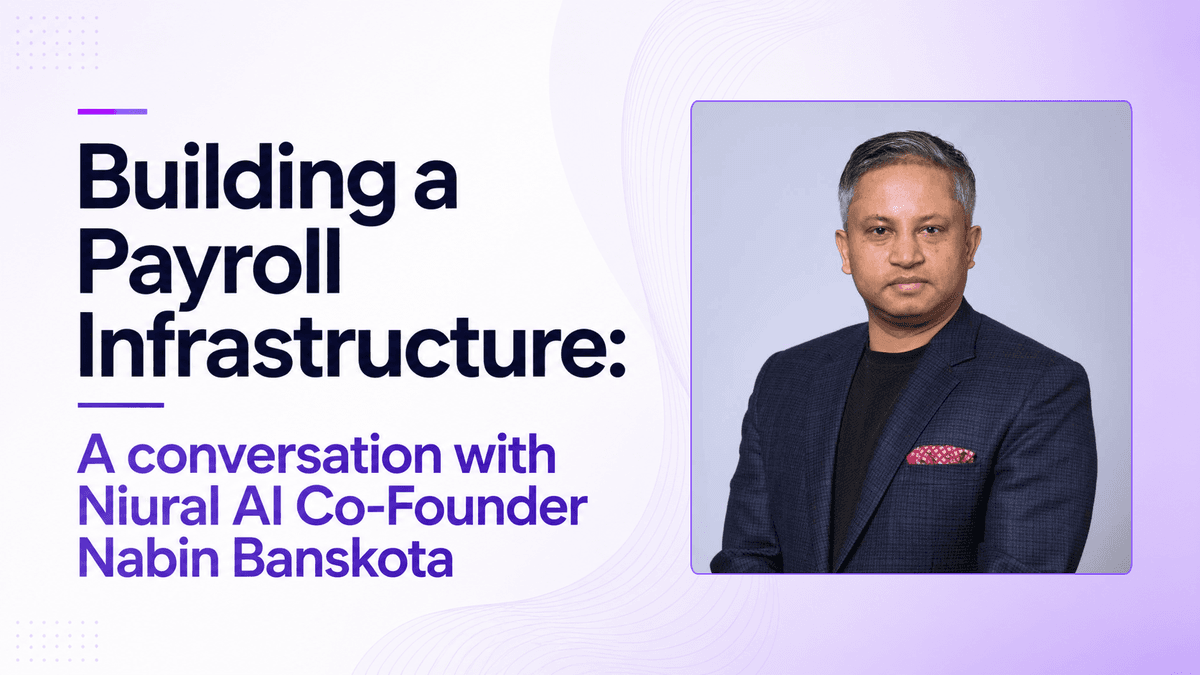
In a conversation with Brett Ungashick, Founder and CEO of OutSail, Niural AI co-founder and President Nabin Banskota walked through why he spent nearly three years building payroll infrastructure before selling a single seat.
The thread running through all of it: payroll isn't a software problem you patch. It's an infrastructure problem you rebuild.
The Infrastructure for the Next 100 Years
Banskota's path into payroll came the long way around: a CFO role inside Citi's alternative investment practice, a consumer fintech company acquired by Acorns, and a period leading U.S. sales and strategy at global payroll provider TMF. Each stop taught him the same lesson from a different angle: the plumbing behind payroll and payments barely changes, and almost no one wants to rebuild it.
That's exactly why Niural did. Where incumbents have coasted on decades-old systems, Banskota saw an opening to build the category's next foundation rather than stack another layer on top of it.
"We really saw a tremendous opportunity to disrupt this space by building the infrastructure from the ground up for the next 100 years."
The thesis rested on three pillars: modernize the payroll stack so it scales from a company's first hire all the way to IPO, unify payroll processing with payment processing (which fall apart the moment you go global), and treat benefits as part of one system instead of a bolted-on afterthought. AI ran underneath all three; the layer Banskota bet would set Niural apart from every stack built before it.
Nobody Focused on the Hard Part
Ask most people what "global payroll" meant five years ago and you'll hear the same answer: Aggregation. A single dashboard sitting on top of independent in-country processors, stitched together and hoping the data reconciled.
A newer wave of vendors pushed further and started owning more of the infrastructure. But Banskota argues most of that effort landed on the front end, dashboards and data aggregation, while the hard part went untouched: the backend stack that actually runs gross-to-net payroll, onboarding, payments, and the benefits layer.
His conviction was that you can't rent your way to reliability. So Niural AI built its own.
"Everybody else in this industry just uses somebody else's stack. We wanted to be very, very close to the infrastructure and build our own."
Owning the rails is what lets Niural move money without leaning on the payroll-specific exemptions many competitors depend on, which means the same system can pay employees, contractors, and vendors globally, not just process a paycheck.
No Provider Cracked the U.S.
Platforms like Deel and Papaya Global became good at international hiring, Nabin notes, and yet, along with the other companies that came before them, they never truly cracked the United States.
The reason is brutally unglamorous: there are more than 23,000 tax jurisdictions in the U.S., and getting every one of them right is the kind of work that has sunk founder after founder. It's also why Niural refused to ship early. In payroll, Nabin says, age is the enemy; the fewer years you've spent in the space, the worse you'll do, and you can't go to market with an MVP and expect anyone to buy it.
Cracking the U.S. also meant cracking PEO, arguably the hardest, most compliance-heavy corner of the domestic market, and the one where legacy infrastructure shows its age most clearly. By Nabin’s estimate, roughly 90% of PEOs still run on software built in the 1980s.
It also meant securing the kind of relationships that define whether a PEO can actually serve growing companies. Nabin’s favorite illustration is the master medical plan:
"There's a joke in this industry: getting a banking license is easier than getting a master plan with carriers like Aetna and Kaiser."
Niural's answer is a primary-vendor approach: land with the PEO, the stickiest, most painful part of a customer's stack, and expand into contractors, EOR, and global entity payroll from there. Because the system is flexible enough to move a company from PEO to an ASO model with its own benefits as it scales, customers don't outgrow the platform at 250 employees. That flexibility, he notes, is something legacy PEO software simply can't do.
The Only Executional AI in the Payroll System
Every payroll vendor now claims AI. Nabin draws a sharp line between AI that talks and AI that acts.
In this domain, accuracy isn't a nice-to-have. A general-purpose foundational model, he says, might get you 60 to 65% of the way there; the last 30% has to be built internally, and the final 5% is where the real difference lives in payroll tax calculations. Niural's approach pairs its own trained models with human review from an internal research team as well as external experts who validate how tax-law changes get interpreted before anything reaches production.
But the payoff of owning the infrastructure shows up in what the AI is allowed to do.
"Today we're probably the only executional AI in the payroll system. You go in, you ask questions, and before you finalize, it'll actually go and run payroll for you, make payments, hire people; take actions on your behalf based on what you prompted."
This is the difference between a chatbot that flags a problem and an agent that resolves it. Niural's executional layer, EMMA, doesn't just surface a classification risk or a missed filing; it completes the workflow. And because it runs on a single authoritative dataset rather than middleware pulling from five systems, it can act with the precision payroll demands. Nabin expects the interface itself to keep shifting toward a prompt-first model as teams grow more comfortable delegating to AI.
The best analogy he offers isn't a single payroll company at all. Gusto is excellent for very small businesses but doesn't scale; ADP scales to the enterprise but skips features that should be standard today. Niural AI, built after the tech had advanced far enough, didn't have to choose.
Long Horizon Agents
The most recent chapter is Niural AI Labs, the company's dedicated research arm. The goal is to push executional AI past the single-run tasks it handles today toward what Nabin calls long-horizon agents; workflows that unfold over time rather than in one click.
Dismissing an employee in the U.S. is straightforward. In the Netherlands and many other countries, separations involve drafts, negotiations, and multi-step legal processes that span weeks. Teaching agents to navigate that kind of complexity is the frontier the Labs team is built to chase.
There's a deeper bet underneath it: as foundational models specialize into specific domains, they'll need industry-specific training environments, "training gyms," to get from good to reliable. Niural AI wants to build one for payroll, HR, and payments. The point isn't automation for its own sake; it's making mundane work obsolete so HR teams get their time back for the culture-building work they were hired to do in the first place.
Find out more: