Key takeaways
- Corporate payroll services cover the wage math, tax deposits and filings in every state, the deductions, the year-end forms, the ledger sync, and the movement of the money.
- Errors compound. An EY analysis puts the average fix at $339, and the IRS charges 2% to 15% on late federal tax deposits.
- Assess the providers on the infrastructure side: tax engine ownership, the pre-run checks, international hiring, and who gets paid on your payroll cash.
A 200-person company would never go out and rebuild their payroll. It's growth that drives that decision. An engineer moves from Austin to Denver, and the company is now liable for Colorado withholding. The first hire in Berlin signs an offer. The controller then spends the last three days of every month getting the payroll provider, the benefits broker, and the bank statements all in line.
At that point, corporate payroll is part of your financial infrastructure. They work out what you owe, they pay it, and they file with all the various tax agencies in your name. Every new state, every new entity, every new type of worker drives up the cost of a bad decision.
What does corporate payroll cover?
Corporate payroll is the process of calculating, paying, taxing, and reporting wages for a company with employees in multiple states, multiple entities, and/or multiple countries. A full-scope provider will do all of the above.
- Gross-to-net pay, including overtime, bonuses, and retro pay
- Federal, state, and local tax withholding, deposits, and quarterly filings
- New state tax registrations when someone works from a new location
- Benefits deductions, 401(k) contributions, and wage garnishments
- Year-end W-2s and 1099s
- General ledger sync and reconciliation reports
- Payroll funding and payment to employees and agencies
Small-business payroll | Corporate payroll | |
States | One or two | Many, often with local taxes |
Worker types | Mostly W-2 employees | Employees, contractors, international hires |
Who runs it | The owner or one admin | Payroll, HR, and finance, with approvals |
Reporting | Pay stubs and tax forms | Cost by entity, department, and location |
Cost of an error | A correction | Penalties, audits, wage claims |
What does one payroll error cost you at your size?
An EY analysis (updated October 2026) found an error in one of every five payrolls, at an average cost of $339 to correct each one. EY found 1,139 time, attendance, and expense errors per 1,000 employees per year, at a cost of approximately $289,722 to fix.
Tax deposits are more expensive. The IRS levies a penalty on late employment tax deposits depending on how late they are:
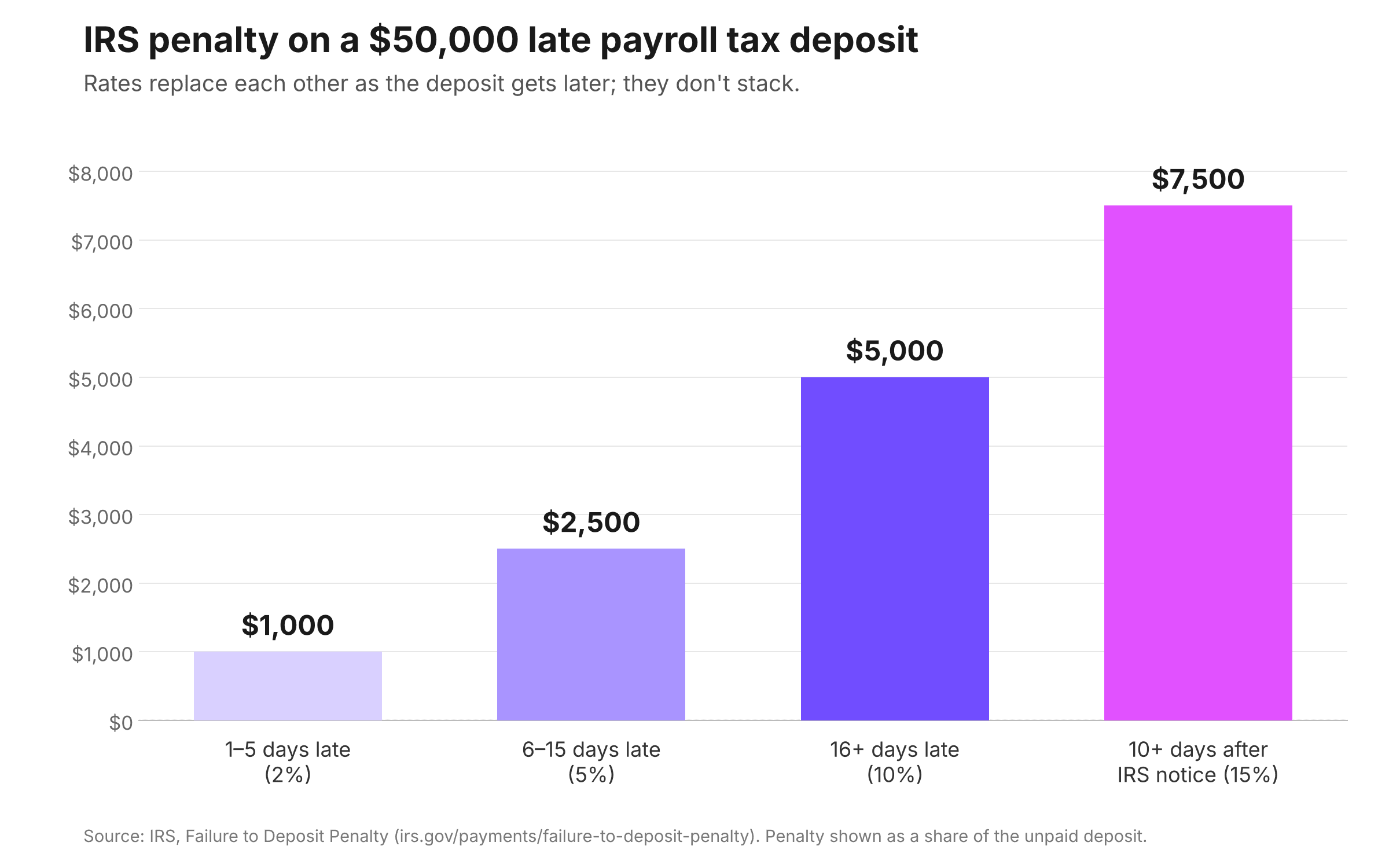
Taxes withheld from paychecks that never get to the IRS can also become the personal liability of the officers under the Trust Fund Recovery Penalty. With 500 employees, payroll accuracy is a finance control that should be on the CFO's risk list.
What happened when payroll went dark in Dec 2021?
In December 2021, UKG was forced to take its Kronos Private Cloud offline as a result of a ransomware attack. Many employers were left without timekeeping and payroll for weeks prior to the holidays.
Some employers calculated hours. Others simply reissued the last clean payroll. A January 2022 lawsuit alleged that the MTA in New York paid straight time and failed to pay overtime. Hourly workers brought suit against their employers under the FLSA. UMass Memorial Health settled for $1.2m, and Honda agreed to pay $2.3m.
For the buyer, the provider outage becomes a wage and hour issue for the employer. Ask every vendor how you'd pay people if their system was down tomorrow and get that answer in writing.
Who gets the interest on your payroll?
Most providers will ask you to fund your payroll a day or so in advance of payday. Until the staff and the tax authorities have been paid, that cash sits in the account and earns interest. That balance is known as your payroll float.
The numbers go up very quickly. Take a company running a $3m bi-weekly payroll that funds two days early. That's $3m sitting for 52 days a year. With most corporate payroll providers, the interest on that balance goes to the provider, and the terms are in the funds handling section of the contract. The large processors will report the interest on the client's funds as revenue in their public filings.
Two questions must be in any evaluation. Who is on the funded balance? Does any of it come back to us?
How to choose corporate payroll software
Most corporate payroll solutions look the same in a demo. You separate them by the infrastructure underneath.
Criterion | Question to ask | Red flag |
Tax engine | Who maintains rates and filings in each state? | "Our partner handles that." |
Pre-run checks | What does the system catch before payroll is submitted? | Errors surface through employee tickets |
Growth path | How do we pay a hire in another country? | A referral to a separate vendor |
Ledger sync | Does payroll post to our GL by entity and department? | Monthly CSV exports |
Continuity | How would we pay people during an outage? | No written plan |
Why build on AI-native payroll from your first hire
Niural is AI-native payroll, built on its own tax engine and payment rails. The more complex payroll becomes as you accrue tax registrations, pay history, and integrations, the harder it is to replace. So the cheapest time to get the right infrastructure is before you actually need it.
- Checks before money moves. EMMA, Niural's AI layer, validates payroll before the run, flags missing rate changes, and flags potential misclassification risk.
- Your float earns for you. Payroll funding balances held in the Niural Wallet will earn cash rewards* until payday.
- One platform from first hire to global scale. U.S. payroll, PEO, EOR, contractor payments, and compliant stablecoin payouts for crypto-native teams all run on the same platform.
If you're looking at corporate payroll services this quarter, start with the infrastructure questions above. See how Niural Payroll works.
Other related articles:
Payroll reconciliation guide
Payroll taxes explained
Payroll deductions guide
What is a Global PEO
Frequently Asked Questions
What's in corporate payroll services?
Wage calculations, tax deposits and filings, deductions, year-end forms, ledger reporting, and payments to every state and entity.
How is corporate payroll different from small business payroll?
More states, more worker types, more approvals, and more reporting. The penalties increase in line with the size of the payroll.
What is payroll float?
You can send cash to a provider prior to payday; it's held until the employees and the tax authorities have been paid.
What's the IRS penalty for late deposit of payroll taxes?
2% to 15% of the unpaid deposit, depending on how late it is.
Who is liable in the event of an error by a payroll provider?
In the majority of cases, it's the employer. The IRS will hold the employer liable for employment taxes even if a third party is doing the payroll processing, with the only exception being in certain certified PEO arrangements.
When would a company switch payroll providers?
When it comes to adding states/countries, the errors repeat themselves. Payroll can't be reconciled at all without the use of spreadsheets. Many people make the switch at the start of a quarter or year.
What does AI-native payroll mean?
Payroll built with AI right in the core workflow, checking the data prior to the payroll running.
Can a single provider manage both US and international payroll?
Some can. Others will route their international hires through a partner network (adding the vendor and reconciliation on top of that).
What should I ask a payroll vendor during a demo?
Who owns the tax engine, what's validated before a run, who earns on the float, and what the outage plan is.
Disclaimer: This article is for informational purposes only and does not constitute legal, tax, or financial advice. Consult qualified advisors about your company's obligations.
* Niural is a financial technology company and is not a bank. Banking services are provided by i3 Bank, Member FDIC.