Key takeaways
- Contract labels don't determine worker status. Courts and regulators in the UK, the Netherlands and Spain have all reclassified tens of thousands of gig workers.
- Payroll rules have changed in the UK, India, the EU and Australia between April 2025 and July 2026.
- In PayrollOrg's 2025 survey, 57% of global payroll professionals cited local compliance as their number one challenge.
- The fix is infrastructure: one system of record, validation prior to every run, and a checklist in place when the obligations change.
More than half of global payroll professionals say staying compliant in each country is their hardest problem, according to PayrollOrg's 2025 survey of 585 practitioners. Only 28% of their organizations have a formal global payroll strategy. For a U.S. company paying people abroad through separate providers, that gap shows up as missed filings, reclassified contractors, and back contributions.
Global payroll compliance is about withholding the correct taxes, paying the correct social contributions and statutory benefits, filing on the correct schedules in each country, and protecting the employee data in each country where you pay someone on a regular basis. The rules are local, and they change all the time. The company that is paying the people remains ultimately responsible for them regardless of whether a third party is running the payroll.
What are you liable for when you're paying people overseas?
International payroll compliance breaks down into six obligations. Each country has its own version of each of those.
Obligation | What it covers |
Income tax withholding | Calculating and remitting employee income tax |
Social contributions | Employer and employee payments into pension, health, and unemployment systems |
Statutory pay and benefits | Mandatory pay elements beyond base salary |
Payment and filing deadlines | When money and reports are due |
Worker classification | Whether someone is an employee, a worker, or a contractor under local law |
Data protection | How payroll data is stored and moved across borders |
Where do companies get burned?
Worker classification
Company | Country | What happened | What it means for you |
Uber | UK | In February 2021, the UK Supreme Court held drivers are workers owed the national living wage and paid holiday from the moment they log in. Uber then extended minimum wage, holiday pay, and pensions to more than 70,000 UK drivers. | Control over pricing and work outweighed the contract wording. |
Deliveroo | Netherlands | In March 2023, the Dutch Supreme Court upheld that riders were employees despite contracts that said otherwise, opening retroactive benefit claims. Later rulings required Deliveroo to pay into the industry pension fund. | Deliveroo left the Netherlands in November 2022. The cases continued anyway. |
Every country runs its own test, and the tests are all about how the work gets done: who sets the rate, who controls the program, who provides the tools. Your contractors in Spain or the Netherlands are going to be judged by those same tests.
Rules that change under you
In 18 months, these changes hit companies with employees abroad:
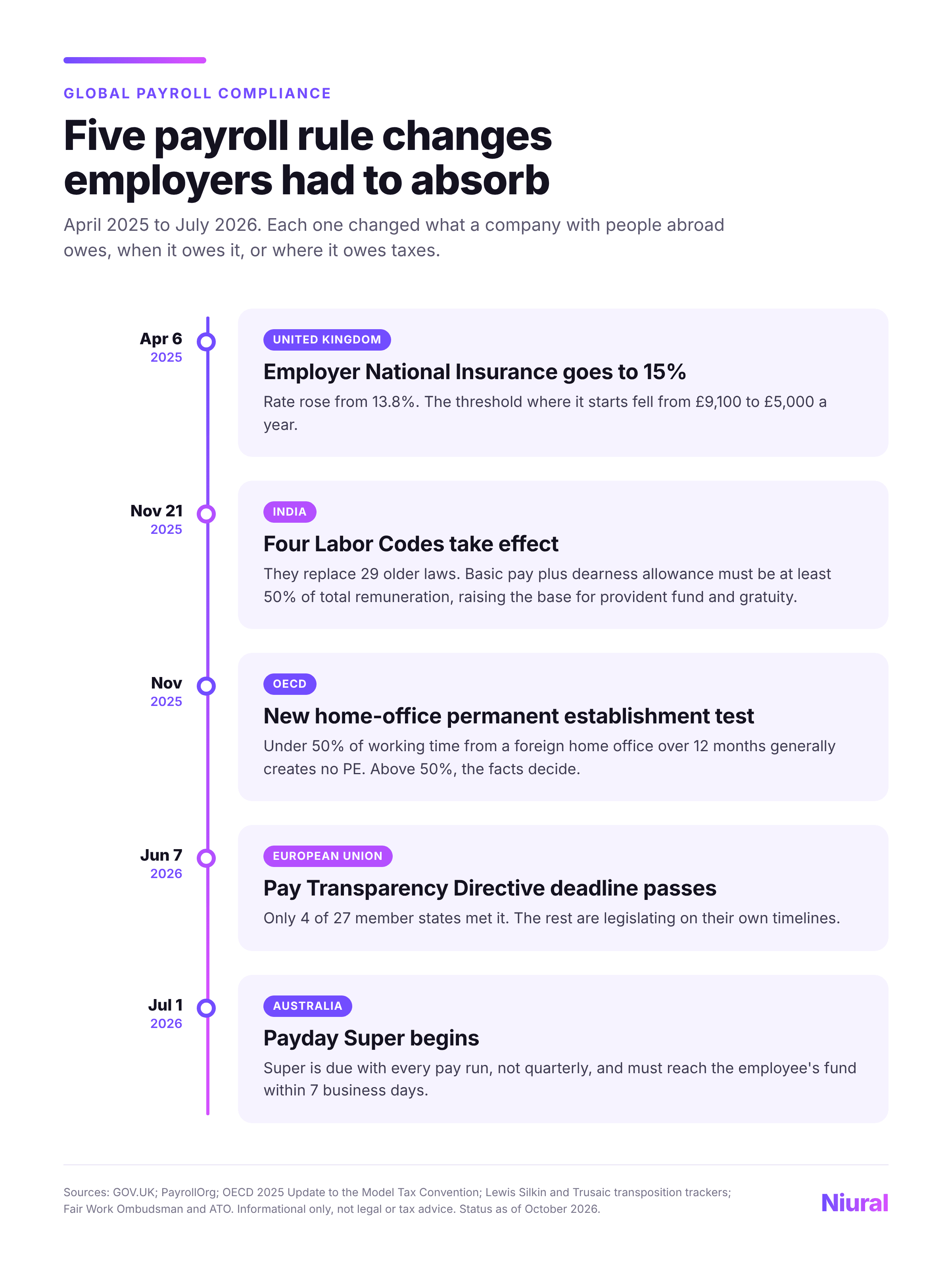
With a different provider in each country, the change goes onto a different vendor's update schedule, and someone on your team has to confirm each one.
A remote employee can create a tax footprint
Under the OECD November 2025 update, an employee working from a home office abroad for less than 50% of their working time over a rolling 12-month period will generally not create a permanent establishment for the employer. Crossing the 50% threshold doesn't in itself create a permanent establishment but does trigger a more detailed examination of the facts, including whether or not there is a commercial purpose for the employer to have the employee there.
Why does the patchwork stack fail first?
As per PayrollOrg's 2025 data, the top three reasons for reduced payroll accuracy were poor quality data inputs, late/inaccurate time data, and inputs after the payroll cut-off. So the Achilles heel of global payroll compliance is the data that's being fed into payroll prior to the run.
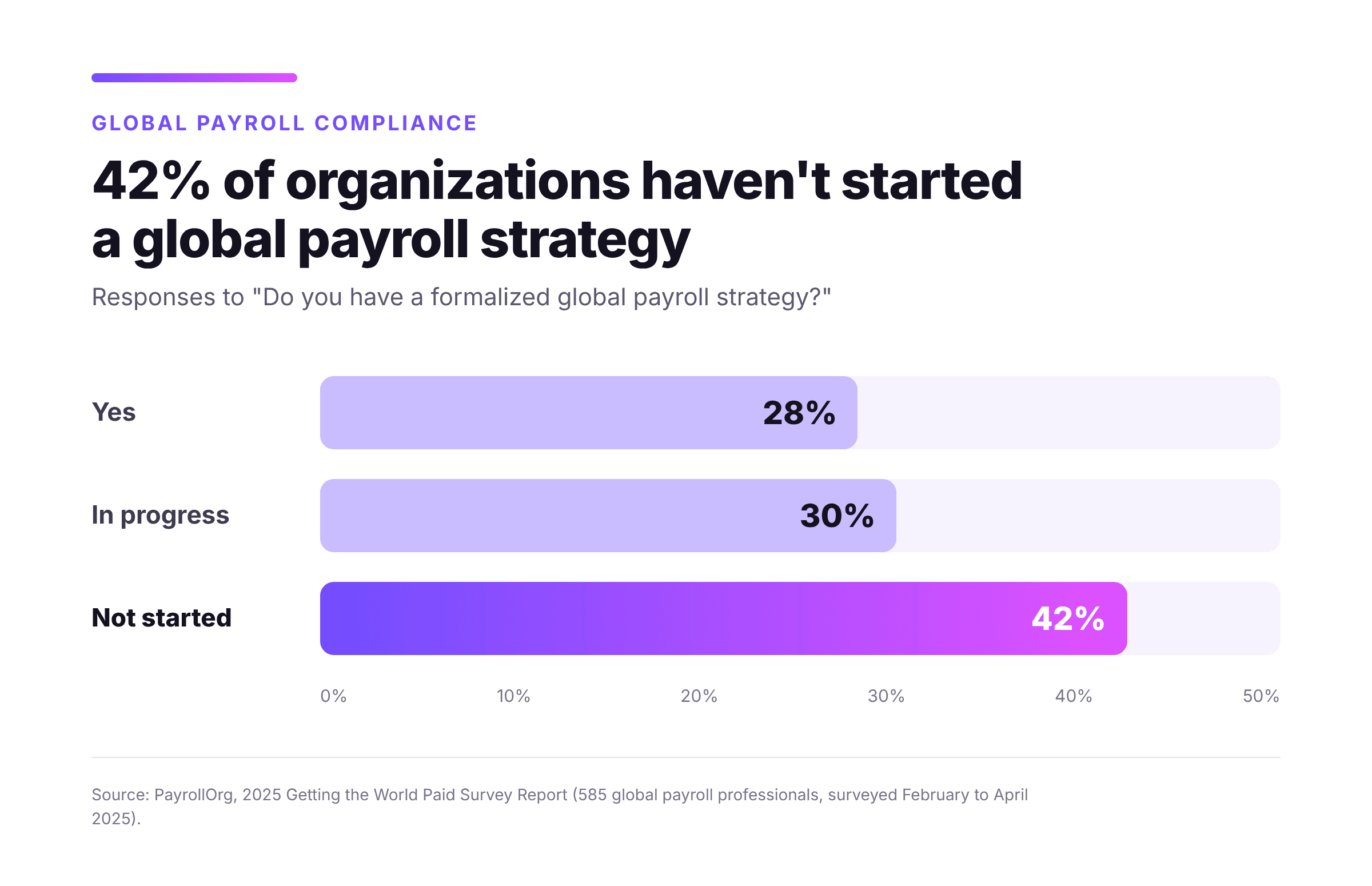
The same survey found that 38% of organizations don't track payroll performance at all and only 19-20% achieve the 80% process standardization, which the report refers to as the industry benchmark. The authors point out that compliance responsibility remains with the company even when the vendor is running the technology.
Each additional provider is another place where the data gets re-keyed and another place where a rate change could potentially miss the payroll that needed it.
Your compliance checklist, sorted by when it happens
Treat this as the minimum payroll compliance baseline for every country in which you pay people.
Before the first hire in a new country
- Pick the route (your own entity, an employer of record, or a contractor) and test the role against that country's classification rules.
- If you're hiring through your own entity, you'll need to register with the local tax and social security authorities.
- Check for a U.S. totalisation agreement prior to relocating an American employee.
- Build in the statutory rates of pay, benefits, and notice period in the offer.
- Confirm the legal basis for transferring employee data to other jurisdictions.
Every pay cycle
- Validate the inputs prior to the run: rate changes, new hires, terminations, and time data.
- Withhold and remit tax and contributions on each country's schedule.
- Payroll in the local currency on time and then reconcile the payments to the payroll register.
Quarterly and annually
- Re-review every contractor against the local tests.
- Check where remote employees actually worked against the OECD 50% benchmark.
- Confirm that each country's statutory changes have been implemented into payroll.
- Full year-end filings and employee tax docs.
When anything changes
- Re-run the classification and tax setup after a new country, a role change, a relocation, or a contractor moving to full time.
Why AI-native payroll belongs in the stack from hire one
Niural is AI-native payroll, designed so the system you have in place on day one continues to work as you add states, countries, and worker types. It's one platform from first hire through to global scale. U.S. payroll is on Niural's own tax and payment rails, and we have global payroll and EOR coverage in over 150 countries.
Niural's AI agent (EMMA) validates the payroll prior to the run, flags any missing rate changes and potential misclassification risk so the input problems that PayrollOrg would rank as being first are caught before any money actually moves. All employees and contractors in every country are on one system of record, so a rate or role change is updated once.
If you're paying people in more than one country, then take a look at how Niural global payroll compliance works.
Other related articles:
Group Health Plans vs. Individual Plans
PEO vs. Employee Leasing
How a PEO Can Improve Your Turnover Rate
Payroll Reconciliation
What is a Tax ID
Payroll Tax vs. Income Tax
Frequently Asked Questions
Who is responsible for compliance if a provider is running our payroll overseas?
Your company is. The provider will handle the payroll, but the employer remains liable for the tax, the contributions, and the filings.
Do we need a local entity to pay an employee in another country?
No, an employer of record can legally employ that person and run the local payroll for you.
Can I pay foreign workers as contractors?
Only if the relationship passes that country's classification test. The courts look beyond the contract to how the work actually operates.
Does a remote employee based overseas create a permanent establishment?
Possibly. The OECD guidance is that under 50% of working time from a foreign home office generally won't count. It's the facts and the commercial reason that will determine whether it's over 50%.
Do Americans working overseas still pay U.S. Social Security?
Often when a U.S. employer employs them. A totalisation agreement can assign the coverage to one country. The U.S. has 30 totalization agreements in force.
How often should we be reviewing contractor classification?
At least once a year and any time the work changes (new duties, fixed schedule, company equipment, exclusivity, etc.).
What causes the majority of international payroll errors?
In PayrollOrg's 2025 survey, poor-quality data inputs ranked first, followed by late time data and changes submitted after the cutoff.
Disclaimer: This article is based on information available as of October 2026 and is for informational purposes only. It is not legal, tax, or accounting advice. Payroll and employment rules vary by country and change often. Consult qualified advisors in each jurisdiction before acting.