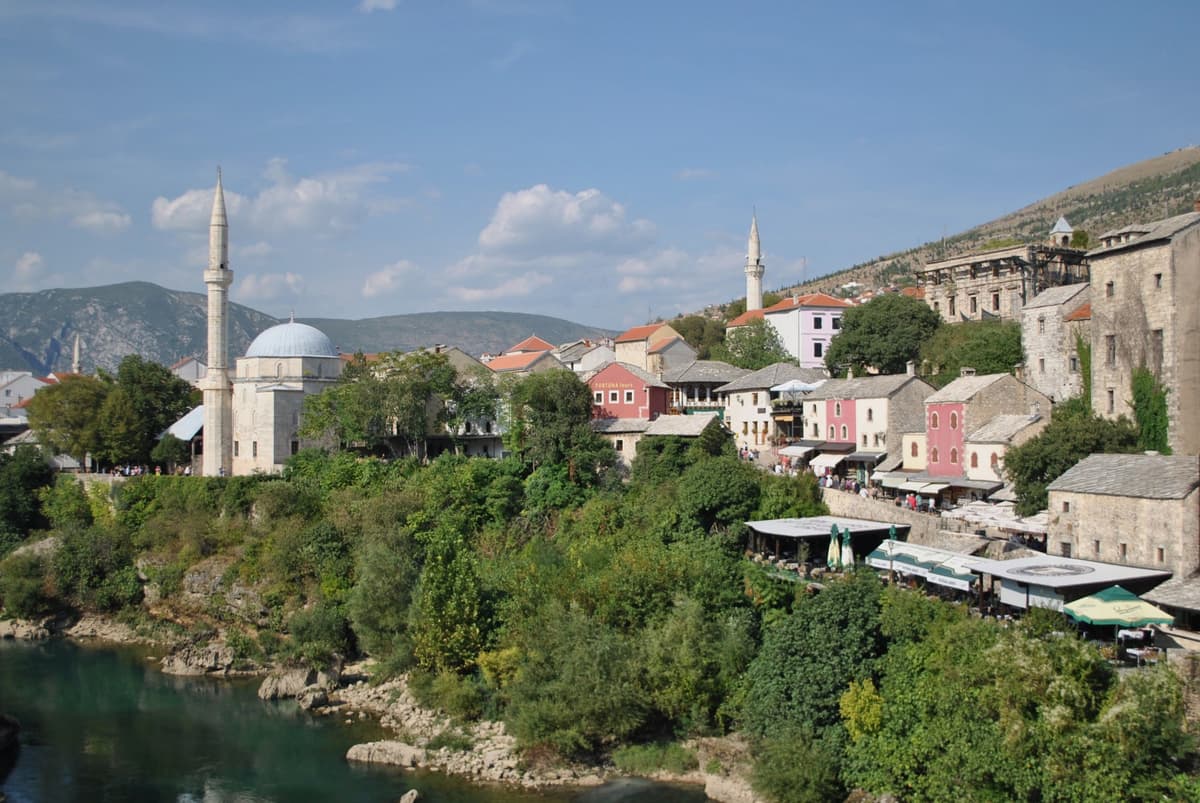
The work culture in Bosnia and Herzegovina is a strong blend of traditional hierarchy and interpersonal communication. This nation on the Balkan Peninsula offers a growing pool of tech and engineering graduates from universities in Sarajevo, Banja Luka, and Mostar, along with employer payroll costs that remain considerably lower than those in neighboring European Union member states.
However, hiring in Bosnia and Herzegovina requires careful navigation of a decentralized legal system, since the Federation of Bosnia and Herzegovina (FBiH), Republika Srpska (RS), and Brčko District each maintain their own labor regulations. This guide walks American employers through the minimum wage in Bosnia and Herzegovina, employment contracts, payroll, leave entitlements, termination rules, and the steps required to legally onboard a Bosnia and Herzegovina national.
Key Facts About Employment in Bosnia and Herzegovina
Information Category | Details |
Minimum Wage in Bosnia and Herzegovina | BAM 1,027 per month for FBiH BAM 1,000 - BAM 1,450 per month for RS. |
Standard Workweek | 40 hours standard. |
Payroll Frequency | Monthly processing. |
Fiscal Year | Calendar year (January-December). |
Main Employment Laws | Labor Law of the Federation of Bosnia and Herzegovina Labor Law of Republika Srpska Labor Law of the Brčko District. |
Employment Contracts in Bosnia and Herzegovina
Employment contracts in Bosnia and Herzegovina must be concluded in writing and signed before the employee begins work, and any clause less favorable than the statutory minimum is considered void. The main contract types used across both entities are listed below.
- Indefinite-term contracts: These open-ended agreements are the default form of employment. There is no expiration date for this type of contract.
- Fixed-term contracts: These are reserved for temporary needs and are typically capped at two years under the proposed reforms, with strict limits on consecutive renewals.
- Temporary agency contracts: These are concluded between a worker and a licensed temporary employment agency, which then assigns the worker to a host business under a worker assignment agreement; agencies must obtain prior approval from the Federal Ministry of Labor and Social Policy before placing workers.
- Special work contracts (ugovor o djelu): These are service contracts used to engage individuals for specific tasks or deliverables outside a traditional employment relationship, with the focus placed on the outcome rather than how, when, or where the work is performed.
Every written employment contract must include the following mandatory details: the names of both parties, the place of work, a clear job title and description, the contract start date and expected duration if fixed-term, the salary and any allowances, the probation period (which cannot exceed six months), notice period terms, working hours, and annual leave entitlements. Employers may also add confidentiality clauses or non-compete provisions, provided they comply with employment law in Bosnia and Herzegovina.
Payroll, Taxes, and Social Security in Bosnia and Herzegovina
Payroll in Bosnia and Herzegovina is administered separately in each entity, which means rates differ depending on whether your employee lives in the Federation, Republika Srpska, or the Brčko District. Personal income tax is a flat 10 percent across the country, but social security contribution structures vary significantly.
Federation of Bosnia and Herzegovina – Employer Contributions
Contribution Type | Rate |
Pension and disability insurance | 6.0% |
Health insurance | 4.0% |
Unemployment insurance | 0.5% |
Natural disaster protection (on net salary) | 0.5% |
Water protection charge (on net salary) | 0.5% |
Federation of Bosnia and Herzegovina – Employee Deductions
Deduction Type | Rate |
Pension and disability insurance | 17.0% |
Health insurance | 12.5% |
Unemployment insurance | 1.5% |
Personal income tax | 10% flat |
Brčko District – Employer Contributions
Contribution Type | Rate |
Pension contribution (only if employee opts for FBiH fund) | Applies under FBiH rules |
Pension contribution (if employee opts for RS fund) | None |
Brčko District – Employee Contributions
In the Brčko District, employees choose whether to contribute to the FBiH or RS pension fund, which then determines whether the employer makes a pension contribution. The remaining contributions are paid by the employee on the gross salary.
Contribution Type | Rate |
Pension and disability insurance (FBiH fund) | 17.0% |
Pension and disability insurance (RS fund) | 18.5% |
Health insurance | 12.0% |
Unemployment insurance | 1.5% |
Personal income tax | 10% flat |
Republika Srpska – Employee Contributions
Contribution Type | Rate |
Pension and disability insurance | 18.5% |
Health insurance | 12.0% |
Unemployment insurance | 0.6% |
Child protection contribution | 1.7% |
Personal income tax | 10% flat |
Note: No employer contributions apply.
Tax residents pay personal income tax on worldwide earnings, while non-residents are taxed only on income sourced within Bosnia and Herzegovina, with the 183-day rule determining residency. Bosnia and Herzegovina has double-taxation treaties with various countries; employers should confirm whether a treaty applies to the employee’s jurisdiction and country of residence.
Compensation & Benefits in Bosnia and Herzegovina
Total compensation packages combine the statutory minimum wage in Bosnia and Herzegovina with mandatory benefits and optional perks that employers use to attract talent. The table below outlines what American employers should expect to provide.
Benefit Category | Details |
Health insurance | Mandatory enrollment in compulsory health funds; private top-up insurance is a popular supplementary perk |
Pension and disability | Mandatory contributions to the state pension and disability insurance system |
Meal allowance | Commonly provided as a daily or monthly stipend and considered standard market practice |
Transportation allowance | Frequently offered to cover commuting costs to and from work |
Performance bonuses | Discretionary and used as a competitive differentiator |
13th-month salary | Not legally required, although some employers offer it as a retention tool |
Other supplemental benefits | Training budgets, additional paid leave, and flexible work arrangements are increasingly common |
Working Hours and Overtime in Bosnia and Herzegovina
Bosnia and Herzegovina enforces strict limits on weekly hours and provides clear premium pay rules for overtime, which American employers must respect when designing schedules for local hires.
Item | Standard Requirement |
Standard workweek | 40 hours over five days |
Standard workday | 8 hours |
Overtime cap (FBiH) | Maximum of 8 hours per week and 150 hours per year |
Overtime cap (RS) | Maximum of 4 hours per day and 180 hours per year |
Overtime premium | At least 30% above the regular hourly rate, with most collective agreements setting premiums between 125 and 130% of base pay |
Night work | Performed between 10 p.m. and 6 a.m. and compensated with an additional premium |
Leave and Statutory Time Off in Bosnia and Herzegovina
Leave entitlements in Bosnia and Herzegovina are generous compared to those in the United States, and they vary slightly between the Federation and Republika Srpska. The table below summarizes the core statutory leave types.
Leave Type | Entitlement |
Paid annual leave | At least 20 working days per year, with FBiH allowing up to 30 days based on collective agreements |
Sick leave (FBiH) | First 42 days paid by the employer at 80 percent of salary, then covered by the health insurance fund; 100 percent for work-related illness or injury |
Sick leave (RS) | First 30 days paid by the employer, then covered by the health insurance fund for up to 12 months |
Maternity leave | Up to 12 months, with a mandatory minimum of 42 days post-birth in FBiH and 60 days in RS |
Paternity leave | Approximately 7 paid days in FBiH, with no statutory paternity entitlement in RS (though collective agreements may apply) |
Parental and childcare leave | Unpaid leave available until the child reaches age three; mothers returning to work before the child turns one are entitled to paid breastfeeding breaks |
Below is the complete list of public holidays observed in Bosnia and Herzegovina, including national holidays and regional holidays specific to the Federation of Bosnia and Herzegovina (FBiH) or Republika Srpska (RS).
- New Year's Day
- New Year's Holiday
- Orthodox Christmas Eve – RS only
- Orthodox Christmas – RS only
- Orthodox New Year's Day – RS only
- Independence Day – FBiH only
- Ramadan Bajram / Eid al-Fitr – FBiH only
- Good Friday Catholic – FBiH only
- Easter Sunday Catholic – FBiH only
- Easter Monday Catholic – FBiH only
- Orthodox Good Friday – RS only
- Orthodox Easter Sunday – RS only
- Orthodox Easter Monday – RS only
- Labor Day
- Victory Day – RS only
- Hijri New Year / Islamic New Year – FBiH only
- St. Vitus' Day – RS only
- All Saints' Day – FBiH only
- General Framework Agreement Day – RS only
- Statehood Day – FBiH only
- Catholic Christmas Day – FBiH only
Hiring and Onboarding Process in Bosnia and Herzegovina
- Decide on a hiring model, which usually means choosing between setting up a local subsidiary, engaging the worker as an independent contractor, or partnering with an Employer of Record (EOR) that acts as the legal employer on your behalf.
- If using an EOR, the provider drafts a compliant written employment contract in the local language, with terms aligned to either FBiH or RS labor law, depending on where the employee resides.
- Collect onboarding documents from the new hire, including a copy of their national ID card (lična karta), proof of address, tax identification number, bank account details, and proof of educational qualifications.
- Register the employee with the relevant Tax Administration, pension fund, health insurance fund, and unemployment insurance fund in their entity of residence within the legally required timeframes.
- Set up payroll in BAM and ensure monthly tax and social security filings are submitted to the correct entity-level authorities.
- For onboarding, provide a clear written welcome packet, complete the mandatory health and safety induction, and confirm the probation period (up to six months) in writing.
- Note that work permits in Bosnia and Herzegovina are only relevant when hiring foreign nationals; hiring a Bosnia and Herzegovina citizen to work remotely for a US company through an EOR does not require any visa or permit.
Termination & Notice Periods in Bosnia and Herzegovina
Termination must follow strict procedural rules under employment law in Bosnia and Herzegovina, and American employers should never apply at-will employment principles when ending a local employee's contract. The core requirements are summarized below.
- Notice from employee to employer: The minimum is 7 days, and the maximum is 30 days in the Federation, with similar short timelines applying in Republika Srpska.
- Notice from employer to employee: The statutory minimum is 14 days in FBiH and 15 days in RS, with a maximum of three months in FBiH and 30 days in RS unless collective agreements provide otherwise.
- Valid reasons for dismissal: Acceptable grounds include economic or business reasons (such as redundancy), personal reasons related to the employee's performance or health, and serious misconduct, with the latter requiring documented warnings before dismissal.
- Probationary termination: During the probation period, either party may terminate the contract with at least seven days' notice.
- Severance pay: Employees with at least two years of continuous service under an indefinite contract are entitled to severance equal to no less than one-third of their average monthly salary for each full year of service, capped at six average monthly salaries in FBiH.
- Misconduct dismissal: An employer may terminate without notice or severance for serious breaches, but must typically issue prior warnings, and the employee has the right to challenge the dismissal in labor court.
Useful Resources
- Tax Administration of the Federation of Bosnia and Herzegovina
- Tax Administration of Republika Srpska
Check out Niural Global Payroll
Other articles
Hiring in Croatia
Hiring in Serbia
Disclaimer: This article is provided for informational purposes only and should not be relied on as legal advice or used as a substitute for advice from qualified legal counsel.