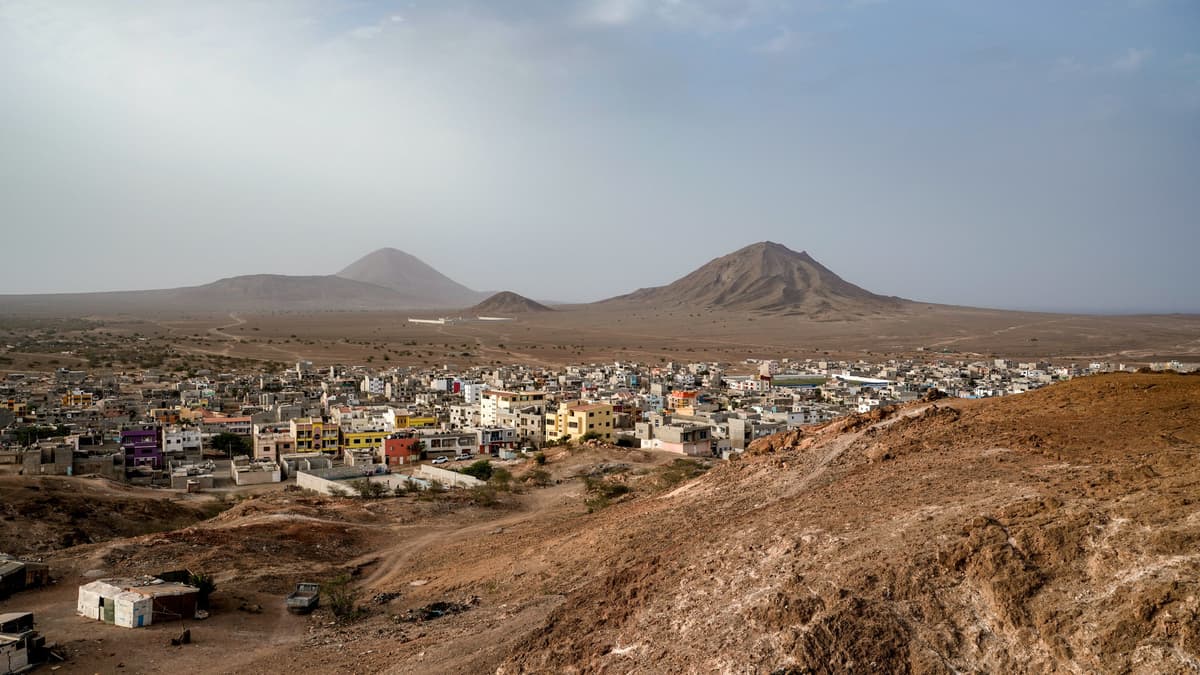
If you could sum up the work culture in Cape Verde in one word, it would be Morabeza. It means deep, hospitable, and warm. People in Cape Verde have a relaxed approach to life, creating a stress-free yet formal approach to work. Hiring in Cape Verde has become an increasingly attractive option for American companies that want a stable, English- and Portuguese-speaking foothold between Africa, Europe, and the Americas. The archipelago combines political stability, a young multilingual workforce, and a tax environment that has been modernized to court foreign investment. At the same time, employers must navigate a civil-law labor system inherited from Portugal, with detailed rules on contracts, social security, leave, and termination.
Key Facts About Employment in Cape Verde
Information Category | Details |
Minimum Wage in Cape Verde | CVE 17,000 per month in the private sector and CVE 19,000 per month in public administration. |
Standard Workweek | 44 hours standard. |
Payroll Frequency | Monthly processing. |
Fiscal Year | Calendar year (January-December). |
Main Employment Laws | Código Laboral 2007. |
Employment Contracts in Cape Verde
Employment contracts are not generally subject to a formal written-contract requirement unless the law requires a written form for the relevant clause or contract type. In practice, employers should use a written Portuguese-language contract for clarity and compliance. Written documentation is especially important for fixed-term clauses, probation terms that differ from the statutory default, and non-compete provisions.
The main contract categories are summarized below.
- A permanent contract (contrato por tempo indeterminado) is the default form of employment and has no preset end date, making it the strongest commitment for both parties.
- A fixed-term contract (contrato de trabalho a termo) may be used only for legally recognized temporary needs and may not exceed five years in total, including renewals. The contract must state both the term and the justification, or it may be treated as an indefinite-term contract.
- A temporary or uncertain-term contract (contrato a termo incerto) is used when the end date depends on a future event, such as covering for an employee on extended leave.
Every written contract should clearly state the job title and duties, the gross salary and any allowances, the place and hours of work, the start date and duration, the probation period, the notice requirements for either party, and any confidentiality or non-compete provisions. The standard probation period is generally two months for most roles and can extend up to six months for technical or supervisory positions and up to twelve months for senior executives. Fixed-term contracts may have probation periods only up to one-quarter of the total contract length.
Payroll, Taxes, and Social Security in Cape Verde
Payroll in Cape Verde is governed by two main contribution streams: personal income tax (IRPS) withheld at source and social security contributions paid to the INPS. Employers are responsible for calculating, withholding, and remitting both.
Employer Contributions
Contribution Type | Rate |
INPS social security contribution | 16% of the employee's gross salary |
Occupational accident insurance | Approximately 1% of gross salary, paid to a private insurer |
Total employer payroll burden | Around 16% on top of gross salary |
Employee Contributions
Contribution Type | Rate |
INPS social security contribution | 8.5% of gross salary, withheld by the employer |
Income Tax Brackets
Annual taxable income (CVE) | Tax rate |
0 – 960,000 CVE | 16.5% |
960,001 – 1,800,000 CVE | 23.1% |
Above 1,800,000 CVE | 27.5% |
There is also a tax exemption for annual net income up to 220,000 CVE.
Other Payroll Essentials
The payroll cycle is monthly, and salaries must be paid by bank transfer with a written payslip showing gross pay, deductions, and net pay. The standard corporate income tax (IRPC) for 2026 sits at 20% for companies under organized accounting. Cape Verde also offers a special tax regime for new residents that grants favorable treatment for seven consecutive years from the year of residence registration, which can be appealing for relocated executives or technical staff. Start-ups, profit reinvestment, and research and development activities are eligible for additional incentives under the 2026 state budget.
Compensation and Benefits in Cape Verde
Beyond the base salary, Cape Verdean employees expect a recognizable package of statutory and customary benefits. American employers competing for talent in Praia, Mindelo, or Sal usually exceed legal minimums on health and allowances to retain skilled professionals.
Benefit | Details |
13th-month salary | Customarily paid in December and widely expected, though not strictly mandated for every employer, many collective agreements require it. |
Health insurance | Public coverage is funded through INPS; supplemental private health insurance is a common attraction benefit |
Transportation allowance | Frequently offered, particularly for staff commuting across islands or longer urban routes |
Meal allowance | Often provided as a daily stipend or company-funded canteen access |
Performance bonuses | Discretionary and increasingly used in tourism, financial services, and tech roles |
Working Hours and Overtime in Cape Verde
Working hours, breaks, and overtime are tightly regulated by the labor code. Employers can adjust schedules to meet operational needs, but they cannot reduce overall protections without a collective agreement.
Item | Rule |
Standard workweek | 44 hours, usually spread across 5.5 days |
Daily maximum | 8 hours, extendable to 9 hours if the employee works a 5-day week |
Workers aged 16 to 18 | Capped at 38 hours per week and 7 hours per day |
Overtime daily limit | 2 hours per day |
Annual overtime cap | 160 hours, extendable to 300 hours with written employee consent |
Overtime pay premium | At least 50% above the regular hourly rate |
Leave and Statutory Time Off in Cape Verde
Cape Verde guarantees a generous package of paid leave, and U.S. employers are responsible for tracking accruals and ensuring eligible employees actually take their time off.
Leave Type | Entitlement |
Paid annual leave | 22 working days per year after one year of service |
Sick leave | The labor code provides sickness-pay rules tied to social security coverage. For covered workers, the employer pays the difference between the worker’s net remuneration and the social security sickness benefit for the first 90 days of each incapacity, and pays net remuneration for the first three days of each incapacity, up to 15 days per calendar year. Different rules apply where the worker is not covered by social security. |
Maternity leave | 90 days of paid leave, funded through the social security system |
Paternity leave | The labor code provides leave for the father in specific cases, including the mother’s incapacity or death, for the period the mother would have been entitled to or the remaining portion of that period. |
Marriage leave | 3 consecutive days |
The full list of nationally observed public holidays is as follows.
- New Year's Day
- Democracy Day
- National Heroes' Day
- Good Friday
- Labor Day
- Youth Day
- Independence Day
- Assumption Day
- All Saints' Day
- Christmas Day
Several islands observe additional municipal holidays in honor of their patron saints, such as São Vicente Day on January 22 and Brava Municipality Day on June 24, so employers should confirm local calendars with their staff.
Hiring and Onboarding Process in Cape Verde
For an American employer recruiting a Cape Verdean national, the cleanest path is to either incorporate a local entity or engage an Employer of Record (EOR) that holds the necessary registrations.
- Decide on an engagement model, choosing between setting up a local entity in Cape Verde or partnering with an EOR that legally employs the worker on your behalf.
- Register the business with the Commercial Registry, the tax authority for an NIF (taxpayer identification number), and the INPS for social security purposes if you incorporate locally.
- Collect the candidate's identification documents, taxpayer number, social security number, and proof of academic or professional qualifications.
- Draft a written employment contract in Portuguese that includes job title, salary, working hours, probation period, notice terms, and place of work.
- Register the employee with INPS or report the employment change within 15 days after the employee starts work.
- Set up monthly payroll, ensuring IRPS withholding, INPS contributions, and bank-transfer payment of net wages, along with a compliant payslip.
- For foreign hires, secure the appropriate long-stay visa and work permit through the Directorate of Immigration and Borders. ECOWAS nationals are exempt from work permit requirements.
- Onboard the employee with a structured orientation that covers internal policies, safety procedures, and cultural expectations, since Cape Verdean workplaces value relationship-building.
Termination and Notice Periods in Cape Verde
Cape Verdean dismissal law leans protective of employees, and U.S. employers should never assume "at-will" termination is available. Every separation requires a documented reason, observance of statutory notice periods, and, in many cases, severance pay.
- Notice period depends on the separation route. For collective dismissal, the employer must notify the Labor Directorate and unions at least 60 days before the planned termination date and later notify affected employees at least 45 days before dismissal. For individual dismissal based on objective just cause, the employer must give the employee written notice at least 30 days before the planned termination date. For employee resignation, absent a contractual notice rule, the employee must give at least 15 days per year of service, capped at two months.
- Valid grounds for dismissal include just cause for serious employee misconduct, objective reasons such as economic difficulty or position elimination, persistent inability of the employee to perform duties, and the expiration of a fixed-term contract.
- Severance pay for fixed-term contracts equals 21 days of base salary if the contract has reached exactly one year, with 15 days of base salary per subsequent year and 1.75 days of base salary per month for contracts between six months and one year in duration.
- Dismissal for just cause does not typically trigger severance, while objective-cause dismissals or expiration of fixed-term contracts do.
- Pregnant employees enjoy heightened protection, and their dismissal is restricted by law, so American employers should treat any such termination as a high-risk decision requiring local counsel.
Useful Resources
Check out Niural Global Payroll
Other articles
Hiring in Brazil
Hiring in Argentina
Disclaimer: This article is provided for informational purposes only and should not be relied on as legal advice or used as a substitute for advice from qualified legal counsel.