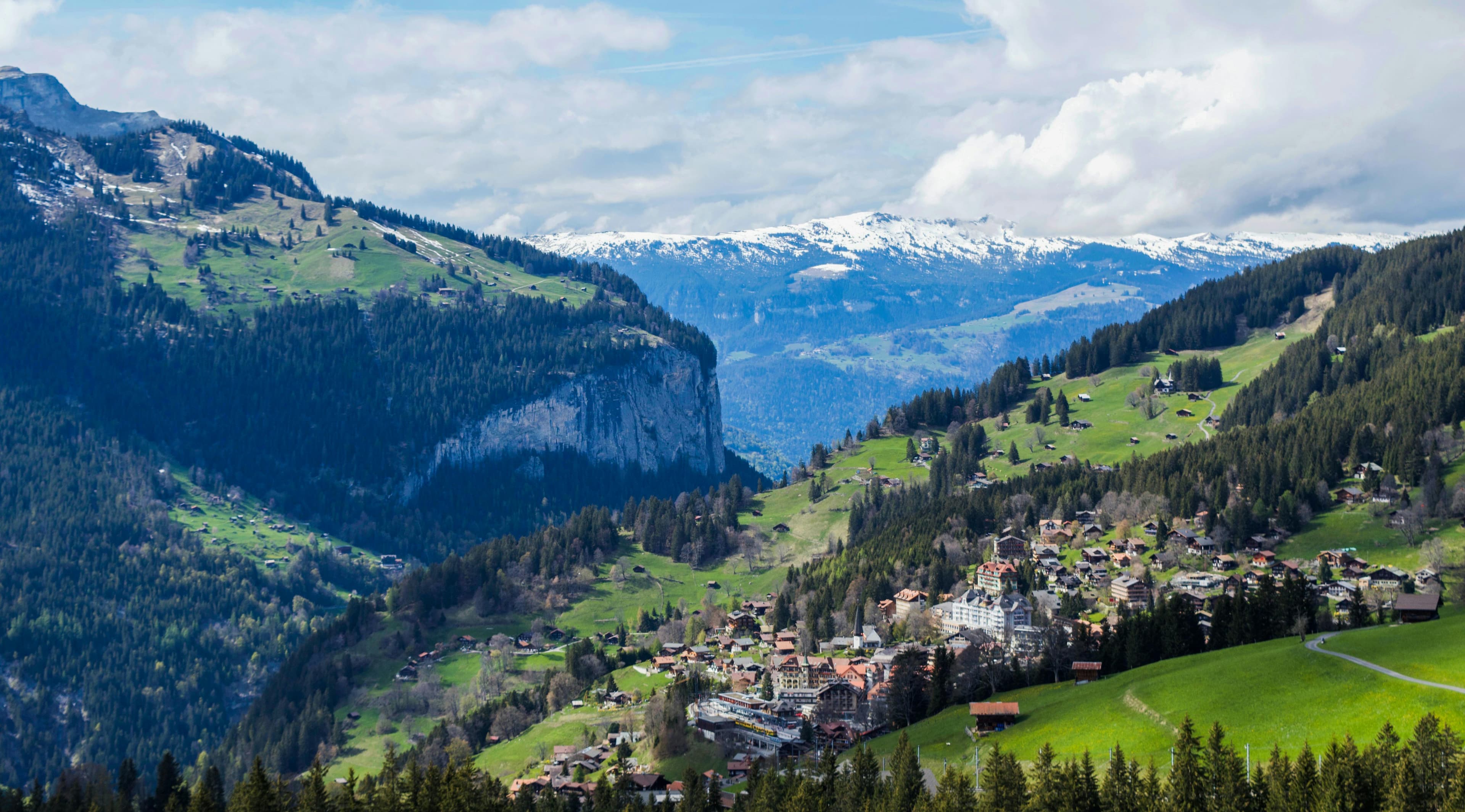
Switzerland stands out as one of the world's most attractive destinations for both employers and employees, offering a highly skilled multilingual workforce, a stable political environment, low unemployment, and one of the highest standards of living globally. Hiring in Switzerland can open doors to talent across the finance, pharmaceutical, engineering, and technology sectors. However, navigating employment law in Switzerland requires careful attention: the country operates under a decentralized legal framework where cantonal (regional) rules complement federal law, meaning payroll, minimum wage requirements, and work permit regulations can vary significantly depending on the location of your business.
Key Facts About Employment in Switzerland
Information Category | Details |
Minimum Wage in Switzerland | No national minimum wage. Cantonal minimums apply (e.g., Geneva: CHF 24.32/hr; Basel-Stadt: CHF 21.70/hr; Neuchâtel: CHF 21.09/hr; Jura: CHF 20.60/hr). |
Standard Workweek | 45 hours for office/industrial workers; 50 hours for retail, hospitality, and similar sectors. |
Payroll Frequency | Monthly processing. |
Fiscal Year | Calendar year (January-December). |
Main Employment Laws | Swiss Code of Obligations (CO) Federal Labor Act (ArG / LTr) Federal Act on Old-Age and Survivors' Insurance (AHV) Federal Act on Occupational Retirement (BVG) Federal Act on Gender Equality (GEA). |
Employment Contracts in Switzerland
Employment contracts in Switzerland are primarily governed by the Swiss Code of Obligations. While oral contracts are legally valid for most roles, written agreements are strongly advised for evidentiary purposes. The following contract types are most common:
- Permanent (open-ended) contracts: This is the default form of employment in Switzerland, terminable by either party with the applicable statutory notice period. These contracts offer the greatest job security and are subject to the full range of Swiss labor protections.
- Fixed-term contracts: This contract type is used for defined project periods or seasonal work. They expire automatically on the agreed-upon end date without requiring formal notice. Repeated renewal of fixed-term contracts may lead a court to reclassify the arrangement as a permanent contract.
- Temporary/agency contracts: Workers placed by staffing agencies are governed by the Federal Act on Employment Agencies (AVG/LSE). They are entitled to the same protections as permanent staff in the host company.
Mandatory details that must be addressed in any employment contract include:
- Full legal names and addresses of both employer and employee.
- Job title and a clear description of duties.
- Start date and end date for fixed-term agreements.
- Probation period.
- Agreed salary (gross) and payroll cycle.
- Standard working hours and overtime arrangements.
- Annual leave entitlement.
- Notice periods for termination post-probation.
- Reference to any applicable Collective Labor Agreement (CLA).
Payroll, Taxes, and Social Security in Switzerland
Payroll in Switzerland is processed monthly and involves contributions at the federal, cantonal, and municipal levels. The Swiss social security system follows a three-pillar model: state-funded basic insurance (Pillar 1), mandatory occupational pension (Pillar 2), and voluntary private savings (Pillar 3). Employer and employee social security contributions are split equally for most schemes.
Employer Contributions
Contribution Type | Rate |
AHV/IV/EO (Old Age, Disability, Income Compensation) | 5.30% |
ALV (Unemployment Insurance, up to CHF 148,200) | 1.10% |
BVG (Occupational Pension – Pillar 2, minimum) | Rate varies by age/fund (At least 50% of total contribution) |
UVG – BU (Occupational Accident Insurance) | ~0.1–2% (fully employer-paid) |
FAK (Family Allowances) | ~2% (varies by canton, employer-paid) |
Total Approximate Employer Burden | ~12.5–14% of gross salary (plus BVG) |
Employee Contributions
Contribution Type | Rate |
AHV/IV/EO (Old Age, Disability, Income Compensation) | 5.30% |
ALV (Unemployment Insurance, up to CHF 148,200) | 1.10% |
BVG (Occupational Pension – Pillar 2) | Share determined by pension fund (typically 3–9%) |
UVG – NBU (Non-Occupational Accident Insurance) | ~1–3% (fully employee-paid) |
Total Approximate Employee Deductions | ~14.4–28.4% of gross salary (varies by canton) |
Income Tax Basics: Switzerland taxes employment income through federal, cantonal, and municipal tax systems. Certain foreign employees, including many holders of B, L, or G permits, may be subject to withholding tax at source, with deductions made through payroll and remitted under cantonal procedures. Employers should confirm the applicable cantonal tax-source rules before payroll setup. Swiss accounting records must generally be retained for ten years under the Swiss Code of Obligations.
Compensation & Benefits in Switzerland
Although there is no federal minimum wage law in Switzerland, compensation is shaped by cantonal law, Collective Labor Agreements, and market benchmarks.
Benefit Type | Details |
13th Month Salary | This is very common in Switzerland and is often contractually mandatory, especially under CLAs. It is paid at the end of the year or split semi-annually. |
Health Insurance | This is mandatory, but privately arranged. Employers do not contribute directly, as employees must enroll in individual health plans. Basic health insurance (KVG) is compulsory for all residents. |
Accident Insurance (UVG) | This is again mandatory. Employer covers occupational accidents, while employee covers non-occupational accidents through payroll deductions. |
Family Allowances | This is a mandatory benefit under the Swiss family allowance framework, with cantonal implementation. Employers generally coordinate payment through payroll and contribute through a family allowance compensation fund; contribution rates vary by canton and fund. |
Bonuses | This is not a statutory benefit but is widely offered, particularly in finance and tech. It is often tied to individual or company performance targets. |
Pension (Pillar 2 – BVG) | This is a mandatory benefit for employees earning above CHF 22,680/year. Employer must cover at least 50% of the contribution. |
Working Hours and Overtime in Switzerland
Category | Details |
Maximum weekly hours: Office/Industrial workers | 45 hours per week |
Maximum weekly hours: Retail/Hospitality/other | 50 hours per week |
Typical contracted hours | ~42 hours per week (common in practice) |
Daily rest period | Minimum 11 consecutive hours between shifts |
Overtime rules | Statutory overtime is work above the legal maximum weekly working time and should be exceptional. It must be compensated with a 25% wage supplement unless the employee agrees to equivalent time off. Statutory overtime may not exceed 2 hours per day, except in limited cases, and may not exceed 170 hours per year where the 45-hour maximum applies or 140 hours per year where the 50-hour maximum applies. |
Employees outside standard working-time protections | Certain categories, such as higher managerial employees, may fall outside parts of the Labor Act. Do not use salary alone as the basis for exemption; classification should be assessed under Swiss labor law and any applicable collective labor agreement. |
Leave and Statutory Time Off in Switzerland
Leave Type | Entitlement | Key Conditions |
Paid Annual Leave | Minimum 20 days (4 weeks) per year | Employees under age 20 receive 25 days. Leave is prorated for part-year employment. Cannot be replaced by cash during active employment. |
Sick Leave | Minimum 3 weeks in Year 1; increases with seniority | In the first year of service, salary continuation is commonly described as at least three weeks if statutory conditions are met. Many employers use daily sickness benefit insurance, often structured to cover at least 80% of salary for 720 or 730 days within a 900-day period. |
Maternity Leave | 14 weeks (16 weeks in Geneva) | Paid at 80% of average salary (up to CHF 220/day) through federal maternity insurance (EO). To qualify, the employee must have been insured under OASI/AHV for at least 9 months before childbirth and have worked for at least 5 months during that period. Mothers are prohibited from working during the first 8 weeks after birth. |
Partner/Paternity Leave | 10 working days (2 weeks) | Must be taken within 6 months of the child's birth, in one block or as individual days. Paid at 80% of salary (up to CHF 220/day) through the EO scheme. |
Adoption Leave | 2 weeks per adoptive parent | Applies when adopting a child under age four. The adoptive parents may share the leave. The allowance covers up to 80% of average income, capped at CHF 220/day, and leave may be taken in one block or as individual days within 12 months after the official adoption. |
Child Illness Leave | Up to 3 days per year | Granted on presentation of a medical certificate. Separate extended leave may apply for care of a child with a serious health impairment, subject to income-compensation rules. |
Caregiver Leave | Up to 10 days per year | For care of seriously ill family members requiring the employee's assistance. |
Military / Civil Service | Duration of service | Employees are protected from dismissal during military service and for four weeks before and after service exceeding 11 days. |
Hiring and Onboarding Process in Switzerland
The process of legally hiring in Switzerland involves registrations at both the federal and cantonal levels. The following steps outline what employers and employees must complete:
- Register the company: Ensure your legal entity is registered in the Swiss Commercial Register (Handelsregister) and with the relevant cantonal AHV compensation fund for social security.
- Enroll in a BVG pension fund: Before onboarding any eligible employee, the employer must select and enroll with a licensed occupational pension fund (Pillar 2).
- Arrange accident insurance (UVG): Register with SUVA (the national insurer) or an approved private insurer for both occupational (BU) and non-occupational (NBU) accident coverage.
- Prepare an employment contract: Draft a written contract that complies with the Swiss Code of Obligations requirements, including salary, hours, probation period, leave, and notice terms.
- Collect employee documents: Government-issued ID or passport, residence/work permit (for non-Swiss nationals), bank account details for payroll, and relevant diplomas or certifications.
- Work permits for foreign hires: EU/EFTA nationals may work in Switzerland for up to three months per calendar year without a residence permit, subject to the required notification procedure. For longer employment, they must obtain the appropriate Swiss residence or cross-border commuter permit. Non-EU/EFTA nationals generally require employer sponsorship and are admitted only if they are highly qualified, and the employer can show that no suitable Swiss or EU/EFTA candidate is available. Processing times vary by canton and case type, so employers should confirm timing with the competent cantonal authority.
- Register new hires for withholding tax (Quellensteuer): If the employee holds a B, L, or G permit, register them with the cantonal tax authority and deduct income tax at source from the monthly salary.
- Onboarding tips: Localize employment documents in the language of the relevant canton (German, French, or Italian). Provide a comprehensive overview of the Swiss three-pillar pension system and health insurance enrollment obligations.
Termination & Notice Periods in Switzerland
Swiss employment law permits both parties to terminate an open-ended contract at any time without stating a formal reason, provided the applicable notice period is observed. The following rules govern employment termination in Switzerland:
- Notice periods (statutory minimums, effective end of month):
- During probation: 7 days
- Year 1 of employment: 1 month
- Years 2–9: 2 months.
- Year 10 and beyond: 3 months.
Longer periods are commonly agreed by contract, particularly for senior management (up to 6 months).
- Protected periods: Employers must observe statutory blocking periods, including during pregnancy, for a period after childbirth, during certain periods of incapacity due to illness or accident, and during qualifying military/civil service periods. The length of protection depends on the reason for absence and the employee’s tenure.
- Abusive dismissal: Termination based on personal characteristics, the exercise of constitutional rights, or to circumvent legal claims is considered abusive. The employee may claim compensation of up to six months' salary.
- Severance pay: Switzerland does not have a general statutory severance payment. An exception applies to employees over age 50 who have completed at least 20 years of service; these employees are entitled to a separation allowance equivalent to two to eight months' salary, depending on length of service.
- Immediate dismissal: Permitted only for just cause (e.g., serious fraud, theft, or material breach). Unjustified immediate dismissal entitles the employee to compensation up to the end of the applicable notice period, plus a potential indemnity of up to six months' salary.
- Collective redundancies: Special consultation and notification procedures apply when multiple employees are dismissed within 30 days for operational reasons. The cantonal employment office must be notified.
Useful Resources
Check out Niural Global Payroll
Other articles
Hiring in France
Hiring in Germany
Disclaimer: This article is provided for informational purposes only and should not be relied on as legal advice or used as a substitute for advice from qualified legal counsel.