Nora runs a blended people and finance function at a fast-growing U.S. company. This quarter she has a designer in SF who invoices monthly, a full-time engineer she wants in Vienna, and a data contractor in Toronto who's starting to look an awful lot like an employee. Three workers, three different questions, and the same underlying anxiety: which arrangement is actually legal, and who's on the hook if she gets it wrong?
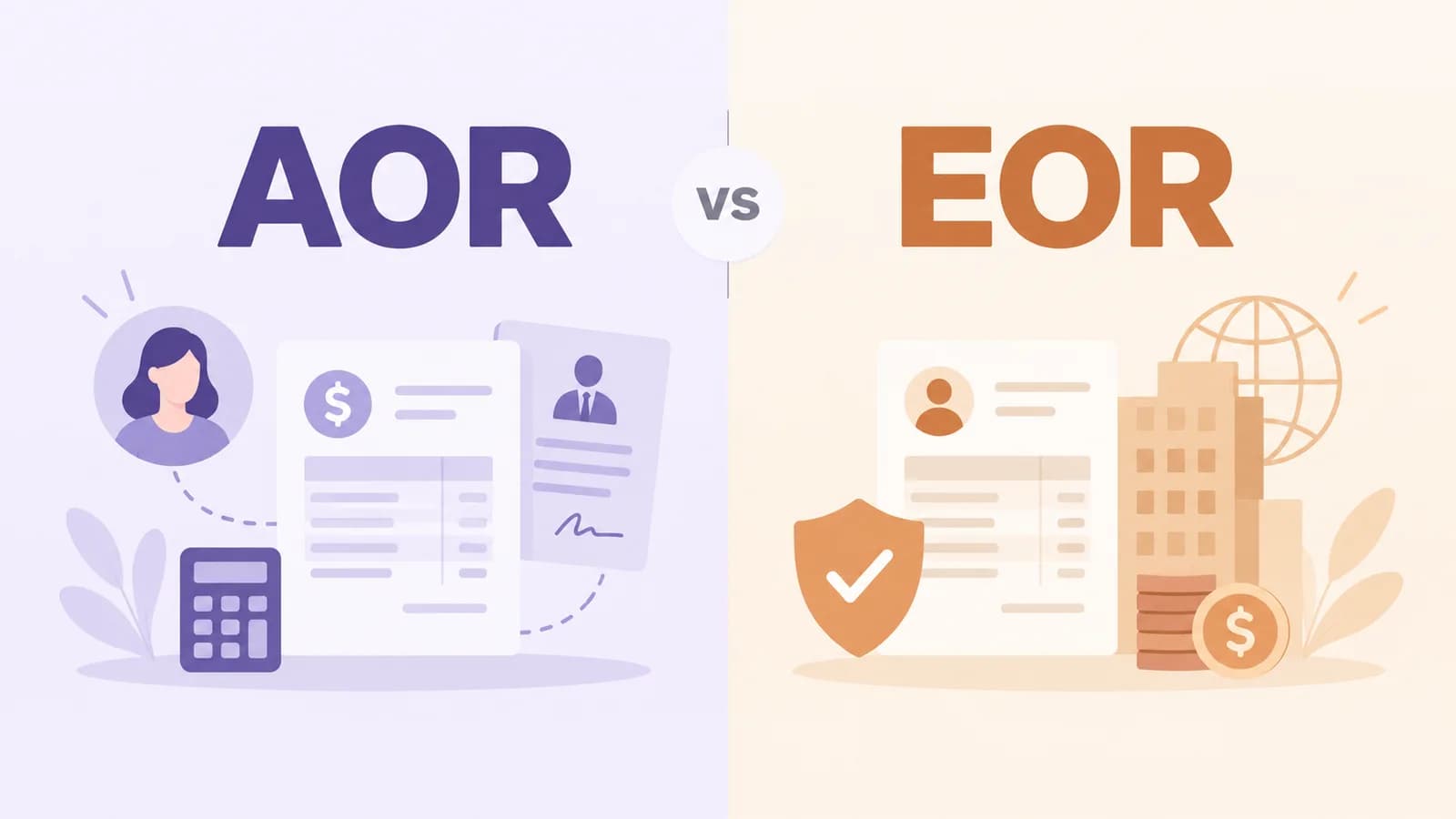
Two service models come up in exactly this situation: Agent of Record (AOR) and Employer of Record (EOR). An EOR employs the worker; an AOR engages the worker as an independent contractor. The difference is classification.
AOR vs. EOR at a glance
Agent of Record (AOR) | Employer of Record (EOR) | |
Legal employer of the worker | Neither you nor the AOR; the worker stays independent | The EOR becomes the worker's legal employer |
Worker classification | Independent contractor (1099-style) | Employee (W-2-style) |
Who directs the work | You do; the worker controls how it gets done | You direct day-to-day work; the EOR handles the employment relationship |
Payroll & tax withholding | Contractor handles their own taxes; AOR pays against invoices | EOR runs payroll and withholds income and payroll taxes |
Benefits & statutory contributions | Generally none | EOR provides statutory benefits and contributions |
Best fit for | Genuine project-based or specialized contractor work | Roles that are really employment, often where you have no local entity |
Typical use | Engaging 1099 contractors at scale, U.S. and abroad | Hiring employees in a country or state where you lack an entity |
Classification risk | AOR assumes defined, contractual responsibility for the determination; you retain your own direct-relationship obligations | EOR carries statutory employment compliance for that worker |
Onboarding speed | Fast engagement and payment setup | Fast relative to entity setup, usually a few weeks |
What an Agent of Record actually does
An AOR sits between your company and your independent contractors for the purpose of making the engagement compliant. In practice, that means a handful of concrete jobs.
It screens classification before the work starts. The AOR assesses whether the worker genuinely meets the legal definition of an independent contractor in the relevant jurisdiction, which in the U.S. can differ by federal test and by state. Companies that engage contractors directly usually skip this, and it's where misclassification originates.
It papers the relationship correctly. The AOR issues a compliant contractor agreement, collects business-entity verification and any required documentation, and holds the engagement on its own paper rather than yours.
It handles payment. Once the contractor is verified, they invoice or log milestones, and the AOR processes payment, so you're not managing dozens of one-off contractor relationships and payment methods yourself.
A reputable AOR engages the contractor on its own paper and takes on defined, contractually specified responsibility for the classification determination, typically through an indemnification clause. That reduces your exposure. If a worker is later reclassified as an employee, how much protection you actually have depends on what the agreement says. Read the indemnification provisions, and don't assume "AOR" means "no risk."
What an AOR does not cover: Workers who fail independent-contractor classification in the first place, employee benefits, or workers' compensation claims arising from an employee-type relationship. If the role is really employment, no amount of contractor paperwork fixes it, which is where the EOR comes in.
What an Employer of Record actually does
An EOR is a third party that becomes the legal employer of your worker in a jurisdiction where you don't have your own entity, a state you're not registered in, or a country where standing up an entity would take months.
That legal-employer status is the whole point. The EOR holds the employment contract, runs payroll, withholds income and payroll taxes, makes statutory contributions, and administers benefits and mandatory protections under local law. You still manage the person's actual work, what they do, how their day goes, what they deliver. The EOR carries the employment compliance around them.
The clearest use case is hiring a full-time employee in a market where entity setup isn't worth it yet. Instead of registering a foreign subsidiary to make one hire, you engage an EOR, and your employee is compliantly employed in weeks rather than quarters. For Nora, that's the Vienna engineer, a genuine employment relationship in a country where her company has no presence.
So which one do you need?
The decision follows the nature of the work, not which model you'd prefer. The core question every classification test circles back to is whether this person is running their own independent business or is functionally part of yours.
A simple way to work through it:
Look at the working relationship, not the label. Who controls how the work gets done? Is it ongoing or project-based? Does the worker serve other clients, use their own tools, set their own hours? The more your company controls the day-to-day, the more the relationship looks like employment.
If it's genuinely a contractor relationship → AOR. Independent, project-scoped, self-directed work from someone who operates their own business is a fit for an agent of record.
If it's genuinely employment → EOR. Control, permanence, and integration into your core operations point to an employee. If you lack an entity where they sit, an EOR lets you hire them compliantly.
If it's ambiguous, resolve the classification first. "Ambiguous" is the danger zone.
Two quick scenarios to make it concrete:
The freelance designer in SF. She invoices monthly, works for three other clients, uses her own software, and delivers to a scope. That's a genuine contractor. An AOR engages and pays her compliantly, and screens the classification so it holds up if challenged.
The "contractor" in Toronto who works full-time hours, only for you, on your systems, on your schedule. On paper, he's a 1099. In practice, he looks like an employee, which is exactly the setup that triggers reclassification. Papering over it with an AOR won't fix that. This is employment, and an EOR (or setting up properly) classifies him correctly from the start.
Where one system beats stitching two together
Most companies don't need only an AOR or only an EOR; they need both, plus visibility across everyone. Nora's roster is typical: contractors, a would-be international employee, and a domestic team, all needing consistent records, clean payment, and defensible classification.
The friction shows up when each model lives in a separate tool. Contractor engagement in one vendor, EOR employees in another, domestic payroll in a third, and finance reconciling across all of them at close. That fragmentation is how records drift and how classification questions go unnoticed until they become liability events.
This is where a unified platform earns its place. Platforms like Niural consolidate contractor engagement and EOR employment, alongside domestic payroll and finance operations, in one system with a single source of truth. For an HR or finance leader, that means one place to see who's a contractor and who's an employee, consistent onboarding and payment across both, and classification checks built into the workflow.
The takeaway
An AOR is for genuine independent contractors. An EOR is for employees, especially where you have no entity. The decision follows the nature of the work, and the most expensive mistake is forcing the wrong model onto a worker to save time or cost.
Get the classification right first. Then choose the model that matches it, and, ideally, run both from one place so your records tell a consistent story.
Frequently asked questions
Is an AOR only for U.S. contractors?
No, the AOR model is often associated with U.S. 1099 compliance, but the same need exists anywhere you engage independent contractors. Classification rules differ by country and, in the U.S., by state.
Does an AOR remove all my misclassification liability?
Not entirely. A reputable AOR assumes defined, contractual responsibility for the classification determination, usually via indemnification, which reduces your exposure. But terms vary by provider, and you keep obligations tied to how you direct the work. Review the agreement carefully rather than assuming full transfer.
Can I move someone from an AOR contractor to an EOR employee?
Yes, and sometimes you should. If a contractor relationship starts to resemble employment, converting to an EOR employment arrangement is often the compliant path.
What's the real difference in one line?
An EOR employs the worker as an employee. An AOR engages the worker as an independent contractor. The right choice depends entirely on which the worker genuinely is.
Who decides the correct classification?
Ultimately, the applicable legal tests do; federal (IRS, DOL) and state. A good AOR screens against those tests before the engagement begins, but the determination has to reflect the actual working relationship, not the label on the contract.
Do I need both?
Often, yes. Companies with a mixed workforce, contractors plus employees across states or countries, commonly use both models, which is why consolidating them in one system is worth considering.
Disclaimer: This article is for informational purposes only and does not constitute legal, tax, or compliance advice. Worker classification depends on the specific facts of each working relationship and applicable federal and state rules. Consult qualified legal, tax, or compliance professionals before making classification or engagement decisions.
-768x432.webp&w=3840&q=75)