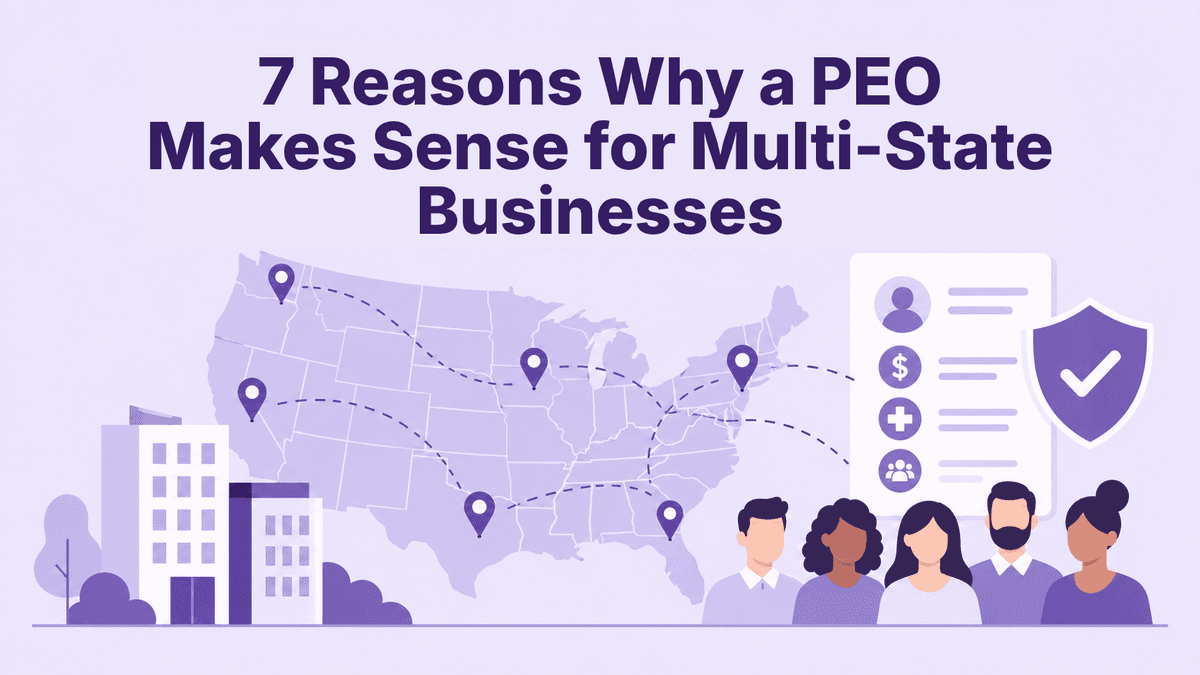
Your first hire outside your home state feels like a recruiting win. Then the paperwork starts. Before that person's first paycheck, you may need a withholding account in their state, an unemployment insurance account, workers' comp coverage that applies there, and enrollment in a state paid leave program you've never heard of. For a founder without an HR team, this is the point where a PEO for multi-state businesses starts to earn its fee.
What changes when you hire in a second state?
Employment obligations generally follow the employee, not your headquarters. If you're based in Texas and hire a remote engineer in Colorado, Colorado's payroll, leave, and wage rules apply to that engineer.
A new state typically triggers:
- State income tax withholding registration, unless the state doesn't tax wages
- A state unemployment insurance (SUI) account and an assigned tax rate
- Workers' compensation coverage that's valid in that state
- Paid family and medical leave contributions, where the state runs a program
- Local taxes in certain cities, counties, or school districts
- New wage and hour rules, required notices, and workplace posters
7 reasons why a PEO makes sense when your team crosses state lines
1. Every new state comes with its own registrations
Each state where you have employees needs its own withholding and unemployment accounts, and often a paid leave account too. A PEO handles these registrations as you hire.
States also treat PEOs differently for unemployment tax. In PEO-reporting states, the PEO files SUI under its own account. In client-reporting states, your company must keep an account tied to its own EIN, and the PEO typically files on your behalf using that account. Hybrid states assign your company a separate account linked to the PEO's master account.
In practice, joining a PEO may mean closing some existing SUI accounts and keeping others. A good PEO tells you which is which during onboarding.
2. State payroll taxes don't follow one pattern
Nine states don't tax wages: Alaska, Florida, Nevada, New Hampshire, South Dakota, Tennessee, Texas, Washington, and Wyoming. Most others do, each with its own withholding tables and forms. Some go further with local income taxes, such as Ohio municipal taxes, Pennsylvania's local earned income tax, and New York City's resident tax. Neighboring states may also have reciprocity agreements that change where an employee's taxes are withheld.
Withholding for the wrong state can leave an employee owing money at tax time and your company correcting filings in two jurisdictions. A PEO applies the right state and local rules based on where each employee works and lives.
3. State paid leave laws are expanding fast
Paid family and medical leave (PFML) is changing fastest. Twelve states plus Washington, D.C., now pay PFML benefits. Three programs went live in 2026 alone: Delaware and Minnesota on January 1, and Maine on May 1. Maine's program covers private employers with even one employee in the state. Maryland's program is scheduled to begin paying benefits in January 2028, and Virginia enacted its own program in April 2026, with contributions starting in April 2028.
Existing programs change too. Washington raised its PFML premium rate from 0.92% to 1.13% for 2026.
Each program means payroll deductions, employer contributions, quarterly reports, and employee notices. This is one of the clearest cases for a PEO for multi-state businesses: the PEO tracks effective dates and rate changes and builds contributions into payroll before they come due, so a new state program doesn't surprise you in the middle of a quarter.
4. Workers' comp works differently
Workers' compensation rates depend on job classification codes, and those codes and rates vary by state. Four states (North Dakota, Ohio, Washington, and Wyoming) require employers to buy coverage through a state-run fund rather than a private insurer. Texas lets most private employers opt out of coverage entirely. Remote employees generally need coverage under the rules of the state where they work.
Outside the state-fund states, PEOs typically cover client employees under a master policy, so you don't buy a new one each time you enter a state. The PEO also handles claims administration.
5. Wage and hour rules
The federal minimum wage is $7.25 an hour, but most states and many cities set higher rates. The differences go beyond minimum wage:
- Overtime: California requires overtime after eight hours in a single day, not just after 40 hours in a week.
- Exempt status: States like California, New York, and Washington set salary thresholds for exempt employees that are higher than the federal level.
- Final pay: Deadlines range from the day of termination in some states to the next regular payday in others.
A PEO keeps payroll settings aligned with each employee's state, so a job offer that is compliant in one state doesn't quietly violate the rules in another.
6. Your benefits have to work where your employees live
Small-group health plans are often built around regional networks. That works when everyone lives near headquarters and breaks down when your team spans five states. An employee in Denver shouldn't find that every in-network doctor is in Austin.
PEOs pool employees from many client companies into a larger group, which can give a startup access to national carrier networks usually reserved for much larger employers.
7. You get HR expertise
At 15 or 30 employees, a full-time HR leader is hard to justify. A PEO gives you HR and compliance specialists for handbooks, state-specific policies, leave questions, and terminations.
According to NAPEO research, businesses that use a PEO see a return on investment of about 27% from cost savings alone. They also grow about twice as fast, have 12% lower employee turnover, and are 50% less likely to go out of business than comparable companies that don't use a PEO.
What do you handle yourself vs. what does a PEO handle?
Obligation | Handling it yourself | With a PEO |
State withholding registration | Register with each state's revenue agency | PEO registers as employees are added |
State unemployment insurance | Open accounts, file quarterly, manage rate notices | PEO files under its own account or yours, depending on the state |
Paid family and medical leave | Track each program, deduct, report, remit | PEO calculates, withholds, and remits contributions |
Workers' compensation | Buy coverage in each state, manage claims | Master policy where permitted; PEO handles claims |
Local taxes | Identify city and county taxes, register separately | PEO applies local taxes based on work location |
Wage and hour rules | Monitor minimum wage, overtime, and final pay rules | PEO configures payroll to each state's rules |
Health benefits | Find plans with networks in every state | Access to the PEO's large-group plans |
Year-end forms | Produce W-2s with correct state and local data | PEO issues W-2s |
How does Niural handle multi-state employment?
Niural is an AI-native PEO, which means the intelligence works inside the payroll run rather than alongside it. EMMA, Niural's AI layer, validates payroll before the run. It flags missing rate changes, such as a new state leave contribution rate, and flags potential misclassification risk before either reaches an employee's paycheck or a state agency. Your team still reviews and approves each run. EMMA takes on the checking that usually happens by hand.
Underneath, Niural's PEO runs on its own payroll tax engine rather than a patchwork of third-party providers. When you hire in a new state, Niural handles the state registrations and filings, including coordinating client-level accounts where a state requires them, so your payroll is ready before the first paycheck.
Your payroll funds earn while they wait
Payroll cash usually sits idle between the day you fund it and the day employees get paid. With Niural Wallet, the balance you hold for upcoming payroll earns cash rewards until it goes out. The same wallet funds payroll, contractor, and vendor payments, so you manage one operating balance instead of prefunding separate accounts for each.
One platform from first hire to global scale
Multi-state hiring is usually one stage of a longer growth path. Niural is built to support each stage on the same platform:
- First hire: Run payroll, benefits, and compliance through Niural's PEO in your home state.
- Second state, then tenth: Niural handles new registrations, filings, and state leave programs as you hire, under the same payroll and benefits program.
- First international hire: Hire employees in 150+ countries through Niural's EOR without setting up a local entity, or pay international contractors from the same system.
- Global scale: When running employment under your own EIN makes more sense, move from Niural's PEO to its ASO model while keeping your payroll history, employee records, and reporting on one platform.
Each new state, country, or stage extends the setup you already have instead of adding another vendor.
The bottom line
For a founder without an HR team, every state-level obligation above competes with the product and growth work only you can do. A PEO for multi-state businesses takes on the registrations, filings, and rule tracking, so adding an employee in a new state works much like adding one at home.
Hiring in a new state? Assess your PEO fit with Niural.
Other related articles:
PEO vs. Payroll Service
PEO vs EOR vs Staffing Agency
PEO vs. Employee Leasing
How to Save on Benefits With a PEO
Frequently Asked Questions
Do I need to register in every state where I have an employee?
Generally, yes. Most states require withholding registration if they tax wages and an unemployment insurance account once you have employees working there. Many also require paid leave registration. A PEO handles these registrations as you hire.
What happens to my existing SUI account when I join a PEO?
It depends on the state. In PEO-reporting states, you usually close your account and the PEO files under its own. In client-reporting states, you keep your account and the PEO typically files for you. Hybrid states link a separate account to the PEO's master account.
Does a PEO handle state paid family and medical leave contributions?
Typically, yes. A PEO calculates employee deductions and employer contributions, remits them, and files the required reports for each state program. If you've opted into a state-approved private plan, confirm how the PEO administers it.
Is a PEO worth it if I only have a few employees in another state?
Often, yes. The registration and filing work in a new state is roughly the same for one employee as for 50, so a PEO tends to deliver the most relief early, before you have staff to absorb that work.
Disclaimer: This article is for informational purposes only and does not constitute legal, tax, or benefits advice. State requirements change frequently. Consult qualified advisors for guidance specific to your business.