The first thing Ryan, people and culture manager at a tech company, saw on Monday was, "My paycheck's wrong." An engineer had crossed a wage threshold mid-year, Social Security had kept coming out when it should have stopped, and now Ryan was trying to remember which taxes cap and which ones don't.
That gap is common, and it's not a knowledge failure. The two taxes get confused because they arrive at the same place, the paycheck, and leave from the same line items. But they answer different questions.
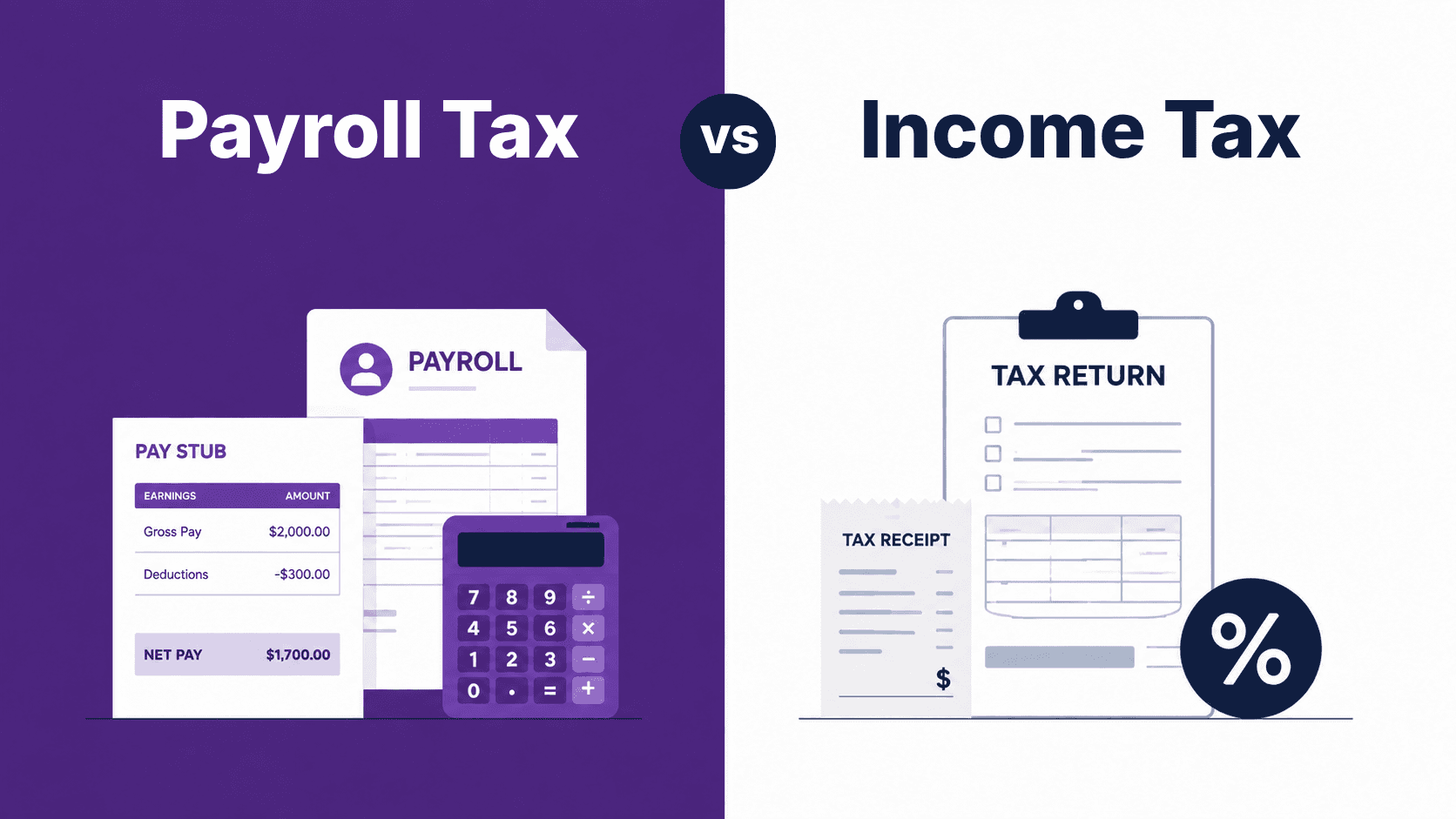
Payroll tax vs. income tax: At a glance?
The cleanest way to separate them is to ask three questions of each: who pays it, who owes it, and what it funds.
Payroll Tax | Income Tax | |
Who pays | Employer and employee usually split it (some parts are employer-only) | Employer withholds it from the employee's wages |
Who owes it | Both parties owe their share directly | The employee owes it; the employer is a collector |
What it funds | Specific programs: Social Security, Medicare, unemployment | General government spending at federal, state, and local levels |
How it's calculated | Flat percentages, some with an annual wage cap | Progressive brackets based on the employee's total income and W-4 |
Main employer filings | Form 941 (quarterly), Form 940 (annual, for FUTA) | Reported alongside wages on Form 941 and W-2 |
When payroll tax is wrong, it's often the company's own money on the line as well as the employee's. When income tax withholding is wrong, it's the employee's money you mishandled.
The taxes that come out of a paycheck
"Payroll tax" is an umbrella. Underneath it sit four distinct obligations, and each behaves a little differently. These are the figures for 2026:
Tax | Employee pays | Employer pays | Applies to | 2026 detail |
Social Security (OASDI) | 6.2% | 6.2% | Wages up to the annual wage base | Wage base is $184,500; max tax is $11,439 per side |
Medicare | 1.45% | 1.45% | All wages, no cap | Unchanged |
Additional Medicare | 0.9% | none | Wages over $200,000 (single) / $250,000 (married filing jointly) | Employer withholds once wages pass $200,000, regardless of filing status; no employer match |
Federal unemployment (FUTA) | none | 6.0%, effectively 0.6% | First $7,000 of each employee's wages | About $42 per employee after the standard 5.4% state credit; Form 940 |
Social Security caps; Medicare doesn't. Once an employee's wages hit $184,500 in 2026, you stop withholding the 6.2% Social Security portion for the rest of the year. Medicare keeps going with no ceiling. That mid-year rollover is precisely the kind of thing that produced Ryan's ticket; the cap wasn't applied when the employee crossed it.
Additional Medicare is employee-only and threshold-based. There's no employer match on the extra 0.9%, and you're required to start withholding it once an employee's wages with you exceed $200,000 in the year, even though the employee's actual liability depends on their filing status and total household income. The withholding rule and the tax rule aren't the same, and that mismatch confuses a lot of teams.
FUTA and SUTA are employer-only. Federal unemployment (FUTA) and its state counterpart (SUTA) don't come out of the employee's check at all. Most employers pay an effective FUTA rate of 0.6% because they get a credit for paying state unemployment on time. A handful of states carry a "credit reduction" in a given year, which raises the effective rate for employers there; it's worth checking your states annually rather than assuming 0.6%.
The income tax side: federal, state, and local
Income tax withholding also isn't one thing. Depending on where your people work, you may be withholding on three levels at once.
- Federal income tax. Calculated from the employee's Form W-4 using the IRS withholding methods in Publication 15-T. It's progressive, so it scales with earnings, which is why two employees with the same salary can have different withholding based on their W-4 elections.
- State income tax. Most states levy it, but nine don't: Alaska, Florida, Nevada, New Hampshire, South Dakota, Tennessee, Texas, Washington, and Wyoming. Rates, brackets, and rules vary widely across the states that do.
- Local income tax. Some cities and counties add their own rules. New York City and a range of Ohio and Pennsylvania localities are common examples. This is easy to miss when an employee moves.
One thing sits across both categories: supplemental wages. For federal income tax, employers can withhold on these at a flat 22% in 2026 (37% on cumulative supplemental wages above $1 million).
That flat rate is a withholding convenience, not the employee's final tax. This is a distinction worth explaining before bonus season, because employees often read the 22% as their tax rate and get surprised at filing.
Why this matters for HR
Finance owns the numbers at close. But HR owns the moment they become real to an employee. When Social Security over-withholds, when a state tax isn't set up for a new remote hire, when a bonus looks "taxed too high," the first message doesn't go to the CFO. It goes to the HR team.
Ryan isn't a tax accountant, but he's the one employees email when a number looks wrong. Getting the payroll-versus-income-tax distinction straight is what lets him answer an employee accurately in the moment instead of escalating, and what lets him spot a setup error.
Where it goes wrong
The failures cluster in predictable places:
- Multi-state setup gaps. An employee moves or works remotely across a state line, and the company isn't registered or isn't withholding the right state (and sometimes local) tax. Payroll runs "fine" for months, then the exposure surfaces.
- The wage-base rollover. Social Security keeps deducting past the cap, or restarts incorrectly, exactly Ryan's issue. Manual systems don't always track cumulative wages cleanly across pay periods.
- Supplemental wage confusion. Bonuses withheld at the flat rate get misexplained, or the calculation folds them into regular wages inconsistently.
- Classification bleeds. A worker treated as a 1099 contractor who should be a W-2 employee means payroll taxes that were never withheld or paid, a payroll-tax problem dressed up as a classification decision.
Getting it right: a working checklist
A practical baseline for keeping both taxes clean:
- Map every work location. Know which state and locality each employee actually works in, and confirm you're registered and withholding correctly there.
- Track cumulative wages, not just per-period. The Social Security cap and the Additional Medicare threshold only make sense against year-to-date totals.
- Separate "employer cost" from "employee money" in your own head. FUTA and SUTA are yours. Withheld income tax and the employee's FICA share are held in trust; the IRS calls these trust fund taxes for a reason.
- Re-check rates and bases every January. The Social Security wage base moves annually; some figures don't. Don't carry last year's assumptions forward.
- Have a supplemental-wage explanation ready. Before bonuses go out, be able to tell employees that 22% is withholding, not their final tax.
- Validate before you run. Catching a missing rate change or a misconfigured state before the payroll run is the difference between a note and a correction cycle.
How the right system removes the guesswork
Most of these problems are edge-tracking problems, and edges are exactly what software should handle. A modern payroll system applies the correct federal, state, and local rates automatically, enforces wage-base caps as employees cross them, and keeps year-to-date totals accurate so thresholds trigger on time.
Niural runs on its own tax engine rather than stitched-together middleware, so the correct rates and wage-base caps apply automatically across every state a team operates in. Its AI layer, EMMA, validates payroll before the run, flagging missing rate changes and surfacing the kind of threshold and setup issues that generate tickets like Ryan's. It's meant to get the rollover, the registration, and the calculation right before anyone hits run. For teams managing employees across states and worker types, that turns payroll tax from a monthly guessing game into something that simply holds.
See how Niural handles payroll.
See related articles:
Essential Payroll Tax Forms
Enterprise Payroll Workcenter
Discretionary vs. Non-Discretionary Bonuses
Frequently asked questions
How do you distinguish between payroll tax and income tax?
Payroll taxes fund specific programs, Social Security, Medicare, and unemployment, and are usually shared between employer and employee. Income tax is a general tax on a person's earnings; the employee owes it, and the employer withholds and remits it on their behalf.
Do employers pay income tax on employee wages?
No, employers withhold income tax from employee wages and send it to the tax authorities, but the income tax liability belongs to the employee.
What are the four main types of payroll tax?
Social Security, Medicare (including the Additional Medicare tax on high earners), and federal unemployment (FUTA), alongside state unemployment (SUTA). Income tax withholding is often grouped in as well, though it's technically an income tax the employer collects.
Is Social Security tax the same as income tax?
No, Social Security is a payroll tax with a fixed 6.2% rate for both employers and employees in 2026, applied only to wages up to the annual wage base of $184,500. Income tax, on the other hand, is progressive and depends on the employee’s total earnings and W-4 elections.
Which states have no income tax?
Nine states have no broad personal income tax: Alaska, Florida, Nevada, New Hampshire, South Dakota, Tennessee, Texas, Washington, and Wyoming.
Why do bonuses seem to get taxed more?
Bonuses are supplemental wages, and employers can withhold federal income tax on them at a flat 22% in 2026. That's a withholding rate, not the employee's final tax; any over-withholding is reconciled when they file their return.
Disclaimer: This article is for informational purposes only and does not constitute tax, legal, or accounting advice. Payroll tax rules change and vary by jurisdiction. Consult a qualified tax, payroll, or legal professional for guidance specific to your business.

-768x432.webp&w=3840&q=75)