Chloe’s support team had carried the company through a brutal launch quarter. So in a Friday all-hands, she said, "Anyone who's here and on time every day next month gets an extra $500."
Six weeks later, her fractional CFO pulled her aside with a spreadsheet and a question: Did you run that bonus through overtime?
She didn't even know it was a question. And that one sentence in an all-hands had quietly turned a feel-good gesture into a wage-and-hour problem stretching back across every workweek the bonus covered.
The words "discretionary" and "non-discretionary" sound like HR jargon. But under federal law, which bucket a bonus falls into decides whether you owe extra overtime, and the label you call it has nothing to do with the answer.
The short version
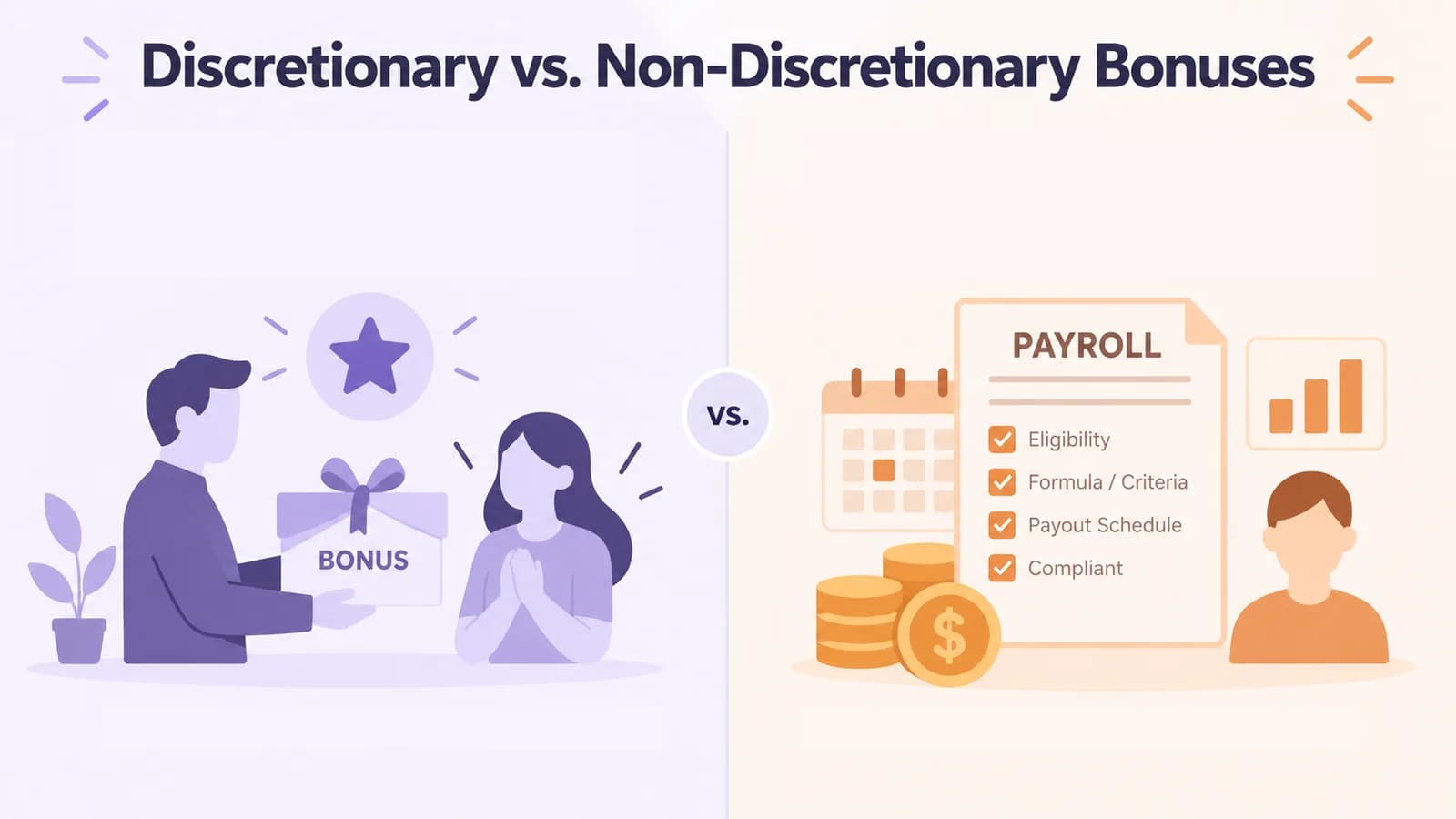
A discretionary bonus is one where you, the employer, decide whether to pay it, how much to pay, and when, all at your own discretion and near the end of the period, with no prior promise that leads employees to expect it. It stays out of overtime math.
A non-discretionary bonus is one employees can expect or work toward: it's announced in advance, tied to a formula or metric, or promised as part of the deal. Because employees earn it by hitting known criteria, federal law treats it as part of their pay, which means it has to be folded into the "regular rate" used to calculate overtime.
Most bonuses are non-discretionary. The moment you announce it, attach it to a target, or let people count on it, you've likely created one. Chloe's "$500 if you're on time all month" checks every box.
What makes a bonus "discretionary"
Discretionary is a narrow legal category with a specific test. The U.S. Department of Labor's Fact Sheet #56C lays out the standard. A bonus is discretionary only if it meets all of these:
- You keep sole discretion over whether to pay it, right up until at or near the end of the period the bonus covers.
- You keep sole discretion over how much to pay, over that same window.
- There's no prior contract, agreement, or promise that causes employees to expect the payment regularly.
Miss any one of those, and the bonus is non-discretionary. That's a high bar. A true discretionary bonus is essentially a surprise: you weren't obligated, you didn't pre-announce a formula, and nobody was working all month specifically to earn it.
The DOL's own examples of bonuses that can qualify as discretionary include a reward for getting through an unusually stressful stretch, recognition for a one-off extraordinary effort that wasn't tied to pre-set criteria, or a spontaneous "employee of the month" pick. None had an announced rule or created an expectation, and each was decided after the fact.
Chloe's mistake was announcing the rule up front. The instant she said "be on time every day, and you get $500," she gave up her discretion. Employees knew exactly what to do to earn it. That's the definition of non-discretionary.
What counts as non-discretionary
A non-discretionary bonus is any bonus that fails the discretionary test above. In practice, that's the majority of them. The usual suspects:
- Attendance and punctuality bonuses.
- Production or performance bonuses tied to quotas, output, or metrics.
- Retention or "stay" bonuses contingent on remaining employed through a date.
- Signing bonuses promised as part of an offer.
- Bonuses designed to make people work more steadily, faster, or more efficiently, or to keep them from leaving.
The promise doesn't have to be in writing, which trips up even careful founders. A verbal commitment in a team meeting counts. And keeping the option not to pay doesn't save you. If employees know the bonus exists and know how to earn it, the expectation itself makes it non-discretionary.
The name you give the payment is irrelevant, too. The DOL is explicit that the label on a bonus and the reason for it don't decide the question.
Why the difference matters: the regular-rate trap
Under the Fair Labor Standards Act (FLSA), non-exempt employees must be paid overtime at 1.5 times their "regular rate" for hours worked over 40 in a workweek. The catch is that the regular rate isn't just the base hourly wage; it includes almost all earnings, including non-discretionary bonuses.
So when you pay a non-discretionary bonus, you have to go back, spread it across the workweeks it covered, recalculate the regular rate for each of those weeks, and pay additional overtime on top. A bonus paid in April can raise the overtime you owed in February and March.
The DOL's January 2026 opinion letter walks through the math with a clean example. Take an employee earning $12.00 an hour who works 50 hours in a week and earns an extra $9.50 per hour in non-discretionary bonus pay for all hours worked:
- Straight-time pay: (50 × $12.00) + (50 × $9.50) = $1,075
- Regular rate: $1,075 ÷ 50 hours = $21.50/hour
- Overtime premium owed: half the regular rate ($10.75) × 10 overtime hours = $107.50 extra for that week
That $107.50 is money the employer would owe on top of what they already paid. Even when the employer designed the bonus plan and set its terms entirely on its own, the bonuses were still non-discretionary because they ran on a predetermined plan employees could work toward. Discretion over creating the program is not the same as discretion under the FLSA.
Multiply a missed calculation across a team and several months, and you understand why plaintiffs' attorneys watch for this.
Discretionary vs. non-discretionary: At a glance
Discretionary bonus | Non-discretionary bonus | |
Who decides, and when | Employer alone, at or near the end of the period | Determined by pre-set criteria or a formula |
Announced in advance? | No | Yes (in writing or verbally) |
Tied to a metric or goal? | No | Yes, attendance, output, retention, etc. |
Do employees expect it? | No | Yes |
Counted in the overtime regular rate? | Excluded | Included |
Common examples | Surprise spot bonus, one-off recognition, employee of the month | Attendance, production, retention, signing bonuses |
What Chloe should have done
Chloe's instinct, to reward a team that showed up, was good. The execution created risk. She had a few better paths:
- Keep it genuinely discretionary. Say nothing in advance, then, after a strong month, surprise the team with a bonus decided entirely at her discretion.
- Keep the incentive but account for it correctly. If she wants the motivating power of an announced attendance bonus, which is often the point, she keeps it, but treats it as non-discretionary and runs it through the overtime calculation for every affected non-exempt employee.
The second path is usually the right one. Announced incentives work because people can count on them.
How the right payroll setup catches this before it becomes a liability
In a lot of growing companies, the bonus decision, hours data, and the overtime calculation live in three different places: a Slack announcement, a time-tracking tool, and a payroll platform that never learns the bonus was promised. Nothing connects them, so nothing flags the problem.
Where Niural fits
This is the class of error Niural is built to prevent. Niural runs U.S. payroll, benefits, contractor management, and compliance on one platform, so bonus data, hours, and classification aren't scattered across disconnected tools. Its executional AI layer, EMMA, validates payroll before the run and flags missing rate changes, the kind of gap that turns an announced bonus into unpaid overtime.
For a founder like Chloe, that means the connection between "I promised the team $500" and "that changes what I owe in overtime" gets caught on screen, before money goes out, instead of surfacing later as a retroactive liability.
See how Niural handles payroll.
See related articles:
Unified Payroll vs. Integrated Payroll
Top 8 Payroll Problems
How to Choose a Global Payroll Provider
Frequently asked questions
What's the difference between a discretionary and non-discretionary bonus?
A discretionary bonus is decided entirely by the employer, at or near the end of the period, with no advance promise, so employees don't expect it. A non-discretionary bonus is announced in advance or tied to criteria employees can work toward, so they can expect to earn it.
Do bonuses affect overtime pay?
Non-discretionary bonuses do. For non-exempt employees, the FLSA requires that non-discretionary bonuses be folded into the "regular rate" used to calculate overtime, which can retroactively increase the overtime you owe for the weeks the bonus covered. Discretionary bonuses are generally excluded.
Is a signing bonus discretionary or non-discretionary?
A signing bonus promised as part of an offer is generally non-discretionary, because it's agreed to in advance and the employee expects it. How it factors into overtime can depend on the specifics, so it's worth confirming the treatment with a qualified advisor.
Does calling a bonus "discretionary" make it discretionary?
No, the DOL is clear that the label and the stated reason don't decide the question. What matters is the structure: whether it was announced, tied to criteria, and expected.
If I keep the right not to pay a bonus, is it discretionary? Not necessarily. If employees know the bonus exists and know how to earn it, that expectation can make it non-discretionary even if you technically reserve the right to withhold it. Retaining an option to cancel doesn't, by itself, satisfy the discretionary test.
Can a bonus paid months later change overtime I already ran?
Yes, a non-discretionary bonus has to be apportioned back across the workweeks it covered, and overtime is recalculated for those weeks, so a bonus paid in one month can raise overtime owed for earlier months.
Disclaimer: This article is for informational purposes only and does not constitute legal, tax, or compliance advice. Wage-and-hour rules vary by state and by situation. Consult qualified legal or payroll counsel before designing or paying bonuses to non-exempt employees.

-768x432.webp&w=3840&q=75)