Pepper recently raised her Series A. Since then, she's hired across five states, and last week her best candidate for a senior engineering role lived in Lisbon. Her lawyer mentioned an EOR. A recruiter friend told her to just use a staffing agency for the contract designers she needs through launch. Different suggestions, and Pepper still doesn't know which one she's supposed to pick.
She's confused because these models get compared as competitors, but they answer three different questions. Once you know which question you're asking, the choice gets a lot simpler.
Who employs the person you're paying?
Who is the legal employer of the worker? That determines who files the taxes, who carries the compliance risk, and who signs the employment contract.
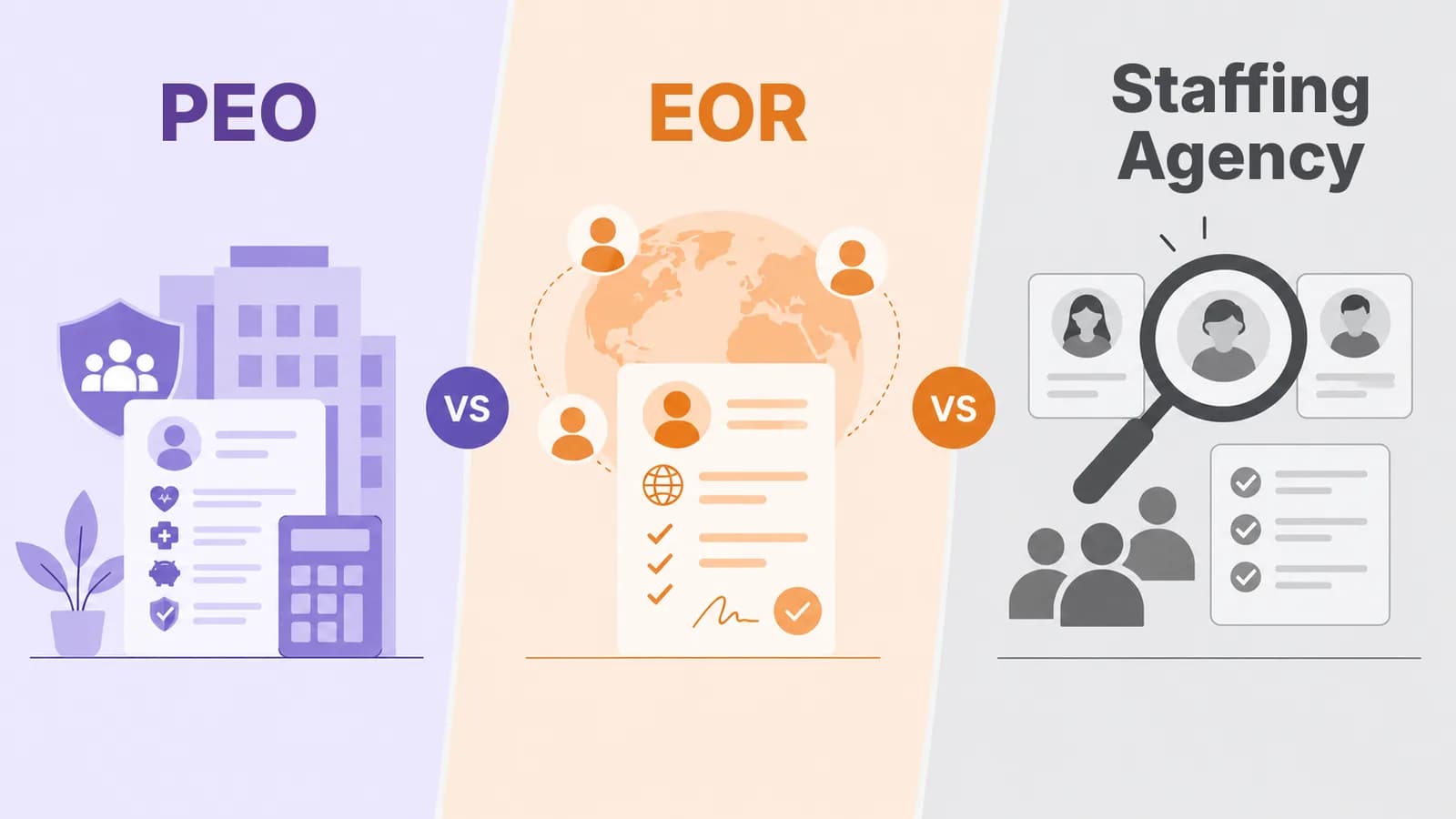
- PEO: You and the PEO share the employer role. This is called co-employment. You already have a legal entity; you make all the hiring and management decisions, and the PEO becomes the employer of record for payroll, taxes, and benefits. It's used almost entirely inside the United States.
- EOR: The EOR is the sole legal employer in a country or state where you have no entity of your own. You direct the work day-to-day; the EOR carries the full legal employment relationship on paper.
- Staffing agency: The agency employs the worker on its own roster and supplies them to you, usually for temporary, contract, or temp-to-hire roles. You direct the work; the agency stays the employer.
PEO vs EOR vs Staffing agency: At a glance
PEO | EOR | Staffing agency | |
Legal employer | Shared (co-employment) | The EOR | The agency |
Your entity required? | Yes | No | No |
Best for | Permanent US team | Permanent hires abroad where you have no entity | Genuinely temporary or contract work |
You control the work? | Yes | Yes | Yes, day to day |
Who owns compliance | Shared with PEO | The EOR | The agency |
Typical use case | Growing US headcount | First hire in a new country | Seasonal surge, short project |
A PEO is for the team you already employ
A Professional Employer Organization co-employs your US workforce. You keep every decision that matters to how you run the company: who to hire, who to fire, what people work on, what your culture feels like. The PEO takes on payroll, tax filings, benefits administration, workers' compensation, and a large share of HR compliance.
For Pepper, this is the model for her core US team. She has a Delaware entity and employees in five states, and each new state means new registrations, new tax accounts, and new labor rules. A PEO absorbs that and gives her people access to benefits plans a 40-person company usually can't get on its own, because the PEO pools thousands of employees to negotiate rates.
Pros
- Fortune 500-level benefits a small team usually can't get alone, because the PEO pools thousands of employees to negotiate rates.
- Payroll, tax filings, workers' comp, and most HR compliance handled for you.
- You keep full control of hiring, firing, and day-to-day management.
- The numbers back it up: NAPEO finds PEO users grow about 2x faster, have 12% lower turnover, and are 50% less likely to go out of business. More than 230,000 US businesses now use one.
Cons
- Does not solve international hiring.
- Co-employment means sharing the employer relationship, which is worth understanding closely before signing.
- Quality and technology vary widely between PEOs, so the platform matters as much as the pooled benefits.
Use a PEO when
- You're building a permanent US team.
- You already have a US entity.
- You want enterprise-grade benefits and compliance support without hiring a full HR function.
An EOR is for international hiring where you don't have an entity
An Employer of Record becomes the legal employer of a worker in a place where you have no registered entity. That's the whole point of it. Pepper's engineer in Lisbon is a permanent, full-time hire she wants on the team for years, but opening a Portuguese entity to employ one person would take months and cost more than the hire is worth in year one.
An EOR already has an entity in Portugal. It signs the local employment contract, runs local payroll, handles statutory benefits, and ensures compliance with Portuguese labor law. Pepper manages the engineer exactly as she manages everyone else. On paper, the EOR is the employer.
Pros
- Hire compliantly in a new country in days instead of months.
- Skip entity setup entirely.
- The EOR owns local payroll, statutory benefits, and compliance risk.
- Ideal speed for testing a new market or landing one strong candidate abroad.
Cons
- Typically costs more per employee than your own local payroll once you have real headcount there.
- It's an on-ramp, not always the permanent home. Enough hires in one country and opening your own entity gets cheaper.
Use an EOR when
- You're making a permanent hire where you have no entity.
- You need to move fast.
- You don't want to build a local legal presence yet.
A staffing agency is for work that's temporary
A staffing agency employs workers on its own payroll and places them with you for temporary, seasonal, or project-based work. Think of the contract designers Pepper needs through launch, or a warehouse team for a holiday surge. The agency recruits them, employs them, and bills you, usually at a markup on the hourly rate that typically runs 25% to 50% above the worker's pay, or a placement fee of roughly 15% to 25% of first-year salary for a permanent hire it sources for you.
Pros
- Fast: the agency has people on its bench, so you get help quickly.
- Flexible: when the project ends, the engagement ends, and you never carry the employment relationship.
- The right fit for short-term or seasonal needs.
Cons
- Clean only while the work stays temporary.
- When a "temporary" placement stretches on, and the worker becomes part of your core team, you drift toward a misclassification problem. Courts look at the substance of the relationship, not the label on the contract.
- The wrong tool for a permanent role you're trying to fill on the cheap.
Use a staffing agency when
- The work is temporary or seasonal.
- You need people quickly for a defined period.
- You don't intend to bring the role in-house.
So which one do you need?
Run the decision in this order:
Is the role permanent or temporary? Temporary or seasonal → staffing agency.
If permanent: do you have a legal entity where the person will work? Yes, in the US → PEO. No entity there → EOR.
That's most of the decision. Permanent versus temporary tells you whether staffing is even in the conversation. Entity or no entity tells you PEO versus EOR. The edge cases (a contractor who should be a W-2, a country where you're about to cross the threshold for your own entity) are worth a closer look, but the rule above handles the majority of founder situations.
You're probably going to use more than one
These models aren't mutually exclusive, and most growth-stage companies run more than one at once. Pepper's likely setup within a year looks like a PEO for her US team, an EOR for the engineer in Lisbon and the next few international hires, and a staffing agency for the contract designers through launch. Each model is doing the job it's built for.
The real problem shows up once you're running three arrangements at once. Three logins, three sources of payroll data, and three different answers to "who does this person cost us and are we compliant?" The fragmentation Pepper was trying to avoid comes back through the side door.
Where a system like Niural fits
Niural runs US PEO, global EOR, and contractor management on one platform, so the permanent side of Pepper's workforce, domestic and international, lives in a single system instead of a stack of disconnected vendors. She sees one view of who she employs, where, at what cost, and whether each arrangement is compliant.
Niural’s AI layer, EMMA, helps here too, flagging classification and compliance issues before payroll runs rather than after a filing goes wrong. For a founder like Pepper, that's the difference between finding a misclassified worker in an audit and catching it the week the contract starts.
Frequently asked questions
Is an EOR the same as a staffing agency?
No, an EOR is the legal employer of workers you choose and manage, typically permanent hires in places where you have no entity. A staffing agency recruits and supplies its own workers for temporary placements. The EOR runs employment for your people; the agency brings you theirs.
What's the difference between a PEO and an EOR in one sentence?
A PEO shares the employer role with you where you already have an entity; an EOR becomes the sole employer where you don't.
Which model has the most misclassification risk?
Staffing carries the most risk if a temporary placement quietly becomes permanent and the worker gets integrated into your team. PEO and EOR arrangements carry low misclassification risk for the workers under them, because the employment relationship is clearly defined.
Do I have to pick just one?
No, and most scaling companies don't. A common setup is a PEO for the US team, an EOR for international hires, and a staffing agency for temporary roles. The goal is a clear reason for each model, not one model for everything.
When should I switch from an EOR to my own entity abroad?
Roughly when you have enough permanent headcount in a country (around 20) that running your own local payroll costs less than paying per-employee EOR fees. There's no fixed number, but many companies revisit it around the point they're supporting a small local team rather than one or two hires.
Disclaimer: This article is for general informational purposes only and does not constitute legal, tax, or compliance advice. Worker classification and employment obligations depend on the specific facts of each relationship and vary by jurisdiction. Consult qualified legal, tax, and HR advisors before making employment decisions.
-768x432.webp&w=3840&q=75)