In March, Andrew made two hires. The first was a support lead in Austin, the first employee outside the company's home state of Massachusetts. The second was a sales engineer in Berlin, the first outside the country. Both offers went out the same week, and Andrew filed them mentally under one heading: we're expanding.
They were not one heading. Austin triggered a state registration Andrew didn't know existed and had almost no time to complete. Berlin raised a question about whether the company now owed corporate tax in Germany. One problem was administrative, the other structural, and neither was solved by the payroll system Andrew already had.
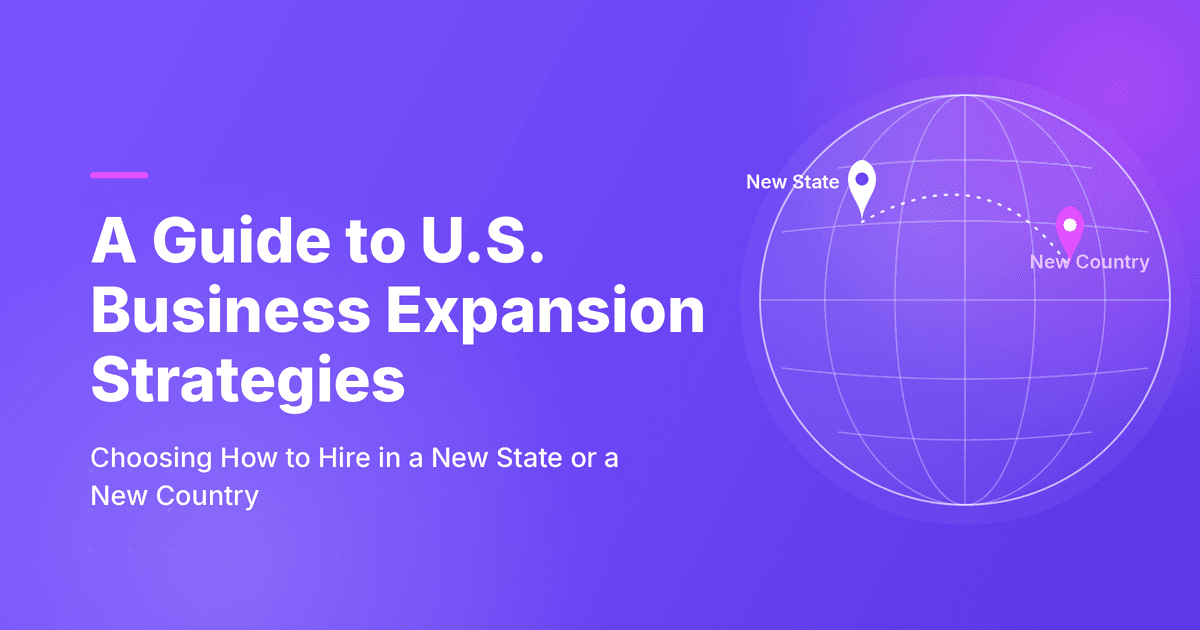
Workforce expansion isn't one decision. It's two. Crossing a state line and crossing a border are governed by different rules and served by different instruments. There are four ways to employ someone in a new place: direct employment, a PEO, an EOR, or independent contractors, and they don't all work in both directions.
What business expansion really means once you start hiring
Search for expansion strategy, and you'll find market penetration, diversification, M&A. That's market expansion. This is the other kind. Workforce expansion is what happens when someone starts doing work for your company in a jurisdiction where you have no legal presence. Unlike a go-to-market plan, it comes with filing deadlines.
Expanding inside the U.S. means employing someone in a state where you aren't a registered employer. Expanding outside the U.S. means employing someone in another country. Neither requires an office. Both are triggered by one person accepting one offer.
Why crossing a state line isn't the same as crossing a border
Andrew's instinct, that Austin and Berlin were versions of one problem, is the most common and most expensive assumption in early expansion. The two directions have different menus.
Mode | Inside the U.S. (new state) | Outside the U.S. (new country) |
Direct employment | Register with the state | Set up a local entity |
PEO | Available | Not available |
EOR | Rarely the answer | The primary instrument |
Independent contractor | Available | Available |
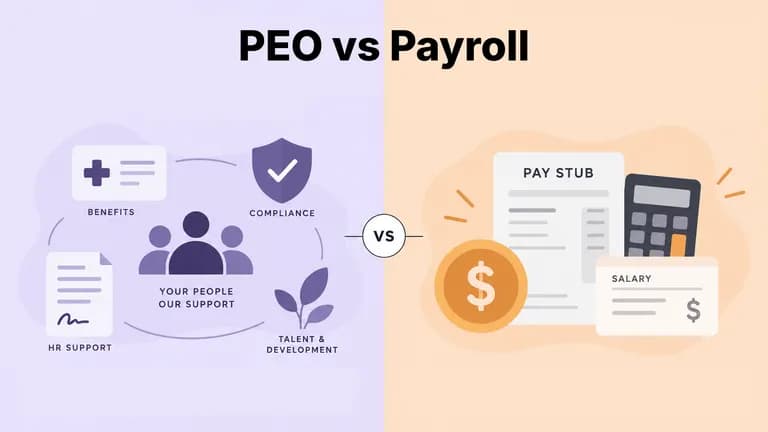
The row that surprises people is the PEO row. A PEO works through co-employment: you remain the legal employer, and the PEO takes on defined employer responsibilities alongside you. That model assumes you're already a registered U.S. employer.
An EOR is the cross-border instrument. The EOR becomes the legal employer through its own entity in that country. It's rarely the right call inside the U.S., where registering directly is a form, not a foreign subsidiary.
The short version: PEO for domestic, EOR for international. Most founders learn this a week after signing a vendor who covers one and not the other.
The expansion challenges that catch founders off guard
Inside the U.S., one hire triggers everything
Andrew assumed Austin was a payroll settings change. But employment tax nexus has no minimum threshold. Sales tax generally requires crossing a revenue floor, often $100,000, before a state takes an interest. Employment doesn't work that way. If an employee performs work in a state, including from their kitchen table, you typically have nexus and must register for state income tax withholding and unemployment insurance. Most states want that done before or at the first paycheck. Not the first quarter. The first check.
Then multiply: fifty states, fifty registration processes, fifty wage-and-hour regimes. Complexity scales with the number of states, not people; twelve employees across nine states can carry more payroll administration than sixty across two.
Outside the U.S., you can become taxable without deciding to
Berlin was a different animal. Permanent establishment is a tax concept: if your activities in a country look enough like a fixed place of business, local authorities may determine you have a taxable presence, triggering corporate tax filing obligations and often foreign entity registration. No office required. No decision required. And what drives the risk isn't headcount so much as what the person does: an engineer writing code sits at one end, a sales engineer with authority to negotiate contracts at the other. Exactly the hire Andrew made.
An EOR reduces this exposure by employing the person through its own local entity. It does not eliminate it, and any vendor claiming otherwise is selling. Add statutory benefits you didn't budget for, notice periods that rule out at-will termination, and contracts written to local law.
In both directions, classification is the loose thread
The tempting shortcut is the same both ways: skip it, pay a contractor. Sometimes legitimate. Often not, and the label doesn't decide. The working relationship does. Federal contractor rules are in flux in 2026, and state tests differ from federal ones. Misclassification is the one mistake that reaches backward: not a fine going forward, but back taxes, penalties, and retroactive liability for the whole period you had it wrong.
Your four options for hiring in a new state or country
Direct employment: you register, you employ, you carry it
For Austin, this was the obvious answer and the right one. Kyle registers with Texas, opens withholding and unemployment accounts, runs payroll. The asymmetry shows up when the same instinct crosses the Atlantic: employing the Berlin hire directly means a German company. A GmbH, capital requirements, months before anyone gets paid.
That's the trade. Direct employment gives you everything: full control over terms, benefits, and termination, no per-head fee, a local presence that matters for banking and credibility. But you carry all of it: every filing, every liability, and an entity that demands maintenance whether it holds one employee or forty.
The cost shape is front-loaded and fixed. You pay to set it up once, then pay to keep it alive regardless of headcount, so the math improves with every person you add and punishes you when it's just the one. Closing one is neither fast nor free.
A PEO: the co-employment model
A PEO shares defined employer responsibilities with you: payroll, tax filing, benefits, compliance, while you remain the legal employer.
Kyle's real Austin problem wasn't Texas. It was Texas, then Denver in June, then wherever the next great candidate happens to live. One state is a form. Five is a job, and nobody at a 40-person company has that job.
That's where a PEO earns its keep. It doesn't remove the registrations; you still need them, but it absorbs the administration around them and brings something a company Kyle's size can't buy alone: benefits pricing power. Forty people negotiating with carriers have no position. A PEO pooling thousands of worksite employees does. NAPEO's research finds businesses using a PEO grow twice as fast, have 12 percent lower turnover, and are 50 percent less likely to go out of business than comparable businesses that don't, with a 27 percent return on investment in cost savings alone.
The cost is variable, a percentage of payroll or a per-employee fee, scaling with headcount, with little to set up. You're buying administrative capacity you'd otherwise hire for, so the value depends on what you'd build instead.
And it does nothing for Berlin. Not because a provider won't, because the model can't. Co-employment needs an employer to co-employ with.
An EOR: someone else is the legal employer abroad
An EOR employs the person through its own entity in that country. Your team member operationally, their employee legally.
Berlin needed a different instrument. Kyle can't wait four months for a GmbH to hire someone he wants working next month, and he isn't sure Germany is a market yet. That's what the sales engineer is there to find out. Committing to an entity to answer a question you haven't answered is how founders end up maintaining a company in a country they've since left.
An EOR collapses this to weeks: local contract, statutory benefits, payroll, handled by someone who does it daily in that jurisdiction. It converts expansion from a fixed investment into a variable cost, which is the actual reason it exists: you can be wrong about Germany without it costing you a corporate structure.
What you give up is control. The EOR holds the contract, so ending the relationship is a conversation with a provider. And the per-head economics have a horizon. One person in Germany is cheap on an EOR and absurd as an entity. Twelve invert that, somewhere between five and fifteen, depending on the market. A good problem, and a scheduled one.
Find out more about Niural EOR.
Independent contractors: the fastest route, and the one that reaches backward
A contractor is someone in business for themselves, working under a service agreement. No employment relationship, no registration, no benefits.
This was Kyle's first thought for both hires, and it's every founder's first thought, because it makes the whole problem disappear. Sometimes it should. Genuinely independent, project-scoped work with a specialist running their own business is exactly what the arrangement is for, and treating it as inherently suspect is its own mistake.
But the tell isn't the contract. It's whether the person is actually in business for themselves; own hours, own risk, other clients. Kyle's support lead was going to work full-time, on his schedule, with his tools, reporting to his head of CX. Calling that a contractor arrangement doesn't make it one, and the more closely he'd direct the work, the more clearly he'd have built the relationship he was avoiding.
Learn about Niural Contractor Management.
How to choose your expansion mode, and when to switch
Four questions, in order:
- How permanent is this? Testing a market or committing to it?
- How many people, in how many places? Fifteen people in one country and one each in fifteen countries are opposite problems.
- How much control do you need over notice periods, equity, and termination, and how fast do you need them working? Those two pull against each other.
- What's your risk tolerance? Not aspirationally.
The more useful reframe: these modes are phases, not identities.
Most companies run contractors to test, EOR to enter, entity to commit, and domestically, a PEO while they're small and spread across states, direct employment as they concentrate. Andrew's Berlin hire should probably start on an EOR. If Berlin becomes twelve people, it should probably become an entity. Neither is wrong; they're different points on one line.
Which means the real question is what happens when it changes.
The cost nobody models: switching
Every mode change is a migration. New system, new data model, new vendor. Records get re-entered. History strands in a platform you're leaving. And because domestic and international modes change on different schedules, a company running U.S. payroll in one system and international EOR in another ends up permanently reconciling two sources of truth to answer a question as basic as what did our workforce cost this month?
Which makes the technology question architectural, not a feature checklist. What matters isn't whether a system runs payroll in a given country; it's whether it survives the mode change.
Where Niural fits
Most platforms pick a side. "Global payroll" usually means international only, leaving U.S. operations somewhere else, and leaving you reconciling.
Niural runs both: U.S. PEO across all 50 states and EOR across 150+ countries, on one platform. PEO for Austin, EOR for Berlin, one answer to the cost question. Because it's built on owned tax and payment rails rather than stitched partner networks, the mode change stops being a migration; companies start on PEO, hire abroad on EOR, and move to their own entities without changing platforms. EMMA, Niural's executional AI layer, monitors regulatory changes across jurisdictions and validates payroll before it runs.
The takeaway
Expansion isn't a single strategy. It's a sequence of jurisdiction decisions, and the menu changes depending on whether you crossed a state line or a border.
Andrew's mistake wasn't picking the wrong mode. It was assuming one decision where there were two. The founders who handle this well aren't the ones who pick the first time perfectly; they're the ones building on infrastructure that lets them change their mind without changing systems.
Before the next offer goes out, map the direction first. Then pick the instrument.
Frequently asked questions
Can I use a PEO to hire internationally?
No, a PEO is a U.S. co-employment arrangement that assumes you're a registered employer. It doesn't extend to countries where you have no entity. Use an EOR.
Do I have to register in a state if I only have one remote employee there? Generally yes. Employment tax nexus has no minimum threshold. One employee working in a state typically requires registration for withholding and unemployment insurance, usually before their first paycheck.
What's the difference between an EOR and a PEO?
An EOR is the legal employer through its own local entity. A PEO shares employer responsibilities while you remain the legal employer. An EOR enables hiring where you have no presence; a PEO supports hiring where you already do.
When should I set up a foreign entity instead of using an EOR?
When headcount density, permanence, and control outweigh per-head EOR economics, often over 20 employees in a country. Local banking and tax planning also push toward an entity.
Is it legal to hire a contractor instead of an employee to avoid registration?
Only if the person is genuinely an independent contractor. Classification follows the working relationship, not the contract. If they should be an employee, you have the obligations anyway, plus back taxes and penalties.
Disclaimer: This article is general information only and is not legal, tax, or accounting advice. Employment, tax, and classification requirements vary by state and country and change over time. Confirm your specific obligations with qualified counsel before hiring in a new jurisdiction.