
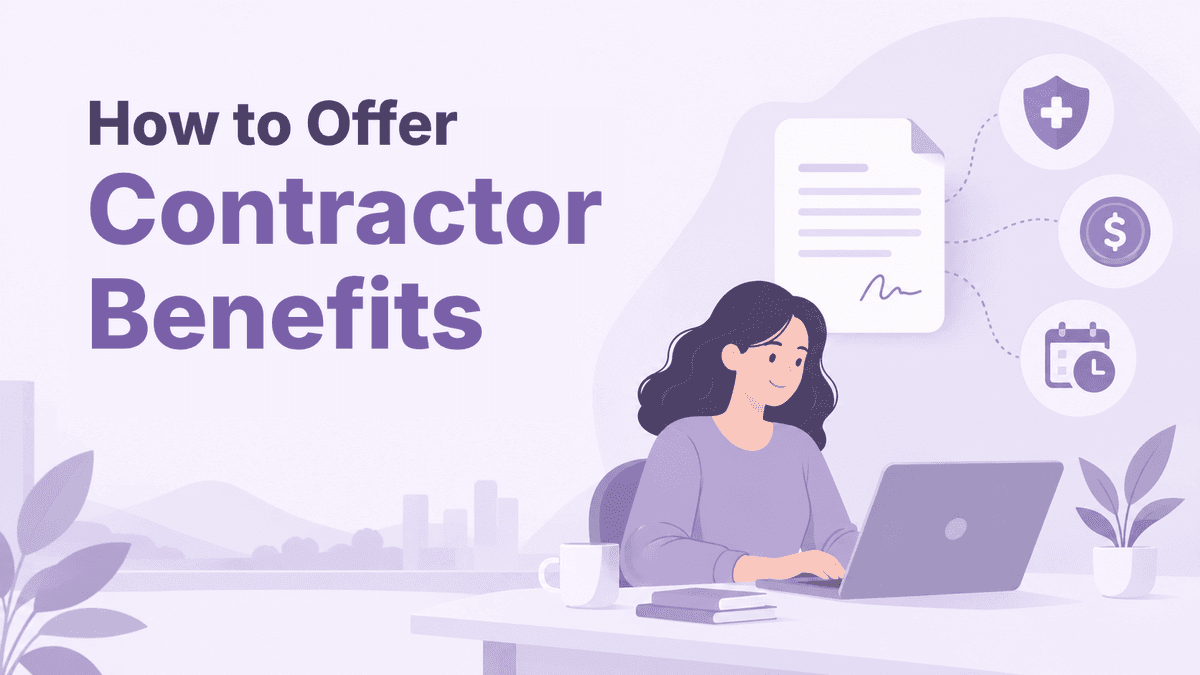
Your best contractor just asked whether you offer any benefits. Your instinct says add them to the wellness program, kick in toward health coverage, maybe a little paid time off for a long-term relationship. Then finance does what finance does and asks the harder question: does giving this person benefits turn them into an employee we should have been paying as a W-2?
That question is the reason contractor benefits are a compliance-design problem. Companies can offer contractor benefits, but only certain kinds. Traditional employee benefits can be read as evidence of an employment relationship. Compliant options are built to support contractors without controlling them.
What "contractor benefits" means
An independent contractor isn't on your payroll. They invoice you, handle their own taxes, and, in principle, run their own business. The moment your company starts providing the things that define employment, agencies and courts start asking whether the label matches the reality.
So can you offer benefits to independent contractors at all? You can, but the line is what kind of benefits and how they're structured. Two frameworks decide it. The IRS common-law test looks at control: who directs how, when, and where the work gets done, and whether the worker is folded into your ongoing operations. The Department of Labor's economic-reality test asks whether the worker is genuinely in business for themselves or economically dependent on you. Employee-style benefits, a company health plan, accrued PTO, a 401(k) match, push both tests toward "employee".
Compliant contractor benefits sidestep this by giving the worker money or access without giving your company control. The worker decides how to use it.
Why this matters for finance leaders
Misclassification lands on finance. Reclassify a contractor as an employee, and the bill can include back payroll taxes with interest and penalties, unpaid overtime, retroactive benefits, and unemployment and workers' comp exposure, plus the internal hours spent unwinding records across payroll, HR, and accounting.
The DOL announced in 2025 that it would stop enforcing the stricter 2024 independent-contractor rule and revert to an older economic-reality framework, and in early 2026 it moved to formally replace that rule with a more business-friendly standard. It would be a mistake to read that as "the risk went away." The 2024 rule still governs private litigation, and plaintiff's attorneys and state agencies drive most misclassification claims, not the federal enforcement calendar. Several states also apply stricter classification tests than the federal government does. For a company operating across state lines, softer federal enforcement changes very little about the actual exposure on the books.
What you can offer compliantly
A handful of approaches let you support contractors without blurring the classification line. Most work by handing over funds the contractor controls, or access they opt into, rather than a company-sponsored plan they're enrolled in.
- Stipends. A fixed allowance for health costs, wellness, home-office equipment, or professional development that the contractor spends at their discretion. Contractor stipends are the most common compliant tool because they're informal by design: you're not sponsoring a plan; you're just adding money the worker directs themselves.
- Marketplace access and navigation support. Point contractors to ACA individual plans and help them shop, without paying the premium directly or sponsoring coverage. Many contractors who qualify can also claim premium tax credits on the exchange.
- Association or group-rate access. Let contractors buy into association health plans or vetted third-party benefit marketplaces at better rates than they'd find alone. They enroll and pay; you facilitate.
- Worker-owned retirement options. Direct contractors toward self-employed retirement vehicles they own and administer, rather than enrolling them in your company plan.
- Group discounts and perks. Access to negotiated rates on software, gym memberships, or financial tools carries essentially no classification risk.
Here's the practical line finance needs:
Compliant to offer | Treat as employee-only |
Health, wellness, or equipment stipends | Company-sponsored group health plan |
ACA marketplace access and shopping help | Employer-paid PTO that accrues |
Association plan / group-rate access | 401(k) with company match |
Worker-owned retirement guidance | Enrollment in employee benefit programs |
Software and service discounts | Anything that directs the worker's schedule or methods |
If the benefit gives the contractor money or access they control, you're on safer ground. If it enrolls them in something your company runs and administers for its employees, you're not.
The tax and budgeting picture
Compliant doesn't mean invisible to accounting. Most contractor stipends are taxable income to the recipient and get reported alongside their other compensation on Form 1099-NEC. That works in your favor. It keeps the arrangement clearly non-employment, and the cost stays predictable and easy to budget.
There's no benefits-renewal surprise and no premium volatility. A stipend is a fixed number you set. The main things to get right are reporting the amounts correctly and keeping each payment's context clean, so an auditor can see exactly what was paid, to whom, and why.
Where a unified system helps
Contractor benefits create administrative surface area: stipends to disburse, amounts to report, agreements to keep straight, and classification context to preserve across dozens of workers in different states. Run that through spreadsheets and email, and the compliance story gets fragile fast. That's often how a defensible arrangement starts to look like a messy one.
This is where consolidated contractor management earns its place. Niural gives finance and operations teams a single source of truth for contractor payments, agreements, and reporting, so stipend disbursements, 1099 records, and the context behind each payment live in one system rather than scattered across tools. What matters is that the paper trail behind your classification decisions holds up when someone asks to see it.
If you're managing a mix of contractors across states, consolidating payments, agreements, and reporting in one place makes the compliant path a lot easier to run. See how Niural's contractor management brings contractor payments and records into one system.
Explore Niural Contractor Management
Other related articles:
Frequently Asked Questions
Can you offer benefits to independent contractors?
Yes, within limits. You can offer stipends, marketplace access, association-plan access, and, in a growing number of states, contributions to portable benefit accounts. You generally should not enroll contractors in the employee benefit programs your company sponsors, because that can be treated as evidence of employment.
Can a contractor get health insurance through a company?
Not as a sponsored employee plan without raising classification risk. The compliant route is helping them access individual ACA coverage or an association plan, and optionally providing a health stipend they use to offset premiums.
Are contractor stipends taxable?
Generally yes. Stipends are typically taxable income to the contractor and reported with their compensation on Form 1099-NEC. Confirm treatment with your tax advisor.
Does offering benefits automatically make someone an employee?
No single factor decides classification. But employee-style benefits are one input agencies and courts weigh, and stacking several of them shifts the analysis toward employment.
Do portable benefits laws protect us from misclassification claims?
In states that have passed them, the safe harbor is designed so that voluntary contributions to a worker-owned account aren't used as evidence of employment. Outside those states, that protection doesn't exist, so the classification risk remains.
-768x432.webp&w=828&q=75)