Owen didn't set out to run an HR department. But eighteen months after the seed round, he was signing off on a state tax registration in a state he'd never visited. All of it was now his problem.
Most founders start by asking how to pay people. Somewhere along the way, the real question becomes who is responsible for being the employer. Those are two different problems, and they map to two different providers. A payroll service handles the first. A professional employer organization (PEO) takes on the second.
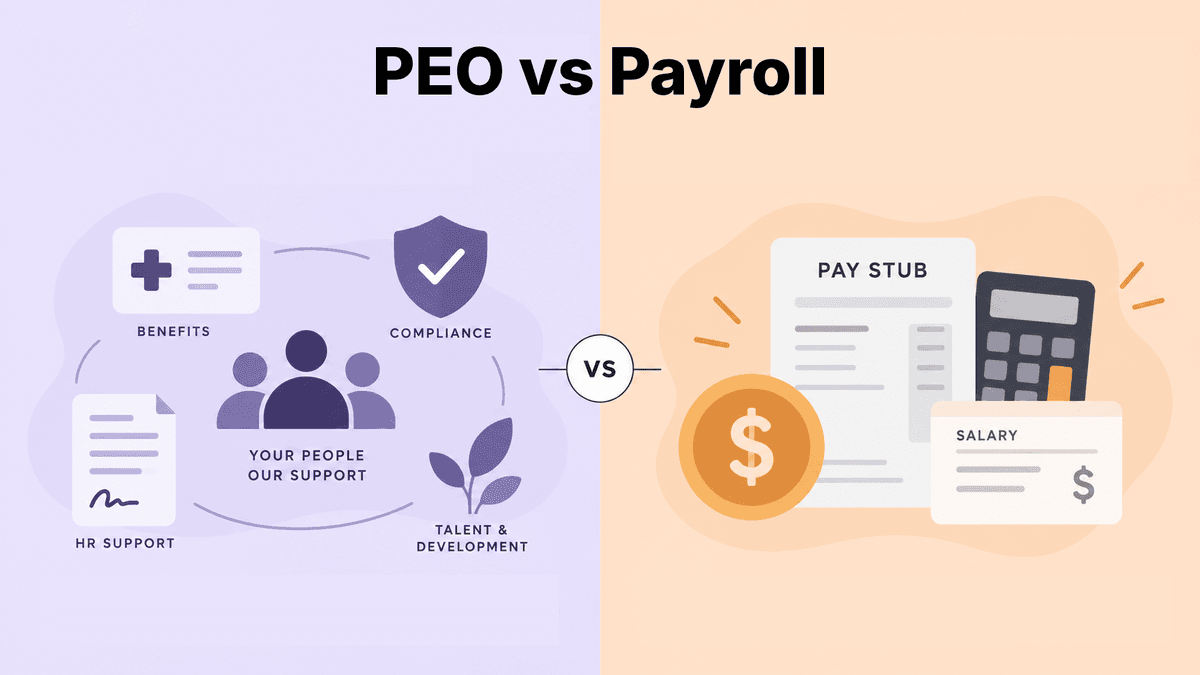
A payroll service calculates pay, runs it, and files payroll taxes under your company's tax ID (EIN), while your company keeps full legal responsibility for compliance, benefits, and HR. A PEO enters a co-employment relationship, runs payroll and remits taxes under its own EIN, and shares the employer's responsibilities with you, including benefits, workers' compensation, and much of the compliance load. A payroll service is usually enough when you have an HR function and straightforward needs. A PEO becomes the better fit once hiring, benefits, and multi-state compliance grow faster than your team can absorb.
What a payroll service does
A payroll service provider does one job well: it turns hours and salaries into correct, on-time payments and the tax filings that go with them. Give it wage data, and it calculates gross pay, withholds the right income and payroll taxes, issues paychecks or direct deposits, and prepares the associated tax forms.
The defining detail is where the responsibility sits. A payroll service files under your EIN, and your business remains the sole employer. That means your company still owns everything the payroll run doesn't cover: HR compliance, benefits administration, workers' compensation, employment law, and the consequences if any of it goes wrong. The payroll provider prepares the forms; the liability stays with you.
That narrow focus is the point. If you already have the people and processes to handle compliance and benefits, a payroll service removes the mechanical work of paying employees without changing how your company is structured.
What a PEO does
A PEO does everything a payroll service does, and then takes on a share of the employer role itself.
The mechanism is co-employment. Under a client service agreement, the PEO becomes a co-employer for tax and administrative purposes. It runs payroll and remits employment taxes under its own EIN, sponsors and administers benefits, provides workers' compensation coverage, and supports compliance across the states where you operate. You keep full ownership of your company and full control over the actual work, hiring decisions, direction, and culture. What you hand off is the administrative and compliance weight of being an employer.
Co-employment sounds alarming, but it's narrow. Employer responsibilities and liabilities are shared by contract. The PEO doesn't own a piece of your company or decide who you hire. That's what lets a lean team offer real benefits and stay compliant without building a full HR and benefits operation from scratch.
Because a PEO pools employees across many client companies, it can also unlock benefits a small company usually can't access alone. Research from the National Association of Professional Employer Organizations (NAPEO) has found that businesses using a PEO grow at roughly twice the rate of comparable companies and are 50 percent less likely to go out of business, with an average return on investment of about 27 percent in cost savings alone.
PEO vs. payroll service, side by side
Payroll service | PEO | |
Core job | Calculate, run, and file payroll | Payroll plus shared employer responsibilities |
Whose EIN files taxes | Your company's | The PEO's |
Employer liability | Stays with you | Shared under co-employment |
Benefits | Not typically included | Group medical, dental, vision, 401(k) via pooled plans |
Compliance & HR support | Minimal; you own it | Ongoing support across states |
Workers' compensation | Handled separately by you | Usually included |
Typical cost model | Per-payroll or per-employee fee | Bundled fee covering payroll, benefits, HR, compliance |
Best for | Teams with an HR function and simple needs | Growing teams without a full HR function |
When a payroll service is enough
A standalone payroll service is often the right call when your setup is contained, and you already have the capacity to manage the rest of the employer role. That usually looks like:
- You have an internal HR, or people function, even a small one, that owns compliance and benefits.
- Your team is concentrated in one state or a small, stable set of states.
- Your workforce is mostly straightforward W-2 employees.
- You're comfortable sourcing and administering benefits yourself, or you don't need to offer much yet.
- You want to keep employer liability in-house rather than share it.
If that's you, adding a PEO can mean paying for infrastructure you already have. A capable payroll service does the job.
When you've outgrown payroll and need a PEO
The crossover happens quietly, which is why so many founders miss it. You don't get a notification that says you now need employment infrastructure. You just start noticing the symptoms. A PEO tends to become the better fit when:
- You're hiring across multiple states. Each new state adds registrations, tax accounts, and its own labor rules. A few states in, this stops being an occasional task and becomes a standing obligation.
- You want to offer competitive benefits. Attracting senior talent means real health and retirement plans, and a PEO's pooled purchasing power makes that reachable without a big internal function.
- Compliance load is outrunning your team. Filings, notices, classification questions, and changing requirements are piling up faster than anyone can keep track of.
- You have no HR function, and headcount is climbing. When the founder is the last line of defense for I-9s, terminations, and benefits questions, HR has become triage.
- The cost of an error is rising. A misclassified worker or a missed filing is a manageable risk at five people and a serious one at fifty.
Where Niural fits
Most companies treat this as a vendor decision: buy a payroll service now, and if you outgrow it, rip it out and buy a PEO later. That second step is a migration, and migrations are exactly the kind of disruption a growing team can't afford.
Niural is built so the crossover isn't a re-platform. Niural runs US payroll on its own tax and payment engine, and extends to a full AI-native PEO on the same system, so moving from "we just need to pay people" to "we need real employment infrastructure" is a configuration change on the same system rather than a migration to a new one.
Along the way, Niural's AI layer, EMMA, validates payroll before each run and flags potential misclassification risk, the exposure that grows as a company adds states and worker types. For founders who don't want to become back-office operators, the value is having one operating foundation that holds as the workforce and the compliance load change.
The takeaway
The choice comes down to how much of the employer role your company is ready to carry. With HR capacity and simple, contained needs, a payroll service does the job. Once hiring, benefits, and multi-state compliance grow faster than your team can manage, a PEO gives you employment infrastructure without building a department to run it.
See how Niural runs payroll and PEO on one system, so you can start with what you need today and scale into more without re-platforming. Book a demo to walk through your setup.
Explore Niural PEO
Explore Niural Payroll
See related articles:
Group Health Plans vs. Individual Plans
PEO vs. Employee Leasing
How a PEO Can Improve Your Turnover Rate
Frequently asked questions
Is a PEO the same as a payroll company?
No, a payroll company processes pay and files taxes under your EIN. A PEO includes payroll but also becomes a co-employer, files under its own EIN, and shares HR, benefits, and compliance responsibilities.
Does a PEO replace my payroll provider?
Yes, payroll is part of what a PEO delivers, so you generally wouldn't run a separate payroll service alongside a PEO.
Does co-employment mean I lose control of my company?
No, you keep full ownership of your business and full control over hiring, direction, and day-to-day operations. Co-employment only allocates employer responsibilities and liabilities for administrative and tax purposes.
Can I use a PEO to hire employees in other countries?
Generally no. A PEO is a domestic (US) model. International hiring typically calls for an employer of record (EOR) instead.
How do I know when to switch from a payroll service to a PEO?
Watch for triggers: hiring across multiple states, wanting to offer competitive benefits, a rising compliance load, and no internal HR function to absorb it. When those stack up, a payroll service alone usually isn't enough.
Does using a PEO mean I don't need HR at all?
Not exactly. A PEO handles a large share of HR administration and compliance, but you'll still own the human side: culture, management, and hiring decisions.
Disclaimer: This article is for informational purposes only and does not constitute legal, tax, or HR advice. Co-employment arrangements and worker classification rules vary by jurisdiction; consult qualified advisors before making decisions specific to your business.
-768x432.webp&w=828&q=75)