Integrated payroll works, until it doesn't
Dana runs People at a 180-person company that's grown into five states and just made its first two hires in Canada. Victor is the controller, one Slack away. On paper, their systems are "integrated." The HRIS pushes to the payroll platform, the payroll platform pushes to the general ledger, and a connector moves contractor payments into accounts payable. Everything is connected. Most months, it holds.
Then a hire in a new state gets entered in the HRIS the day after the payroll cutoff. The connector syncs on its own schedule. The state tax setup doesn't make it into the run. Dana finds out when the employee messages her about a short paycheck. Victor finds out at close, when two systems disagree about what was paid, and someone has to reconstruct why.
That gap is the quiet difference between payroll that's integrated and payroll that's unified. Both are "connected." Only one keeps a single, shared record of what's true.
What's the difference between unified and integrated payroll?
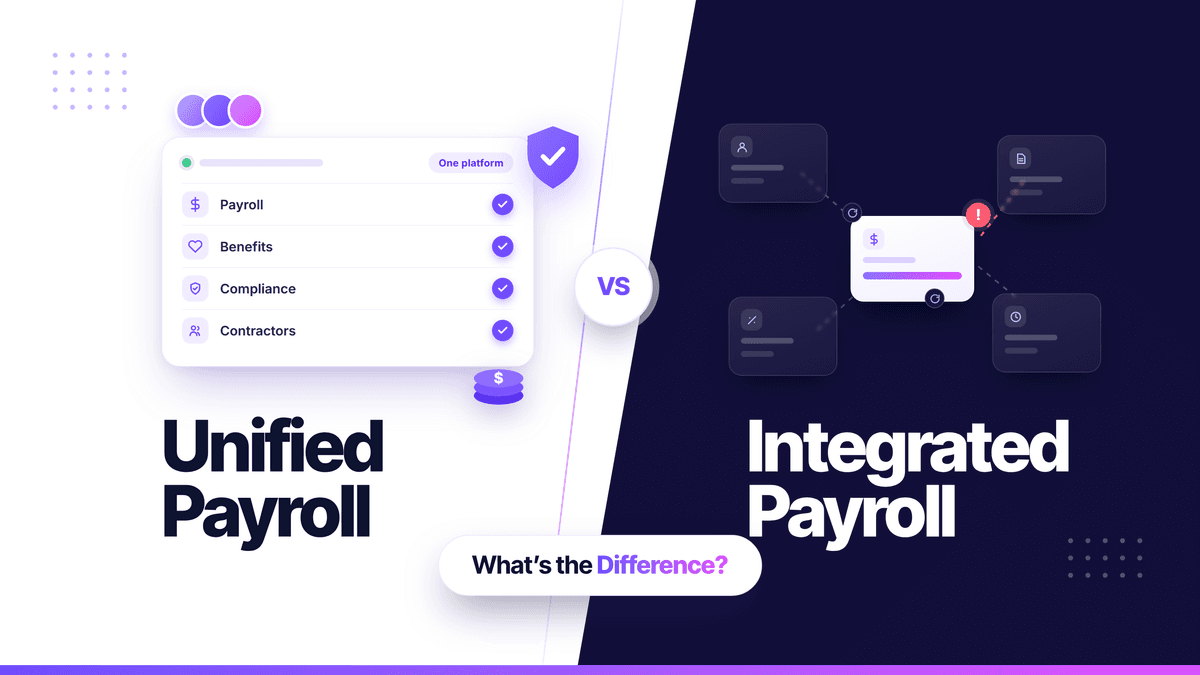
Integrated payroll is several separate systems connected by data syncs. Unified payroll is one system with one data model, where HR, payroll, and finance read and write to the same record.
Integration is a bridge between systems that were each built to stand alone. Every worker, every pay change, and every payment exists in more than one place, and software keeps those copies in agreement, usually well, occasionally late, and never perfectly. Unification removes the copies. There's one record of an employee, one record of a payment, and one ledger, and every team looks at the same object rather than its reflection in another tool.
Unified vs integrated payroll: At a glance
Integrated payroll | Unified payroll | |
Data model | Separate systems, synced copies | One system, one shared record |
Source of truth | Distributed, each tool holds a version | Single, one object everyone reads and writes |
Where errors appear | Between systems, at the handoff | Fewer handoffs, so fewer seams to break |
Reconciliation | Ongoing; you prove the copies match | Reduced; there's less to match |
New state or country | New setup, new sync, new failure point | Extends the same record |
HR and finance view | Two systems, two truths to align | The same numbers, at the same time |
Integrated payroll: what falls between the systems
Integrated setups aren't broken. Most companies assemble their stack one tool at a time, and connectors are what make that stack usable. The problem isn't any single system. It's the space between them.
Think about Dana's new-state hire. In an integrated model, that person is a record in the HRIS, a separate record in the payroll platform, and eventually a line in the GL. Three copies, kept in sync by rules about when and how data moves. When timing lines up, it's invisible. When it doesn't, a sync that runs nightly instead of instantly, a field that maps imperfectly, a change entered after a cutoff, the copies drift, and the drift becomes a wrong paycheck, a missed filing, or a number Victor can't tie out.
The tax is the steady hum of duplicated work.: entering the same person twice, checking that the systems agree, and owning the exceptions when they don't. Capability goes up with every tool. Capacity quietly goes down.
Unified payroll: one record, from hire to paid
Now run the same hire through a unified system. The employee is entered once. Their state, tax setup, classification, and pay all attach to a single record. Payroll doesn't import that person from somewhere else; it reads the record directly, because there's no "elsewhere." When the run completes, the same record carries the outcome into the ledger. HR sees what finance sees, at the same moment, because they're looking at one object instead of two synced copies of it.
There's no seam between the HRIS and payroll because they aren't separate systems exchanging files; they're the same system. That's the distinction that matters. Integration makes separate systems agree. Unification removes the reason they'd ever disagree.
Why unified vs. integrated payroll hits HR and finance hardest
Everyone downstream feels a bad payroll run, but HR and finance are the ones who live at the seam.
For HR leaders, the seam is where onboarding and offboarding break. A start date entered after a sync window means a first paycheck lands wrong. A termination that doesn't reach benefits in time means COBRA notices go out late. Employees don't experience these as integration failures; they experience them as the HR failing them, and Dana is the one they message. Every hour she spends confirming that two systems agree is an hour she isn't spending on the people work she was hired to do.
For finance leaders, the seam is where close gets slow, and reconciliation gets manual. When payroll lives in one system and the ledger in another, Victor's team spends the back half of every month proving the two match, hunting down variances, and re-keying entries that a sync should have carried cleanly. Worker cost visibility suffers because the real-time picture is scattered across tools. And misclassification risk grows in exactly the gaps where a contractor's record in one system never quite reconciles with how they're treated in another.
HR pays in employee trust. Finance pays in lost time.
How to tell whether your payroll is unified or just integrated
Vendors on both sides use the words "unified," "all-in-one," and "single platform." The behavior will tell you a lot. Here's the test Victor eventually ran to figure out what he actually had:
- Enter a change once; does it appear everywhere instantly? Add a new state to an employee. If HR, payroll, and the ledger reflect it in the same moment, that's unification. If it "syncs over" on a schedule, that's integration.
- Ask where the source of truth lives. In a unified system, there's one answer. If the honest answer is "it depends which screen you're on," you have synced copies.
- Look at what breaks at month-end. If closing means proving that two systems agree, you're reconciling an integration. If the numbers are simply already the same, you're closer to unified.
- Count the logins for one payroll cycle. Onboarding, payroll, benefits, contractor payments, AP; one environment, or five that hand off to each other?
- Test a new country or worker type. Does it extend the record you already have, or stand up a new system with a new connector and a new failure point?
Where AI helps, and where it just adds another tab
"AI payroll" is on every vendor page right now. Advisory AI sits beside your systems and answers questions. It's a chat window on top of the same fragmented stack, and it can't fix a seam it can only describe. Executional AI works inside the record; it validates the run before it processes, flags the missing tax setup or the classification that doesn't reconcile, and catches the bonus queued for someone already terminated. AI can only prevent the errors it can see, and in an integrated stack, the most expensive errors happen in the gaps between the systems the AI is bolted onto, exactly where it has no visibility.
This is the practical reason architecture comes before AI. On a unified record, an execution layer can review everything at once, because everything is in one place. On synced copies, it's one more tool inspecting one more version of the truth.
Where Niural fits
Niural is built as a unified system rather than an integrated stack. Payroll, PEO, global payroll, EOR, contractor management, and AP run on one platform with one shared record, so HR and finance work from the same numbers instead of reconciling two versions of them. Because Niural owns its tax and payment infrastructure rather than stitching partner tools together, the handoffs that create most integration errors don't exist to break.
For a team like Dana's and Victor's, that means an employee is entered once and carried through payroll, benefits, and the ledger as a single record. Niural's execution layer, EMMA, validates payroll before it runs, surfacing missing tax data, classification mismatches, and other errors while they're still fixable rather than after a paycheck goes out or a close gets blown. The result HR and finance tend to notice first is a quieter month-end: fewer surprises, less re-keying, and one source of truth across the workforce.
Unification won't erase every operational reality of running payroll across states and countries. But it removes the specific class of problem that comes from keeping a separate copy of everything, which is most of what makes integrated payroll expensive.
The real question is ownership
Dana and Victor didn't need more connectors. They needed to stop maintaining two versions of the truth and reconciling the difference every month. That's the honest frame for this decision: integration makes separate systems agree, and unification removes the reason they'd disagree in the first place.
See how Niural unifies payroll across your entire workforce → Niural Payroll
Frequently asked questions
Is integrated payroll bad?
No, integration is a reasonable way to connect tools that were built separately, and for many companies it works well for some time. The limitation is structural: syncing copies between systems creates seams, and those seams are where timing errors, reconciliation work, and compliance gaps appear as you scale.
What does "single source of truth" actually mean in payroll?
It means one authoritative record for each employee and each payment that every team, HR, payroll, and finance, reads and writes to directly. In a unified system, there's one version. In an integrated system, each tool holds its own copy and software keeps them in agreement.
Does a unified payroll platform remove the need for reconciliation?
It reduces it rather than eliminating it. When payroll and the ledger share one record, there are far fewer copies to prove match at close. You'll still reconcile against banks and outside systems, but the internal system-to-system reconciliation that slows most closes largely goes away.
Why do HR and finance feel this problem more than other teams?
Because they sit on opposite sides of the payroll handoff. HR owns the employee data going in and the employee experience coming out; finance owns the money and the close. Integration errors surface precisely at the boundary between them, so both teams end up owning the cleanup.
Can AI fix an integrated payroll stack?
AI can help, but only where it has visibility. An execution layer can validate a run and catch errors inside the systems it touches; it can't see the gaps between synced systems, which is where the costliest integration errors tend to occur. Architecture determines how much the AI can actually prevent.
Disclaimer: This article is for informational purposes only and does not constitute legal, tax, accounting, or compliance advice. Payroll and worker-classification requirements vary by jurisdiction and change over time. Consult qualified legal, tax, or payroll professionals before making decisions specific to your business.