Elena runs HR at a 90-person company that just closed a Series B. On Monday, her CEO asked her to hire in three new countries by the end of the quarter. By Wednesday, she had a browser full of open tabs and a growing suspicion that every global payroll provider was reading from the same script. They all promised global coverage and easy compliance. None said how.
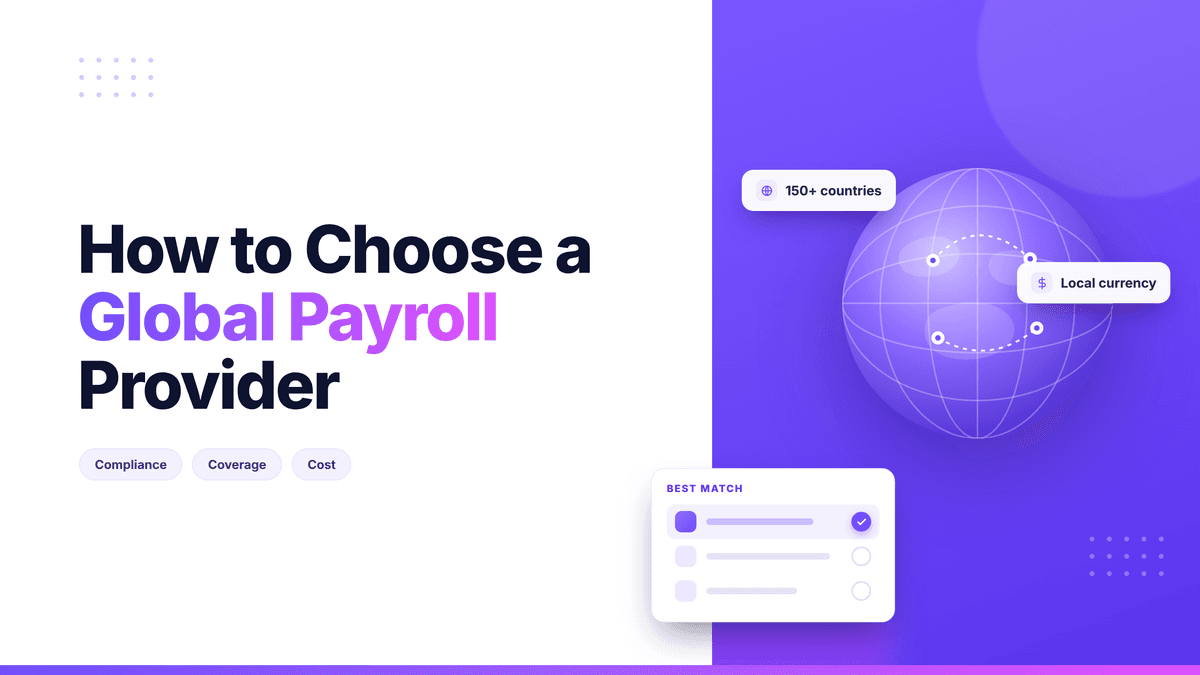
That gap is the whole problem. Choosing a global payroll provider has quietly become one of the higher-stakes infrastructure decisions a growing company makes, and the brand on the invoice tells you far less than the system behind it. Two providers can both promise payroll in the same 150 countries and run completely different operations underneath, with different coverage, different compliance controls, and different real costs.
What do global payroll providers do?
A global payroll provider calculates, pays, and files payroll for your employees and contractors across multiple countries, keeping every pay run compliant with local tax, labor, and reporting rules. The good ones go further. They pull worker data into one place, handle statutory filings, pay people in their local currency, and show you what your workforce actually costs, all in one view instead of one spreadsheet per country.
What Elena figured out fast is that payroll isn't a back-office afterthought anymore. For a distributed team, it sits right where compliance, cash flow, and employee experience meet. That's exactly why she wasn't making this call alone.
The shortlist looks different for finance and HR
Cory is the CFO. He and Elena were staring at the same four providers and wanting almost entirely different things from them.
Elena was thinking about coverage, compliance, and how it would feel to be a new engineer in Portugal getting onboarded. Could the provider actually run payroll where her people lived? Would benefits, classification, and offboarding hold up, or would the cleanup land back on her two-person team?
Cory was thinking about control, cost, and the close. Would payroll data flow into the general ledger without anyone re-keying it? Was every payment auditable? And would the total cost still look reasonable once he added up fees, currency conversion, and the hours his team burned reconciling it all?
Neither of them was wrong. The best-fit provider had to answer both sets of questions from one system, because whenever it couldn't, one of them was going to end up absorbing the difference. That was the bar they set before they looked at a single feature list.
How they run payroll matters more than the name on the invoice
Before you choose a global payroll provider, you have to understand the three ways global payroll actually gets delivered, because that single distinction explains most of the differences in coverage, compliance quality, and cost you'll ever run into.
Owned-entity model | Aggregator (in-country partner) model | Hybrid model | |
How it works | The provider owns and operates its own payroll infrastructure in each country it serves | The provider coordinates a network of independent local partners who run payroll in each country | Owned infrastructure in core, high-volume markets; local partners in the long tail |
Coverage | Deeper but often narrower footprint | Broad, fast-to-expand country coverage | Broad, with owned depth where volume is highest |
Compliance control | Direct, single-owner accountability | Depends on each local partner's quality | Strongest in owned markets, variable in partner markets |
Consistency | Uniform platform and data across countries | Can vary partner to partner | Mixed |
Cost profile | Often lower, no third-party markup | Can carry partner markups | In between |
Best for | Control and consistency in a focused set of markets | Wide reach fast, including one-off hires in niche markets | Most large global operations, in practice |
What tells the good ones apart
With the model sorted, Elena and Cory built a short list of things they'd screen every provider on. These are the factors that decide whether payroll still runs smoothly a year from now.
Do they really cover your countries? A logo on a map isn't the same as a live ability to run payroll there. A provider can serve 100 countries and still stumble in the three that matter to you.
How deep their compliance goes. Global payroll is where classification, tax withholding, and cross-border rules collide. Misclassifying an employee as a contractor can trigger back taxes, penalties, and retroactive benefits. Paying someone in a country where you have no entity can raise permanent establishment questions that hit payroll before finance ever sees the corporate tax issue. Tax authorities increasingly swap data automatically and expect real-time, audit-ready reporting, which means shallow compliance is riskier than it used to be. Elena looked for genuine in-country expertise.
What it really costs. A low per-employee fee can hide costs elsewhere, from currency conversion on every payout to the hours Cory's team would spend reconciling vendors each month. They compared the same team, same countries, same headcount, and looked at total cost before headline price.
Whether it plugs into their stack. Payroll data should flow into the HRIS and, for Cory, straight into the general ledger without a manual rebuild. Automated GL files and clean HRIS sync were where he expected to win back the most time.
How clean the reporting and audit trail are. They wanted consolidated, real-time visibility into workforce cost across countries and a clean record for every payment. Fragmented reporting is what turns month-end close into a manual project.
Who picks up the phone. Payroll is mission-critical. When a filing deadline is looming, a real account team beats a help portal every time.
Ask these before you sign anything
Elena turned the screen into a call script. Vague answers, she decided, were themselves an answer.
- Do you run payroll through your own entity in each of our countries, or through a local partner? Can you show local registration?
- How do you handle worker classification and permanent establishment risk where we're hiring?
- What does total cost look like for our exact team, currency conversion included?
- How does payroll data flow into our HRIS and general ledger?
- What will finance actually get for month-end close and audit?
- Who do we call when something breaks, and how fast do you respond?
- How do you catch errors before a pay run goes out, not after?
The old way of doing this is exactly what's breaking
Somewhere in the process, Elena realized why her current setup was such a mess. It was built the old way: one system per country, stitched together at the end of the month. That stitching is where the reconciliation work and the blind spots live.
A unified platform that pulls employees, contractors, and payments into one source of truth removes the seams where errors hide. And AI, used well, raises the bar again. The useful version runs validation before a pay cycle, catches missing tax data, an expired work authorization, or a bonus queued for someone who already left, so the problem gets fixed before money moves. When Elena talked to providers, she started asking what their automation did at the moment of execution.
Where a platform like Niural comes in
For teams like Elena's, running both U.S. and international workers, Niural consolidates global payroll, EOR, contractor management, and payments into one operating system, built on its own payroll, tax, and payment rails instead of a network of resold middleware. That ownership is what makes single-source reporting, real-time workforce visibility, and consistent compliance possible across markets rather than country by country.
Niural's AI layer, EMMA, validates payroll before each run and flags issues proactively, so people and finance teams spend less time hunting for problems. It's one option worth holding up against the criteria above, especially if you want your U.S. and global workforce, and the payments behind them, on a single system.
How Elena made the call
By the following Monday, Elena was choosing a global payroll provider that fit her three countries, then testing it against real coverage, compliance depth, total cost, integration, and support, and pressure-testing every claim with her call script. Cory signed off because the reporting and the close held up on paper.
If you're weighing how to run U.S. and global payroll on one system, see how Niural approaches global payroll.
See how Niural handles global payroll.
See related articles:
Unified Payroll vs. Integrated Payroll
Top 8 Payroll Problems
Global Payroll 101
Payroll Automation and Compliance
Frequently asked questions
What is a global payroll provider?
A company that calculates, pays, and files payroll for your employees and contractors across multiple countries while keeping every pay run compliant with local tax, labor, and reporting rules. The better ones also consolidate workforce data and reporting into one system.
What's the difference between owned-entity and aggregator payroll?
An owned-entity provider runs payroll through its own legal entities in each country, giving it direct control and consistent data. An aggregator coordinates independent local partners for broader, faster coverage.
Do I need global payroll or an EOR?
Payroll runs pay for entities you already have. An employer of record becomes the legal employer in a country where you don't have an entity, letting you hire compliantly without setting one up. Many companies use both, and the strongest platforms support each within one system.
What are the biggest compliance risks in global payroll?
Worker misclassification, permanent establishment exposure from paying people in countries where you lack an entity, and inaccurate or late statutory filings. Penalties can include back taxes, fines, and retroactive benefits, so classification and filing accuracy deserve real scrutiny.
How do I compare the true cost of global payroll providers?
Compare the same headcount and countries across providers, and include currency conversion and the internal time spent reconciling vendors, not just the per-employee fee. The lowest headline price isn't always the lowest total cost.
This article is for informational purposes only and does not constitute legal, tax, or compliance advice. Consult qualified advisors for guidance specific to your business and the jurisdictions where you operate.