Kyle didn't think he had a turnover problem until he had one. His company was growing. He'd hired carefully, moved fast, and built something people seemed to like working on. Then his second engineer gave notice. A month later, one of his best operations hires followed. The exit conversations were friendly and frustratingly vague: "great opportunity," "right time for a change." Nothing he could point to and fix.
Like most founders, Kyle assumed retention was a culture problem, the kind you solve with better offsites and a nicer Slack channel. The more uncomfortable truth is that the things that actually keep people, strong benefits, dependable HR, a work experience that doesn't generate daily friction, are exactly the things a thirty-person company struggles to build on its own.
That's the gap a PEO is designed to close. A professional employer organization gives smaller companies access to the benefits, HR support, and operational consistency that larger employers use to hold onto their people. Let’s get into how a PEO can improve turnover.
First, what's turnover costing you?
Turnover is the rate at which employees leave your company and have to be replaced. Some of it is healthy and expected. The problem is unplanned turnover: the people you wanted to keep, walking out the door faster than you can backfill them.
The cost rarely shows up cleanly on a P&L, which is part of why it's so easy to underrate. Replacing someone carries the visible expense of recruiting and onboarding, but also the quieter drains: institutional knowledge that walks out with them, momentum lost while the role sits open, the extra load on everyone who covers in the meantime, and the morale hit when a team watches good people leave. For a small company, one or two departures can reset months of progress.
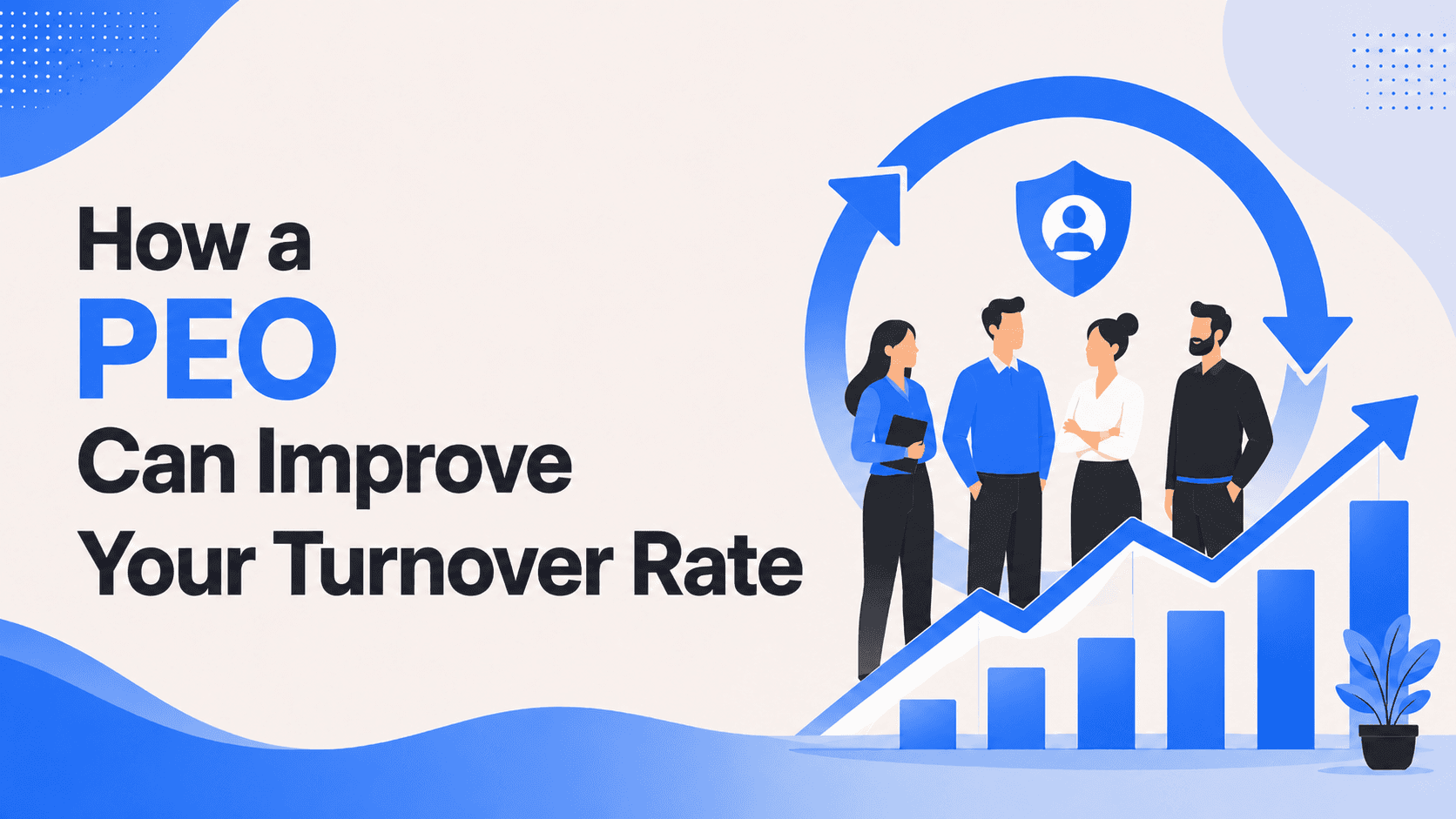
A PEO enters a co-employment arrangement with your business and takes on payroll, benefits administration, HR, and compliance support. And the outcomes track with retention. Today more than 230,000 U.S. businesses use a PEO, and NAPEO's research consistently finds they fare better on the metrics that matter for stability: businesses that use a PEO have turnover about 12 percent lower, grow more than twice as fast, and are 50 percent less likely to go out of business than comparable firms.
Why the retention gap? PEO clients tend to be more attractive employers, because they offer a wider range of benefits and more professional HR management.
You can't out-hire a leaky bucket
Retention starts before anyone signs an offer. If your team is constantly backfilling roles, recruiting stops being a growth activity and becomes a way to tread water. You spend to replace instead of spending to expand.
A PEO strengthens the offer itself. Candidates weigh more than salary; they look at health coverage, retirement options, and whether the company feels like it has its act together. When a small business can put a competitive benefits package on the table and run a clean, professional onboarding process, it stops competing with one hand tied behind its back. Kyle's problem wasn't that he couldn't find good people. It was that the ones he found had better-resourced offers waiting elsewhere, and nothing structural to stay for.
Benefits that punch above your headcount
This is the lever most directly tied to retention. On their own, small companies have little leverage with insurance carriers. A PEO pools the employees of many client companies into a single large group, which unlocks access to health, dental, vision, and retirement plans usually reserved for big employers.
For a thirty-person team, that's the difference between a benefits package that quietly signals "early-stage risk" and one that stands next to a much larger competitor's. It matters for keeping people, not just attracting them. When Kyle's engineer left, one of the few concrete things he mentioned was the health plan at his new employer. That's a retention problem disguised as a benefits problem, and it's the kind a PEO is built to solve.
Give people a reason to grow in place
People rarely leave a job they're still growing in. They leave when they stop learning and can't see a path forward. Small companies feel this acutely, because they seldom have the budget or infrastructure for formal training and development.
Many PEOs help close that gap with learning platforms, training libraries, manager resources, and performance-review frameworks that a small team wouldn't build on its own. That gives employees a way to develop without changing employers, and gives managers structure for career conversations instead of leaving them to chance.
Why your best people quietly check out
Disengagement almost always comes before a resignation, and it's quiet. It looks like your strongest contributor is volunteering less, going silent in meetings, doing the job but not much more. By the time it surfaces in an exit interview, the decision was made months earlier.
A surprising amount of disengagement traces back to operational friction. Pay that's late or wrong. A benefits question no one can answer. A PTO request that disappears into a void. Each one is small; together they tell an employee the company doesn't have its act together. A PEO removes that friction with accurate, on-time pay, self-service tools, and real answers to employee questions, so the day-to-day experience stops working against you.
Culture doesn't scale by accident
In the early days, culture runs on proximity. Everyone's close to the decisions, and norms spread on their own. That breaks as you grow, especially across multiple states or a distributed team, and the cracks show up as inconsistency: different onboarding experiences, uneven policies, benefits that vary depending on where someone sits.
Consistency is the operational backbone of culture. As to how a PEO can improve turnover, it standardizes the pieces that should feel the same for everyone: how people are onboarded, how policies are applied, how the pay and benefits experience works across locations. That doesn't manufacture culture, but it keeps a fragmented back office from quietly eroding the one you're trying to build.
The HR support employees actually feel
Most early and growth-stage companies have no dedicated HR function. The work still exists, so it lands on a founder, an office manager, or whoever has capacity, none of whom can give an employee a confident answer about benefits, leave, or a sensitive workplace issue.
Employees feel that absence. A PEO gives them access to HR professionals and compliance expertise, so questions get answered, and difficult situations get handled properly. Kyle stopped being the accidental head of HR, and his team stopped feeling like their questions vanished. People stay longer where they feel genuinely supported, and support is hard to fake without the people and processes behind it.
Turning retention into a system, not a wish
Here's the bottom line: retention isn't one initiative you launch. It's the sum of everything above working together. A stronger offer brings in people more likely to stay. Real benefits give them a reason to. Development keeps them growing. A frictionless experience keeps them engaged. Consistency protects the culture. Support makes them feel looked after. A PEO turns that from a set of good intentions into infrastructure.
Where a modern PEO changes the math
Not all PEOs are equal. Many deliver strong benefits on top of slow, manual back-end systems, and those delays and errors create exactly the friction that pushes employees out. A late payroll run or a benefits mistake undoes a lot of goodwill.
A modern, AI-native PEO closes that gap. Accurate, real-time payroll, a single source of truth across HR, payroll, and benefits, and automation that catches errors before an employee ever notices them turn the operational layer into something that supports retention instead of undermining it. Platforms like Niural consolidate U.S. PEO, benefits, HR, and compliance into one system, with an executional AI layer, EMMA, that validates payroll and helps prevent the errors that quietly erode trust. For a founder like Kyle, that means the back office finally reinforces the culture he's building rather than working against it.
The takeaway
Kyle's turnover wasn't a verdict on his culture. It was a byproduct of gaps a company his size almost always has, benefits that couldn't compete, no HR to lean on, a back office generating quiet friction. Those gaps are closable, and a PEO is one of the most direct ways to close them.
If turnover is pulling your team's attention away from building, it's worth how a PEO can improve turnover. Explore how Niural's PEO brings benefits, HR, and payroll into one system built to keep your people, and your company, moving forward.
See how Niural's AI-native PEO works.
Other Related articles:
Top 8 PEO Myths
PEO vs ASO
PEO vs EOR
Complete Guide to PEO Renewal
The Case for a Modern PEO
Frequently asked questions
Does a PEO actually reduce employee turnover? Yes, according to NAPEO, businesses that use a PEO have employee turnover rates about 12 percent lower than comparable companies that don't.
How does a PEO improve employee retention? By giving smaller companies the tools larger employers use to keep people: competitive benefits, HR support, training resources, consistent policies, and a reliable pay and benefits experience.
What size company benefits most from a PEO for retention? Small and mid-sized companies, especially those without a dedicated HR team. Most PEO clients fall in this range, and they gain the most from access to enterprise-grade benefits and professional HR they couldn't build alone.
Will employees notice that we use a PEO? Usually in good ways: better benefits, self-service tools, and faster answers to their questions. Under co-employment, the PEO handles payroll, benefits, and HR administration while you retain full control of your business and your people.
Is using a PEO the same as outsourcing HR? Not quite. Outsourcing HR hands specific tasks to a vendor. A PEO enters a co-employment relationship, sharing certain employer responsibilities and giving you access to benefits and HR infrastructure through its larger scale.
Disclaimer: This article is for informational purposes only and does not constitute legal, tax, HR, or benefits advice. PEO arrangements, benefits offerings, and compliance requirements vary by provider and jurisdiction. Consult qualified advisors before making employment or benefits decisions. Statistics cited reflect NAPEO's most recently published figures as of the date of writing.
-768x432.webp&w=3840&q=75)