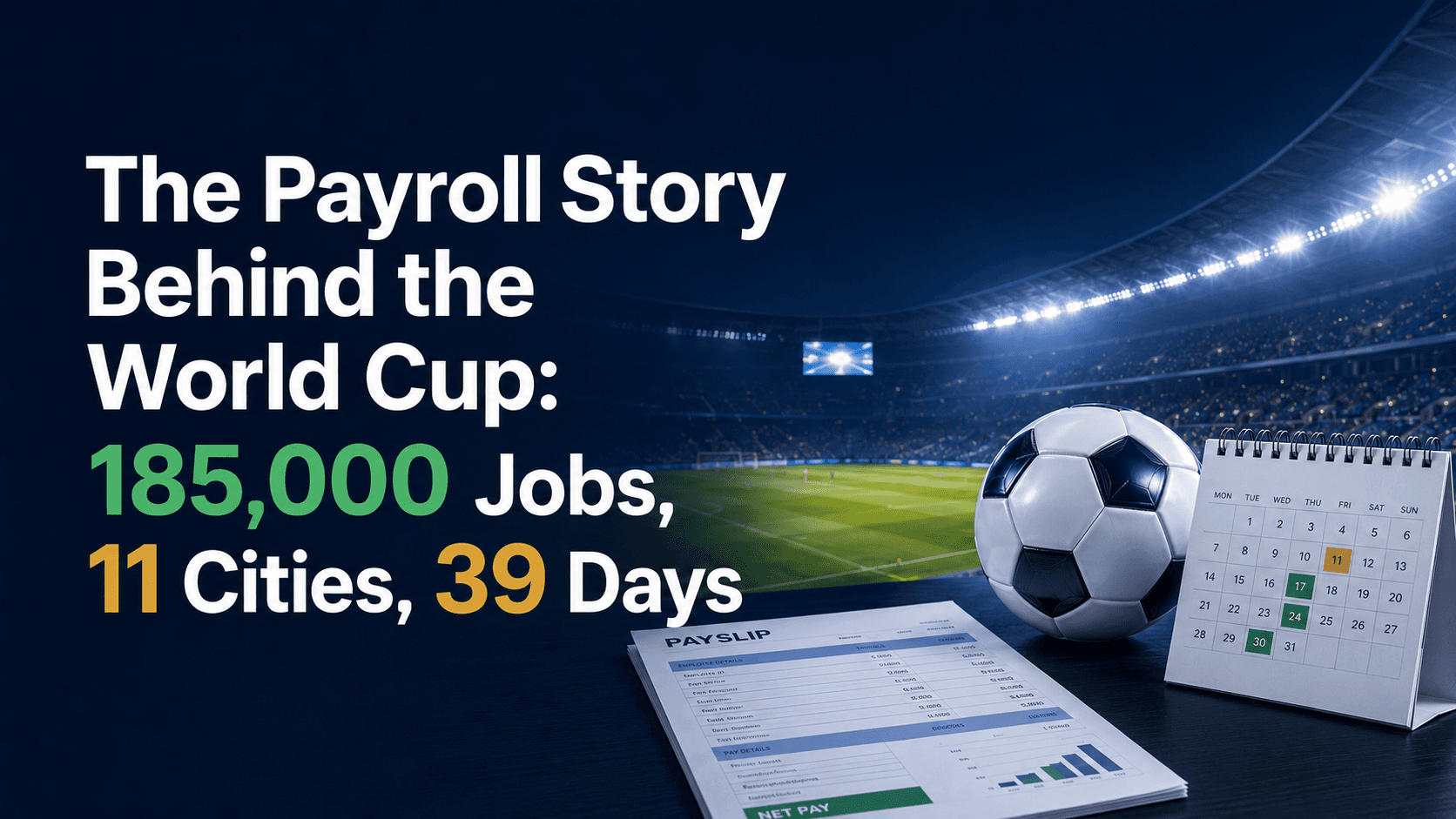
For 39 days this summer, the United States, with Canada and Mexico, is running one of the largest events in its recent history, the FIFA World Cup 2026. Somewhere behind every filled stadium, fan zone, and sold-out hotel is a quieter operation: tens of thousands of people onboarded fast, paid across a dozen tax jurisdictions, and classified correctly under deadline pressure. That operation is the part nobody puts on a highlight reel. It's also the part that decides whether all of this ends in a clean set of books or a stack of penalty notices.
First, the number everyone keeps quoting
The headline figure is 185,000. A joint study from FIFA and the World Trade Organization estimates the 2026 tournament could support roughly 185,000 full-time-equivalent jobs in the U.S., alongside about $30.5 billion in gross output and $17.2 billion in added GDP. Globally, the same analysis points to around 824,000 full-time-equivalent jobs.
It's a big number, and it's being repeated everywhere. But it's worth reading closely, because "full-time-equivalent" is doing a lot of work in that sentence. An FTE isn't a permanent job. It's a unit of measurement that bundles a lot of short, intense, seasonal work into a tidy figure.
But here's the honest version. Goldman Sachs models most of the employment bump as a wave that rises through June and July and then recedes. The 11 U.S. host metros account for roughly a third of U.S. GDP and nearly a quarter of total employment, so the surge is real and concentrated. But it's a surge, not a permanent step up. And with bookings running softer than early forecasts in most host cities, even the surge may land lighter than the projections suggest.
The takeaway isn't that the number is wrong. It's that "185,000 jobs" describes a temporary economy, not a hiring boom you can settle into. And temporary economies are exactly where payroll gets hard.
Hiring fast was never the hard part
Any operator who has scaled a team knows the secret the tournament makes visible: finding people to hire is rarely the bottleneck. Paying them correctly is.
Hospitality hiring across the host metros jumped 30.3% in May compared with the earlier part of the year, with Philadelphia up 83%, Boston up 61%, and Atlanta up 55%. Postings appeared. People applied. That part worked.
What doesn't show up in the hiring stats is everything that has to happen after the offer. Each of those workers needs to be classified as an employee or a contractor. Each one triggers tax obligations that vary by city and state. Each non-exempt worker who crosses 40 hours in a week is owed overtime, and pre-shift briefings and post-shift breakdown can count as paid time. Multiply that across beverage sponsor staffing fan zones in Dallas, Miami, and New York at once, and the simple act of "paying everyone" turns into a coordination problem across labor markets that price the same role very differently. As staffing operators have pointed out, a role that fills easily at moderate wages in Kansas City requires meaningfully higher pay to fill in San Francisco.
The World Cup compresses all of this into 39 days. A growth-stage company faces the same shape of problem, just stretched over a few years of hiring in new states, adding contractors, and expanding abroad.
Now picture that problem landing on your desk
For a founder, this is the part that gets personal.
You didn't start the company to become the back office, but somewhere between the seed round and Series B, you became the fail-safe. A new hire in California adjusts the tax picture. A contractor in another state edges toward looking a lot like an employee. Someone's overtime doesn't calculate the way it should. And if you don't catch it, no one does. It's the quiet 11 p.m. worry that you underpaid someone in one state or misclassified someone in another, and won't find out until it's expensive.
The World Cup is that worry at industrial scale. Thousands of fast hires, many jurisdictions, real deadlines, and a Department of Labor actively running compliance outreach in host cities. When the pace is high enough, the systems that felt "good enough" at a smaller size stop holding.
For a finance leader, the same event reads differently but lands just as hard. The question that keeps a controller up is structural. What is our all-in workforce cost this month, across every worker and jurisdiction, right now? During a surge, that question gets harder to answer, not easier. Contractor payments sit in one system, payroll in another, and the reconciliation that produces a clean number becomes a manual project. Misclassification isn't just a compliance abstraction here; it's a line-item risk with real dollars attached if the classification was wrong.
Two roles, one root problem: hiring fast is easy, and seeing and paying that workforce correctly is where companies get exposed.
The mistake that surfaces when you hire in a hurry
Of all the errors a rapid hiring push produces, misclassification is the most common and the most expensive.
The core trap is simple to fall into and hard to undo. Calling someone an independent contractor doesn't make them one. Federal agencies look at the substance of the relationship: who sets the schedule, who provides the training, who supervises the work. Under pressure, it's tempting to paper a fast hire as a 1099 because it's faster. That decision can quietly convert into back taxes, back wages, and penalties later.
Two more traps show up in surge hiring specifically:
- "The staffing agency handles it" is not a shield. Using an agency doesn't automatically transfer liability. A business that exercises operational control over agency workers can still qualify as a joint employer, sharing responsibility for wage violations. Outsourcing the hiring doesn't outsource the exposure.
- Overtime rules don't pause for busy season. Non-exempt employees must receive time-and-a-half beyond 40 hours in a week, and time spent in mandatory briefings or closing duties can be compensable. Peak periods are precisely when those hours pile up.
The rules here are also in motion. In May 2025, the Department of Labor's Wage and Hour Division issued guidance (FAB 2025-1) directing investigators to return to the 2008 economic-reality test, and in June 2025, further guidance (FAB 2025-3) stated it would no longer seek liquidated damages in pre-litigation settlements. That sounds like relief, but it's narrow: private lawsuits and state agencies are unaffected, and states like California still apply their own stricter tests. The risk didn't disappear. It moved.
How you catch the error before payroll runs
Most payroll systems are built to tell you what went wrong after the run. You process, the money moves, and then a variance report or a penalty notice reveals the mistake. At normal speed, that's survivable. During a surge, catching errors after the fact means reversals, corrections, and the exact 11 p.m. cleanup founders dread.
The better model is to validate before the run, not after it. That's the specific job of EMMA, Niural's executional AI layer. Rather than flagging problems for a human to chase down later, EMMA validates payroll data in real time and works to prevent errors before processing. On the classification question, that means monitoring contractor-versus-employee status and watching as contingent workers approach full-time thresholds, so a misclassification gets caught at the point of entry instead of surfacing in an audit.
The reason this works comes down to architecture. EMMA operates on a single, authoritative dataset, the same record that powers onboarding, payroll logic, and reporting. When classification, hours, and tax data all live in one source of truth, validation can be precise instead of guesswork stitched across systems. For a founder, that's one fewer thing you personally have to be fail-safe for. For finance, it's fewer reversals and a cleaner close.
One system instead of five
Zoom out, and the World Cup exposes a structural point that outlasts the tournament. Companies rarely struggle because they lack another dashboard. They struggle because payroll, hiring, and payments sit on different rails with different sources of truth, and every new state or country adds another vendor and another way to break compliance.
This is where a platform like Niural fits: not as another point tool, but as the operating layer underneath the workforce. Niural runs U.S. payroll on its own tax and payment rails, and consolidates PEO/ASO, contractor management, and payments into one system, so onboarding, classification, payroll, and reporting draw from the same record. The practical effect for a scaling team is the ability to answer "what's our total workforce cost this month?" without reconciling five exports, and to hire into a new state without treating it as a research project. It's the difference between managing a surge and being managed by one.
What a 39-day economy teaches a company built to last
The World Cup will pack up in July. The lesson it leaves behind is durable: the hard part of growth was never the hiring. It's paying people correctly, seeing your true workforce cost in real time, and getting classification right while moving fast. A tournament makes that visible in 39 days. For most companies, it plays out over years of new hires, new states, and new countries, one fast decision at a time.
You don't get to slow the hiring down. What you can change is whether errors get caught before the money moves or after. Building on infrastructure that validates in real time and keeps one source of truth across your workforce is how fast-growing teams scale without turning the founder, or the finance team, into the fail-safe.
If your team is hiring quickly and paying across multiple states, it's worth seeing how Niural runs U.S. payroll on owned rails with validation built in.
Explore Niural's U.S. payroll platform.
Other related articles:
Employee Misclassification
Exempt vs. Non-Exempt Employees
Independent Contractor vs. Part-Time Employee
Frequently asked questions
How do you pay temporary workers across states? Paying temporary workers across states means handling each state's rules, not just one. You first classify each worker correctly as a W-2 employee or a 1099 contractor. For employees, you generally register for payroll tax in each state where work is performed, withhold and remit the right state and local taxes, apply that state's minimum wage and overtime rules, and track hours accurately, since a non-exempt employee is owed time-and-a-half beyond 40 hours in a week. The complexity compounds with every additional state, which is why growing teams move to a single payroll system that manages multi-state registration, tax calculation, and reporting from one record instead of stitching together separate tools per jurisdiction.
Are the World Cup's 185,000 jobs permanent? Mostly, no. The 185,000 figure from the FIFA–WTO study counts full-time-equivalent jobs, which bundle short-term and seasonal work rather than describing permanent headcount.
Do staffing agencies remove my compliance risk? Not entirely. Using a staffing agency can shift administrative work, but it doesn't automatically transfer legal liability. A business that exercises meaningful operational control over agency workers, such as setting their schedules or directing their work, can still be treated as a joint employer and share responsibility for wage-and-hour or classification violations. Contracts help clarify roles, but they don't erase the underlying exposure.
Disclaimer: This article is for general informational purposes only and does not constitute legal, tax, payroll, or compliance advice. Regulations referenced here can change and vary by jurisdiction. Consult qualified counsel or a licensed professional before making classification, payroll, or compliance decisions.
-768x432.webp&w=3840&q=75)