Key takeaways
- Judge the payroll by its architecture, its tax and compliance coverage, how it handles the cash in the gap between funding and payday, and whether it still works when you've got your first international employee.
- Late federal payroll tax deposits cost 2% to 15% of the amount unpaid (depending on how late they are).
A lot of founders will go and pick Payroll the week before their first hire, and a lot of CFOs will inherit that choice. By the time you're doing payroll in six states and you've got your first engineer in Portugal, you're looking at the prospect of migrating tax history, rebuilding your entire approval chain, and retraining the whole team.
Pick a payroll provider you won't have to leave. In 2027, you'll have AI that will validate your payroll before it runs, cash that can earn whilst it's sitting on your balance waiting for payday, and global coverage that you can turn on without having to add another vendor.
What should a payroll company be doing?
Payroll service providers will work out your gross-to-net pay, will withhold and remit your federal, state, and local taxes, will file your quarterly and annual returns, issue your W-2s and 1099s, and pay you on time. The full-service providers will also deal with state registrations and agency notices.
For a growing company, payroll needs to do more than just pay employees. At a minimum, look for a platform that can handle:
- Multi-state tax registration, withholding, and filings as your team grows.
- Contractor payments and 1099 reporting in the same place as employee payroll.
- Checks that catch payroll errors before they affect paychecks.
- Clear visibility into when payroll funds are withdrawn and when payments reach employees.
- Support for paying international employees and contractors without having to switch to another platform.
Why does this decision matter so much in 2027?
Payroll errors get to people very quickly. The PayrollOrg 2026 "Getting Paid In America" survey found that just under 72% of respondents would struggle to meet their financial commitments if their paycheque was one week late, and 40% have no emergency fund whatsoever.
Tax errors compound just as quickly. The IRS will impose a Failure to Deposit penalty on employment taxes that are paid late (paid in the wrong amount, paid in the wrong way, etc.). The rate is 2% to 15% of the amount unpaid depending on how many days late the deposit is, and interest is charged on top of that.
Teams also have fewer people to catch those mistakes. In Gartner's Feb 2026 survey of over 300 CFOs and finance leaders, just under 60% planned to increase their finance AI investment by 10% or more, with hiring plans in decline.
"The real story is in the headcount growth expectations collapse, from 6% in 2025 down to 2% in 2026." Nauman Abbasi, Gartner
With fewer people on the books, the payroll software is going to have to pick up the errors that would have been caught by an additional analyst.
How we evaluated the best payroll companies
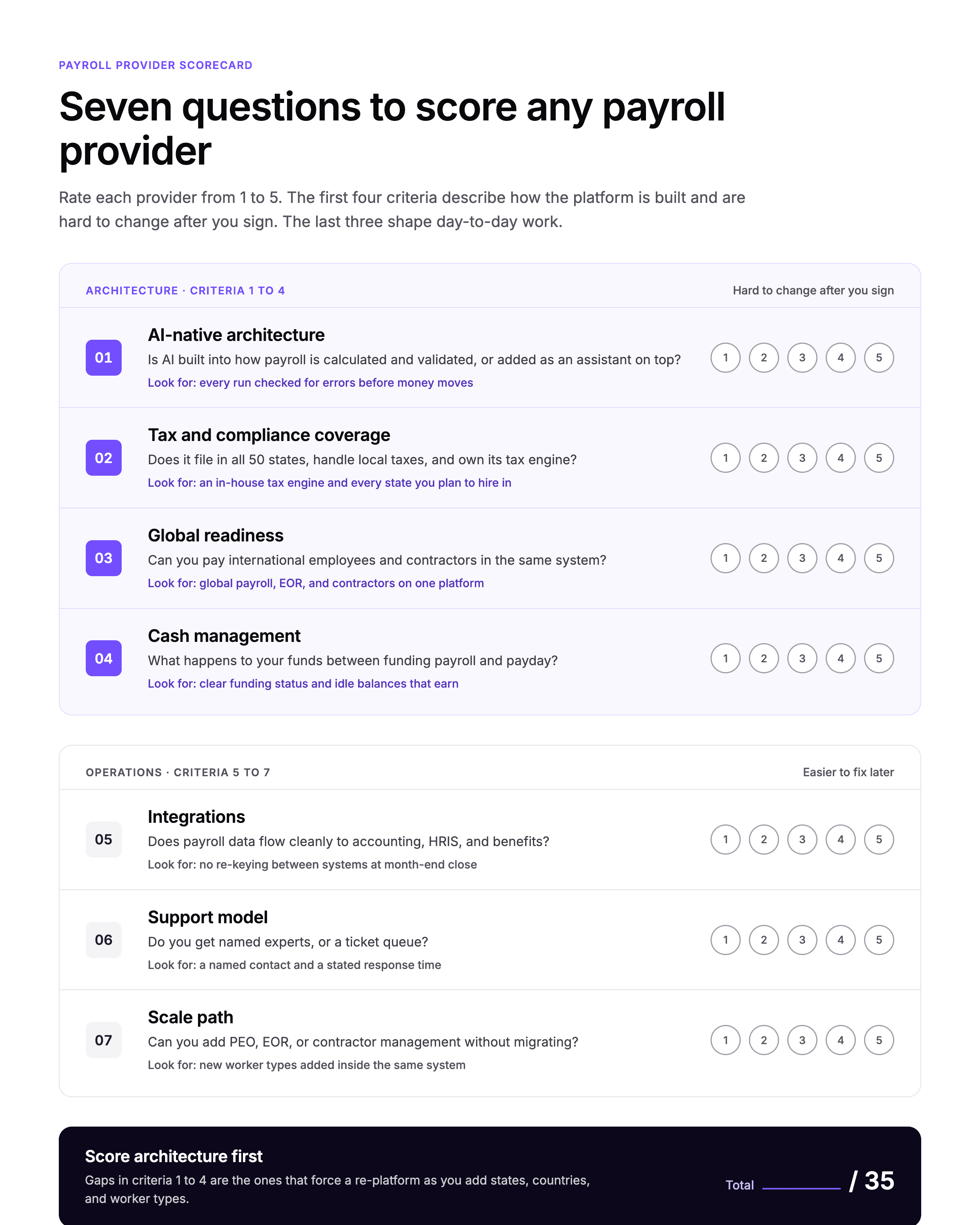
We scored each provider on seven criteria. A payroll provider that meets the first four criteria is less likely to require you to switch providers later.
- AI native architecture. Is the AI built into the architecture of how the payroll is calculated and validated, or is it just an AI as an assistant on top?
- Tax and compliance coverage. Does the provider file in all 50 states, handle the local tax aspects, and own the tax engine?
- Global readiness. Can you pay your international staff and contractors via the same system?
- Cash management. What happens to your money in between the funding and the payday?
- Integrations. Is your payroll data flowing seamlessly into your accounting system, your HRIS, and your benefits platform?
- Support model. Do you have named experts or a ticket queue?
- Scale path. Can you move from Payroll to PEO, EOR, or contractor management without a migration?
The 8 top payroll companies for 2027
Provider | Best for | AI in payroll | Global payroll |
Niural AI | Growing companies building AI-native infrastructure from day one | Built into payroll validation (EMMA) | Global payroll and EOR in 150+ countries |
Gusto | Small U.S. businesses with simple payroll | Anomaly flagging and AI assistant (Gus) | Limited; mainly U.S. |
Rippling | Companies wanting HR, IT, and payroll in one suite | Unity AI across the platform | About 185 countries |
ADP | Established mid-market and enterprise companies | AI agents and assistants | Yes, through separate global products |
Paychex | Owners who want a dedicated payroll specialist | AI tools in Paychex Flex | Limited |
Justworks | Small teams that want payroll bundled with PEO benefits | Limited | Limited |
Deel | International-first teams | Built-in error and anomaly flags | 130+ countries |
Remote | Companies hiring abroad through an EOR | Compliance-focused AI | Owned-entity EOR model |
1. Niural AI
Best for: Growing companies that want AI-native payroll from the first hire through global scale
What it does well
- Runs U.S. payroll on Niural's proprietary tax engine, with PEO and ASO options in the same platform
- Funds payroll, contractor payments, EOR, and vendor bills from one wallet, with every transaction in one ledger
- Pays cash rewards on eligible payroll float until payouts execute, so payroll float earns instead of sitting idle
- Reports 90% fewer payroll errors and more than 10 hours saved per pay period
AI in payroll
- AI is built into the payroll process itself rather than added as a help assistant
- EMMA, Niural's AI layer, validates payroll before the run, flags missing rate changes, and flags potential misclassification risk
- A company that starts at ten employees retains the same checks, records, and approval rules at 200
Global coverage
- Global payroll, EOR in 150+ countries, and contractor management in the same system as U.S. payroll
- The first international hire becomes another worker type, with no second vendor or migration
Things to check
- Map your states and countries against Niural's coverage during the demo
2. Gusto
Best for: Small U.S. businesses that want simple, self-serve payroll
What it does well
- Full-service U.S. payroll with automatic tax filing in all 50 states
- Detects failed direct deposits and reroutes pay when an employee changes bank accounts
- Acquired Mosey in April 2026 to extend state registrations, filings, and renewals
AI in payroll
- Assisted payroll prep compares each run against historical data and flags missing entries or unusual amounts prior to submission
- Gus, its AI assistant, answers payroll and HR questions in plain language
- Some customers can view and run payroll from inside ChatGPT, Claude, and Slack
Global coverage
- Built mainly for U.S. employers; international employees usually require another provider
Considerations
- Companies planning to hire internationally may need another platform to cover their global payroll needs.
- Some of the more advanced features are only available on higher-priced plans.
3. Rippling
Best for: Companies that want to manage HR, IT, and payroll from one platform.
What it does well
- Brings payroll, HR, device management, app access, and company spending together in one place, linked to each employee.
- Offers its own employer of record (EOR) service to help companies hire in countries where they don't have a local entity.
- Has strong U.S. capabilities across payroll, benefits, time tracking, and recruiting.
AI in payroll
- Unity AI, launched in 2026, helps handle routine tasks, answer employee questions about company policies, and flag potential compliance issues.
Global coverage
- Supports global payroll in around 185 countries, making it easier to manage an international workforce from one platform.
Considerations
- Costs can add up as you add more products and features.
- Its global payroll and EOR services are newer than its core U.S. offerings, so check how well it supports the specific countries where you plan to hire.
4. ADP
Best for: Established mid-market and enterprise companies with complex payroll
What it does well
- RUN serves small businesses, and Workforce Now serves mid-sized organizations
- Decades of compliance experience and a large service organization
- Data platform spanning 1.1 million clients in 140 countries and territories
AI in payroll
- ADP Assist agents (launched Jan 2026) will flag payroll variances, suggest fixes for review, and identify any missing state and local tax IDs.
Global coverage
- International payroll is available through separate global products
Considerations
- The setup process, contracts, and extra features can be a lot for a small team to manage.
- Plans vary by business size, so switching products as your company grows may require moving your data.
5. Paychex
Best for: Business owners who want a dedicated payroll specialist to help them manage payroll.
What it does well
- Combines payroll software with dedicated payroll specialists who can guide customers through the process
- Serves around 800,000 customers in the U.S. and Europe through Paychex Flex, Paycor, and SurePayroll
- Offers HR advice and support for businesses without an in-house HR team
AI in payroll
- Uses agentic AI to process payroll requests submitted by voice or email
- Offers a generative AI tool that helps businesses research employment laws and keep up with regulatory changes
Global coverage
- Focused on U.S. payroll, with limited international employee coverage
Considerations
- Businesses that don't need much hands-on support may find they’re paying for more service than they need.
- Not the best fit for companies that need multi-country payroll or want payroll and financial tools in one platform.
6. Justworks
Best for: Small businesses that want payroll and employee benefits bundled together through a PEO.
What it does well
- Offers a standalone payroll plan or a full PEO service, where Justworks shares certain employer responsibilities with the business
- Its PEO Plus plan includes medical, dental, and vision benefits, HSA and FSA management, and COBRA administration
- Keeps pricing and plan options straightforward for small U.S. teams
AI in payroll
- AI is not a central part of its payroll offering today
Global coverage
- Offers EOR, with fewer countries than global-first providers
Considerations
- Costs can add up as your team grows, especially with PEO services.
- May not be the best fit for businesses looking to expand into multiple countries.
7. Deel
Best for: Businesses that hire across multiple countries.
What it does well
- Supports global payroll in 130+ countries and EOR services in 150+ countries, with many services handled through its own local entities.
- Handles U.S. payroll in all 50 states and offers self-service payroll in the U.S. and Canada.
- Brings Deel-managed and third-party payroll into one dashboard through Payroll Connect, so businesses can see payroll across different providers in one place.
AI in payroll
- Built-in AI flags errors, anomalies, duplicate payments, and compliance risks as data is entered and during review
Global coverage
- One of the broadest global footprints in this list
Considerations
- Companies with mostly U.S.-based employees should check whether its domestic payroll and benefits features meet their needs.
- Costs can add up when you use multiple services, such as EOR, global payroll, and contractor management.
8. Remote
Best for: Companies that want to hire employees in other countries without setting up local entities.
What it does well
- EOR through legal entities Remote owns in every country where it offers the service
- Contractor management across 200+ jurisdictions, with a tier that adds misclassification indemnity
- Global payroll for companies with their own foreign entities in 100+ countries
AI in payroll
- Remote MCP connects AI assistants to payroll, contract, and compliance data, making it easier to access that information through AI tools.
- Built-in variance checks help spot unusual payroll changes before a payroll run is approved.
Global coverage
- Designed primarily for companies hiring and managing employees across multiple countries.
Considerations
- Companies with mostly U.S.-based employees may need a separate provider for domestic payroll.
- Treasury and cash management aren't a major focus of the platform.
Which payroll provider is right for you at your stage?
Your situation | What to prioritize | Strong fits |
First 1 to 10 hires, all U.S. | Accurate tax filing, low admin, a platform you won't outgrow | Niural, Gusto |
Multi-state team, 10 to 250 people | Pre-run validation, state compliance, benefits | Niural, Rippling, Justworks |
First international hire | EOR or global payroll in the same system | Niural, Deel, Remote |
Multi-entity, 250+ people | Controls, auditability, service depth | Niural, ADP, Rippling |
What should you be asking yourself before you sign?
Use these questions in every demo:
- Does your system go through every payroll run and flag any errors before the money is actually paid out? Show me what it's picking up.
- Do you have your own tax engine, or do you use a third party to do the calculations?
- Which state and localities are you filing in today?
- What happens to our money in the period between the time we fund the payroll and the time the employees get paid?
- Can we pay our contractors and our international staff through the same system?
- How do you deal with a missed tax deposit or an agency notice?
- Who's our support contact and what's the response time?
- What does it mean to migrate to you or away from you?
The bottom line
The cheapest payroll company in the world can quite easily become the most expensive one if you start to have your team working across state lines (or indeed across the world). You need to start with infrastructure that validates every run, that keeps your payroll float earning, and which can then grow into a global payroll solution without you having to go out and get a second vendor. If that's the sort of thing you're after, then take a look at how Niural Payroll works.
Other related articles:
Payroll taxes: a guide for employers
1099 vs. W-2 classification rules
Payroll reconciliation
Multi-state payroll
Frequently asked questions
How do I choose the right payroll provider?
Match the provider to where your company will be in 2-3 years. Validation, multi-state filing, global coverage, cash management, and support are all things you need to compare before you even consider price.
What are the best payroll companies for startups?
Niural, Gusto, and Rippling are all up there. Niural is the one for the startup that's going to scale or the one that's going to be hiring internationally. Gusto is the one for the simple U.S. team. Rippling is the one for the team that wants HR and IT in one.
What does 'AI-native' payroll mean?
AI native payroll is the AI being built into the calculation and validation so it's actually checking every run prior to it executing. A number of the providers will have an AI assistant sitting alongside the payroll process to answer queries.
What is payroll float?
Payroll float is the money that's been funded for payroll but hasn't yet been paid out. With most providers, that money just sits there. Niural Wallet pays out cash rewards on eligible pre-funded balances until the actual payouts are made.
What's the penalty for late deposit of payroll tax?
The IRS failure to deposit penalty is 2% of the amount of the unpaid deposit if it's 1 to 5 days late, and 15% if it remains unpaid more than 10 days after the first notice. Interest also accrues on top of that.
Can one provider do both US and international payroll?
Yes, Niural, Rippling, and Deel all provide U.S. and international payroll (with different levels of coverage and different models). You'll need to check which country coverage is appropriate for your own hiring scenario.
What's the difference between a payroll provider and a PEO?
A payroll provider will run your payroll and tax filings as the employer. A PEO becomes a co-employer, and you then gain access to group benefits and shared compliance. Some platforms (Niural and Justworks, for example) offer both.
When should a startup switch payroll providers?
Common triggers are a new state or a new country, a string of payroll errors, moving to a PEO, or simply poor financial visibility. Switching at the start of a quarter makes tax reporting a lot easier.
Do payroll providers deal with contractor payments?
The majority of the work is with US-based contractors who will then issue the 1099s. With international contractors, the payment arrangements vary from provider to provider, so you'll need to check with each of them individually as to the currency, the speed of payout, and the classification of the employee.
How long does it take to get payroll set up?
That will vary from a few days to a few weeks depending on how many states you're registering in, whether you're migrating your payroll history, and how clean your employee data is.
Disclaimer: This article is for informational purposes only and does not constitute legal, tax, payroll, or financial advice. Provider features, coverage, and terms change frequently; verify current details with each provider and consult qualified advisors before making decisions.
Niural is a fintech company, not a bank. Banking services are provided by i3 Bank (Member FDIC). Cash rewards are subject to eligibility and terms.