It's the Tuesday before quarter-end, and Warren has three tabs open that all describe the same payroll run. Two of them agree. The third is off by a few hundred dollars. Warren already knows that "a few hundred dollars" is rarely the real problem. Somewhere behind that variance is a deduction that didn't post, a terminated employee still drawing a benefit, or a tax liability that will read one way on the 941 and another way on a W-2 nine months from now.
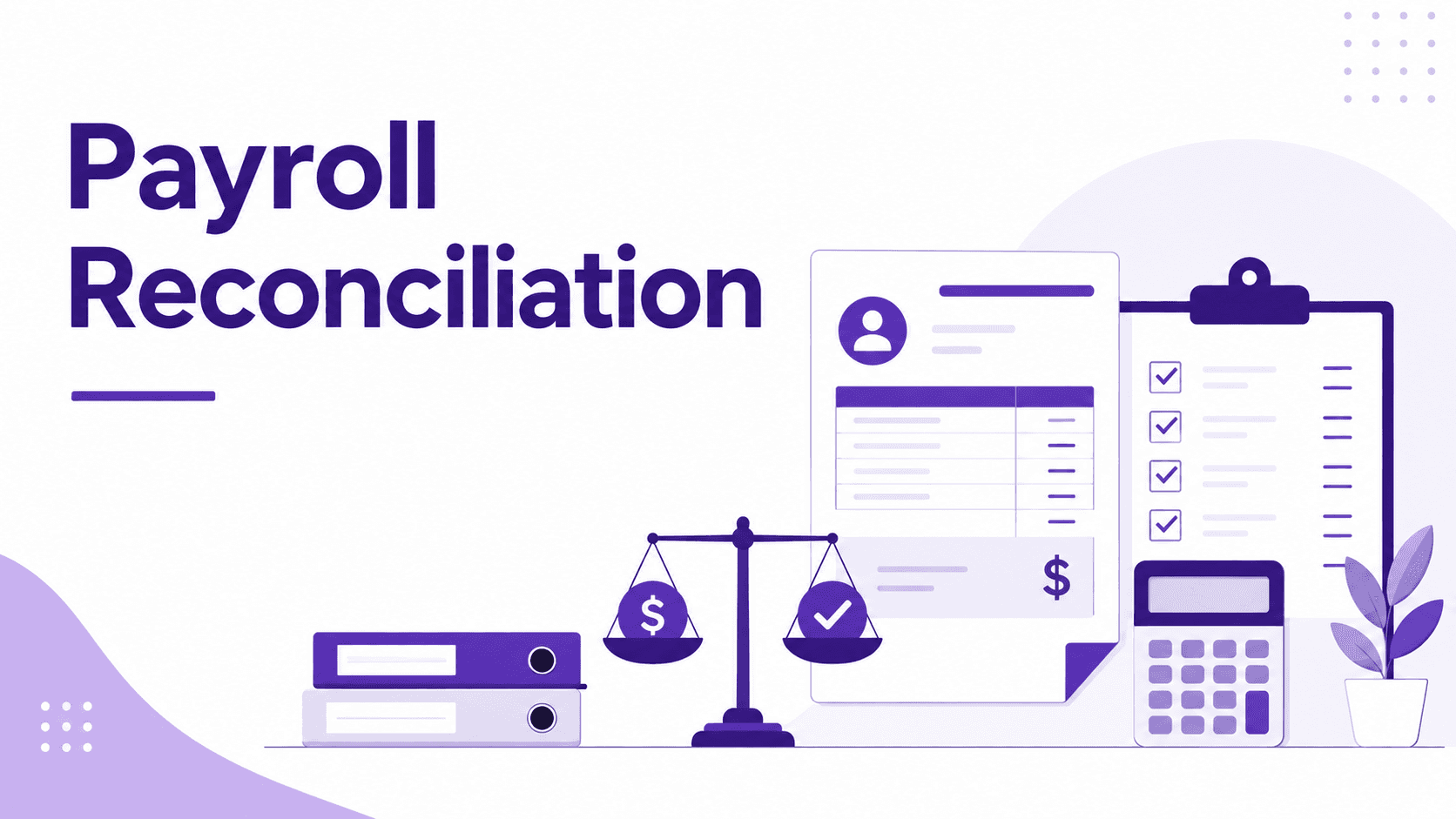
Payroll reconciliation is how a controller finds that gap before an IRS notice. It's the process of comparing your payroll records against your financial records and tax filings to confirm that wages, withholdings, and deductions match across every system before the numbers harden into a close. Get it right, and payroll becomes a clean input to the general ledger. Get it wrong, and the error compounds quietly, quarter over quarter, until it costs real money to unwind.
What payroll reconciliation is
Reconciliation is a match. You take what your payroll system says you paid and prove it against what your accounting records and your bank say happened. The three sources have to tell the same story.
The payroll register lists every paycheck for the period: gross wages, hours, tax withholdings, and each deduction, employee by employee. The general ledger records those same amounts as wage expense and as liabilities sitting in payroll clearing and tax accounts. The bank statement shows the money that left the account. When all three agree, payroll is reconciled. When they don't, the variance is a question you have to answer before you close.
The four cadences a controller should run
Reconciliation isn't a single year-end event. It works as a tiered schedule, and each tier catches a different class of error.
Reconciliation layer | When to run it | What you're matching | What it catches |
Per pay period | At least two days before payday | Register vs. hours, rates, and expected deductions | Wrong pay, missed or duplicate deductions, before money moves |
Monthly | After the month's runs post | Register vs. general ledger vs. bank | GL coding errors, unposted items, timing differences at close |
Quarterly | Alongside each Form 941 filing | Register vs. Form 941 totals | Withholding and deposit mismatches before they're reported |
Annual / year-end | Before issuing W-2s | All four 941s vs. W-2/W-3 vs. Form 940 | Wage and tax discrepancies that would trigger W-2c and agency notices |
Running the per-period check before payday matters most for employee trust, because it's far cheaper to fix a paycheck before it's cut than to claw it back after. The monthly and quarterly layers protect the close and the tax filings. The year-end layer is the backstop that keeps a small mistake from becoming a corrected return.
Why reconciliation lands on the controller
Payroll may be run by HR or an ops lead, but the consequences of a bad reconciliation collect in finance. Warren owns the general ledger those numbers land in, the liability accounts where withheld taxes sit until they're deposited, and the audit trail an examiner will eventually ask to see.
A withholding error isn't only a payroll problem; it's a misstated liability on the balance sheet. A benefit deduction that never posted understates an expense, and if it touches a pre-tax plan, it changes the taxable wages you'll report to the IRS. The payroll reconciliation process is where finance confirms that the workforce's most sensitive, highest-volume transactions are recorded correctly before they're relied on.
Treat it as a control. The point is to catch the discrepancy while it's still cheap and yours to fix.
Benefits reconciliation: the three-way match
Of everything a controller reconciles, employee benefits break the most often, and they break in a way that costs money in both directions.
Benefits reconciliation is a three-way match. The carrier's invoice, the enrollment record in your HRIS or benefits administration system, and the deduction register in payroll all have to agree. In practice, they routinely don't, because these three systems update on different clocks; for example, a new hire enrolls, termination or an employee changes a plan tier after a life event. Each change has to reach all three systems, and the lag between them is where the variance lives.
The most expensive version of this is premium leakage: the company keeps paying a carrier for coverage it shouldn't. The classic case is a terminated employee who isn't removed from enrollment in time. The carrier keeps billing, the employer keeps paying, and because no deduction is coming out of a paycheck that no longer exists, the employer often absorbs 100% of that premium until someone notices. Multiply that by a few missed terminations across several carriers and the leak is real.
There's a compliance edge here too, which is why finance should care as much as HR. Pre-tax benefit deductions, meaning Section 125 cafeteria plans, HSAs, 401(k) contributions, and commuter benefits, reduce taxable wages for federal income tax, Social Security, and Medicare. When a benefit deduction is wrong, the taxable wage base is wrong, which means the quarterly tax filing built on it is wrong. A benefits mismatch doesn't stay in the benefits column. It flows straight into the tax chain.
The tax chain: 941 to W-2/W-3 to 940
The tax layer is where an unreconciled error finally meets the government, and the agencies are built to notice.
Each quarter, Form 941 reports the federal income tax, Social Security, and Medicare withheld from wages, plus the employer's share. Those quarterly numbers have to reconcile to the payroll register and to the tax liabilities recorded in the general ledger. At year-end, the totals from all four quarterly 941s have to agree with the wage and tax figures on your W-2s and their W-3 summary, and with the annual Form 940 for unemployment tax.
This is not a private reconciliation. The IRS compares the totals on your W-3 against the sum of your quarterly 941s, and the SSA matches the W-2 data it receives. When those figures don't line up, the mismatch surfaces as a notice, and correcting it after the fact means issuing W-2c forms and amended returns. Reconciling the 941 to payroll each quarter, and reconciling the full year before W-2s go out, is what keeps that correspondence from ever starting. The IRS publishes a year-end reconciliation worksheet for exactly this comparison, and it's worth using as your checklist.
Where reconciliation breaks
Most reconciliation failures come from a short list of predictable causes. Timing gaps top it: mid-cycle hires, terminations, and life events land in payroll and in the carrier's system on different days. Enrollment lag follows, especially during open enrollment when benefits systems can't keep pace with payroll. Multi-state setup creates its own class of error, since a new work location means new registrations, new local taxes, and new wage bases that have to be configured before the first check. And underneath all of it, manual data entry across disconnected systems means someone is re-keying the same number three times and hoping it matches.
The common thread is fragmentation. When the HRIS, payroll, benefits administration, and accounting systems don't share a record, reconciliation becomes the work of reassembling one truth out of four exports. That reassembly is the job, and it's why month-end can swallow a week.
Making reconciliation a control instead of a cleanup
The way out isn't more diligence on a broken process. It's removing the gaps the process is built to catch.
When HR, payroll, benefits, and payments share one source of truth, the three-way match stops being a manual reassembly job, because the enrollment record and the payroll deduction already live in the same system the payments run through. A terminated employee is removed once, everywhere, so the carrier invoice never inherits a ghost. Deductions and tax liabilities post to the ledger as the run completes, so the monthly match is a review rather than an investigation.
This is where a consolidated platform changes the shape of the work. Niural runs U.S. payroll, benefits, HRIS, and payments as one operating system, so the register, the ledger, and the deductions describe the same event by construction. Its AI layer, EMMA, validates payroll before the run and flags issues like missing rate changes, which moves error-catching upstream of the close. Payroll reconciliation still matters, but it becomes the confirmation step it's meant to be.
That's the version of Warren's Tuesday worth aiming for: three tabs that agree, and a variance report that's short because the errors were caught before they could travel.
See how Niural handles payroll.
See related articles:
What are Fringe Benefits
What is Tax ID
Payroll Tax vs Income Tax
Frequently asked questions
What is payroll reconciliation?
It's the process of comparing your payroll records against your financial records and tax filings to confirm that wages, tax withholdings, and deductions match across every system. The core check is a match between the payroll register, the general ledger, and the bank statement.
How often should you reconcile payroll?
On a tiered schedule: before each payday (at least two days out), monthly at close, quarterly alongside each Form 941, and annually before issuing W-2s. Each layer catches a different class of error.
What documents do you need to reconcile payroll?
The payroll register, employee time records, the general ledger, the bank statement, and, for the tax layers, your Forms 941, W-2/W-3, and Form 940. For benefits, add carrier invoices and enrollment records.
How do you reconcile Form 941 to payroll?
Run the payroll register for the quarter, compare its wage and withholding totals line by line against the 941, and confirm both agree with the tax liabilities in the general ledger. Fix any discrepancy before you file.
What is benefits reconciliation?
It's a three-way match between the carrier's invoice, the enrollment record in your HRIS, and the payroll deduction register. It catches premium leakage, missed terminations, and deduction errors that would otherwise distort both benefits spend and taxable wages.
Why does the IRS send notices about payroll?
Because it compares the totals on your annual W-3 against the sum of your quarterly 941s, and the SSA matches your W-2 data. When those figures don't reconcile, the mismatch generates a notice, and correcting it means filing W-2c forms and amended returns.
Disclaimer: This article is for informational purposes only and does not constitute tax, legal, or accounting advice. Verify current filing requirements and deadlines with the IRS, the SSA, and your own qualified advisors.

-768x432.webp&w=3840&q=75)