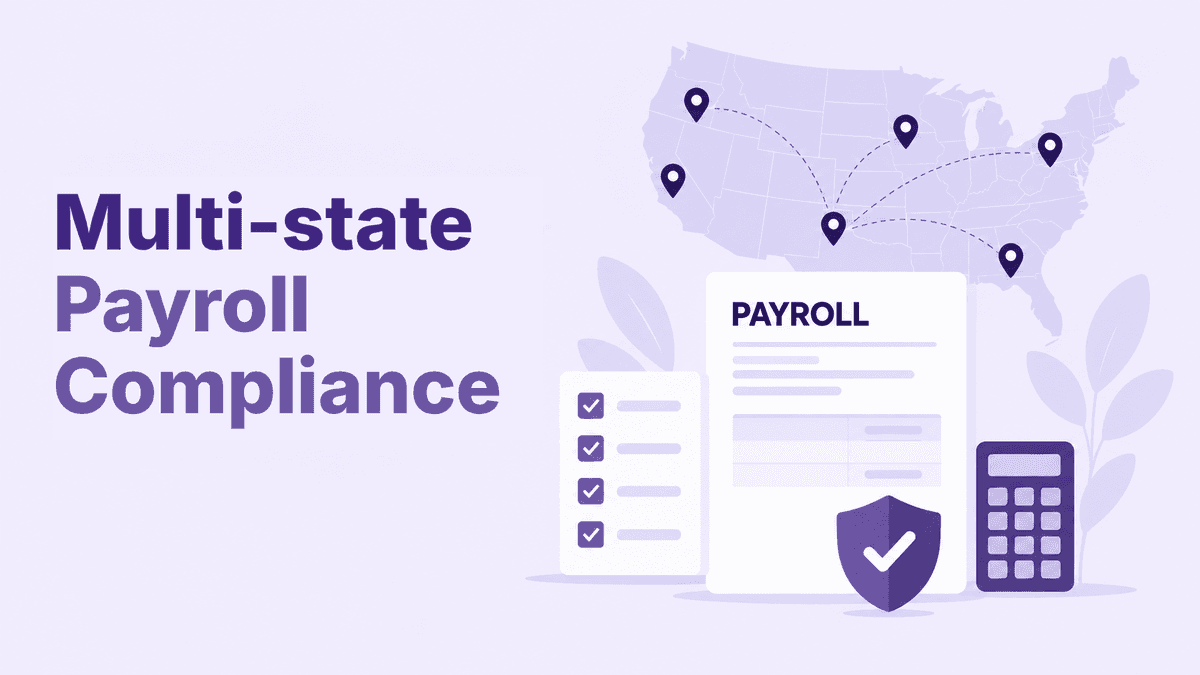
Multi-state payroll compliance is the set of tax, registration, and wage obligations a company takes on when its employees live or work in more than one state. You generally owe payroll taxes to the state where the employee physically performs the work, not where your company is incorporated or where your HR team sits.
For a company with everyone in one office, that rule never comes up. For a company that hired a remote engineer in another state, it already applies, whether or not anyone has registered for it. That gap between "applies" and "handled" is where the risk lives.
What multi-state payroll compliance means
Multi-state payroll compliance is the practice of correctly registering, withholding, filing, and remitting payroll taxes for employees in every state where they perform work. It also covers wage-and-hour rules, paid leave, and unemployment insurance, all of which vary by state.
The concept that ties it together is payroll tax nexus: a connection to a state that creates an obligation to register and pay there. The moment an employee lives or works in another state, you typically create nexus there, which means you must:
- Register with its revenue and unemployment agencies
- Withhold the right taxes
- File on that state's schedule
Remote work turned this from an enterprise problem into an early-stage one. A five-person company with one out-of-state hire faces the same question a 200-person company does: which state's rules apply to this paycheck?
Why it matters most to finance and founders
Payroll teams execute multi-state payroll. Finance leaders and founders carry the exposure when it goes wrong.
For finance, the risk is concrete:
- Unregistered withholding and unemployment obligations
- Penalties and interest on late or missing filings
- A widening audit surface with every new state
- Extra reconciliation work and lost visibility into workforce cost by state
For founders, the risk is quieter but just as real. Every decision to hire in a new state is a compliance decision, and those decisions usually get made in a hiring conversation, not a compliance review. The obligation starts the day the person starts; the registration and filing catch up later, if anyone remembers.
None of this means slowing down hiring. It means treating each new-state hire as a repeatable process rather than a surprise the finance team finds at quarter-end.
The core rules that decide who owes what
The work-state rule
Withhold income tax and pay unemployment insurance for the state where the work happens, usually where the employee sits and does the job. Not your state of incorporation, not where leadership sits. A company headquartered in California with an employee in Texas generally follows Texas payroll rules for that person.
Remote withholding
Same work-state logic, with one simplification: nine states have no state income tax on wages, so no withholding is required there: Alaska, Florida, Nevada, New Hampshire, South Dakota, Tennessee, Texas, Washington, and Wyoming. Everywhere else, register for withholding in the employee's work state before their first payroll run, and set their record to that state, not your home state by default.
Reciprocity agreements
Some neighboring states let an employee who lives in one state and works in another be taxed only by their home state, once they file the right exemption certificate. This can eliminate double withholding, but only a limited set of states have these agreements, and the pairs and forms change over time. Confirm current agreements with the state revenue agency before relying on them.
SUI registration
Unemployment insurance is separate from income tax and easy to overlook. In each work state, you open an unemployment account, get a rate, and file wage reports. A state with no income tax can still require it. Missing this is one of the more common and quietly expensive gaps.
Local taxes
Several states add city, county, or school-district income taxes on top of state withholding. Pennsylvania alone has thousands of local earned-income jurisdictions; Ohio has extensive municipal taxes; and New York City, Philadelphia, and Detroit levy their own. The right local rate follows where the employee actually works, which can shift when someone moves from a city to a suburb.
The convenience of the employer rule. A handful of states can source a remote employee's income back to the employer's office state when the person works remotely for their own convenience rather than the employer's necessity. New York is the most-cited example, and it can create double taxation for employees.
The mistakes that cause penalties
Most failures are operational, not calculation errors, usually a missing or outdated work-location record rather than a broken tax formula.
- Assuming HQ rules apply everywhere. Payroll gets configured once around the home state and never updated as the team spreads out, so employees get the wrong withholding, minimum wage, or overtime treatment.
- Untracked location moves. An employee relocates and no one updates the record before the next run. A single move can create several obligations at once: withholding, unemployment, local tax, and updated employment-law coverage.
- Skipping SUI. Teams register for income tax withholding and forget unemployment, or vice versa.
- Underestimating high-complexity states. California and New York carry heavier obligations; meal and rest breaks, same-day final pay, extensive leave rules. An out-of-state hire there is rarely a copy-paste of your home-state setup.
Worker misclassification
Multi-state operations amplify the oldest payroll risk of all: treating someone as a 1099 contractor who should be a W-2 employee. Classification comes from the actual working relationship, not the label on a contract or the tax form used to pay someone.
Multiple states apply their own, often stricter, tests, and a single worker's status can be judged differently for income tax, unemployment, and wage-and-hour purposes. Get it wrong across state lines and the exposure compounds: back payroll taxes, unpaid overtime, retroactive benefits, unemployment contributions, and audits from more than one agency.
The fix is a consistent classification review for every contractor, especially one working in a state where you have no other presence.
A compliance-first framework
Apply the same sequence to every hire and every move:
- Track work location as the system of record. Capture each employee's actual work state (and city or county where relevant) at intake, and update it before the next run whenever it changes.
- Register before you run payroll. Open withholding and unemployment accounts in each work state, and confirm any local tax obligations.
- Withhold to the work state. Configure withholding to where work happens, applying reciprocity only when confirmed and certified.
- File and remit on each state's schedule. Wage reports, deposits, and returns vary by state; a missed deadline is a penalty even when the tax was right.
- Reconcile and re-check. Reconcile by state each period, and re-run the check whenever someone is hired, relocates, or changes classification.
The goal is to make multi-state payroll a quiet background process instead of a scramble that surfaces at close.
How technology reduces the exposure
The framework is only as reliable as the systems behind it. Penalties come from disconnected tools: an HRIS that doesn't share work-location data with payroll, a payroll system that can't validate before it runs, and no single view of who owes what by state.
Consolidated platforms reduce that exposure in three ways:
- A single source of truth, so work location, registration, and payroll stay in sync
- Validation before payroll runs, so a missing registration or stale work state is caught before it becomes a filing
- Real-time reporting by state, so finance can see workforce cost and obligations without rebuilding them from spreadsheets
Where Niural fits
For teams managing U.S. and international workers across multiple states, Niural consolidates payroll, PEO, contractor management, and compliance into one operating system, so tax registration and payroll live in the same place instead of disconnected tools.
It runs on its own tax and payment infrastructure rather than stitched-together middleware, which lets it:
- Handle state-by-state withholding, SUI, and filings
- Manage registrations as you enter new states
- Settle payroll the same day
Our executional AI layer, EMMA, validates payroll before each run, flagging gaps like a missing state registration, an out-of-date work state, or a possible misclassification before they turn into a filing or a penalty. The result for finance and founders is a single, auditable view of workforce cost and compliance by state.
See how Niural handles multi-state payroll →
Multi-state payroll compliance is a process, not a one-time setup, and it compounds with every hire and every move. Companies that stay ahead of it treat work location as the system of record and register before they run payroll. Handled that way, expanding across state lines stays a growth decision instead of a compliance liability.
Other related articles:
Payroll Reconciliation
What is a Tax ID
Payroll Tax vs. Income Tax
Frequently Asked Questions
What triggers multi-state payroll obligations?
Having an employee live or work in a state generally creates payroll tax nexus there, triggering an obligation to register, withhold, and file, regardless of where your company is incorporated.
Which state do I withhold income tax for when an employee works remotely?
Generally the state where they physically perform the work. Reciprocity agreements and the convenience of the employer rule can change this, so confirm for each employee.
Do I still have obligations in states with no income tax?
Yes, the nine no-income-tax states can still require unemployment insurance registration and filings, plus local taxes and wage-and-hour compliance.
What's the most common mistake?
An outdated or missing work-location record. Most failures are operational, not calculation errors, the actual work state wasn't tracked or updated before payroll ran.
How does misclassification interact with multi-state payroll?
Misclassifying a 1099 contractor across state lines multiplies the exposure, since several states apply their own tests and multiple agencies can assess back taxes, wages, and penalties.
Do reciprocity agreements remove the need to register in the work state?
Not automatically. They can change where income tax is withheld once the employee files an exemption certificate, but you may still have unemployment and other obligations. Verify current agreements with the state agency.
Disclaimer: This article is for informational purposes only and does not constitute legal, tax, payroll, or compliance advice. Multi-state payroll requirements vary by state and change over time, and worker classification depends on the specific facts of each relationship. Verify current requirements with the relevant state agencies and qualified legal, tax, or payroll professionals before acting.