A contractor you hired for one project is still here a year later. They join planning meetings, own part of the roadmap, and keep the same hours as everyone else. The paperwork says "independent contractor." The job says otherwise.
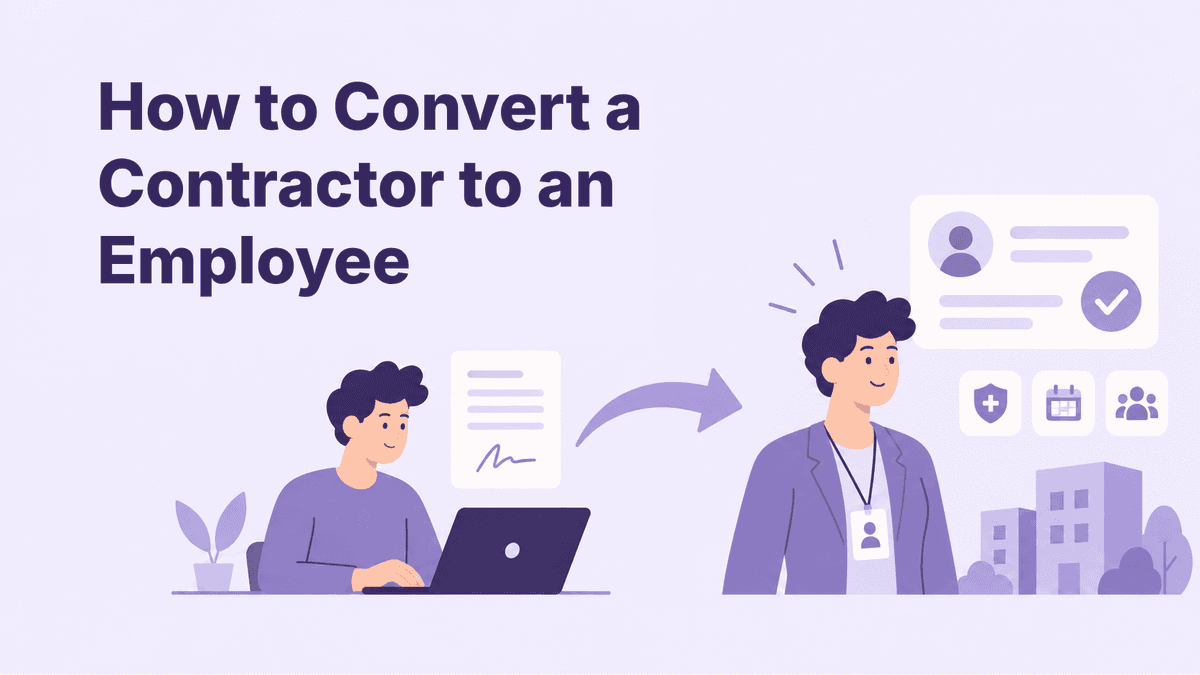
The short answer: Converting a contractor to an employee means ending the contractor relationship and hiring the same person as an employee. If they're in the U.S., you add them to your own payroll as a W-2 employee. If they live abroad, you hire them through an employer of record (EOR).
When should a contractor become an employee?
Classification follows how the work actually happens, not what the contract says. The IRS weighs behavioral control (who directs the work), financial control (who carries costs and can profit or lose), and the relationship (permanence, benefits, and how central the work is).
The Department of Labor applies its own test under the Fair Labor Standards Act (FLSA), and that test is in flux. In February 2026, the DOL proposed a rule to replace its 2024 six-factor standard with one centered on two core factors: control over the work and opportunity for profit or loss. Some states, including California, go further with an ABC test that presumes employee status.
Common signals a contractor has become an employee:
- You set their hours or expect them online during core hours
- They work only for you, or close to it
- Their work is ongoing operations, not a defined project
- You provide their tools, accounts, and training
How do you convert a contractor to an employee, step by step?
1. Confirm the classification
Test the role against the IRS factors, the DOL standard, and your state's rules, and document the facts behind your conclusion. If it's genuinely unclear, either party can file Form SS-8 for an IRS determination.
2. Choose the employment model
Next, decide who will legally employ the person. That depends on where they live.
Where the worker lives | Model | Legal employer |
In the U.S. | Add them to your payroll | Your company |
Outside the U.S. | Employer of record (EOR) | The EOR |
When you add them to your payroll, you become the employer. You run payroll, withhold taxes, register in their state if you aren't already, and cover workers' compensation and benefits.
An EOR becomes the legal employer in the worker's country. It runs local payroll, taxes, and mandatory benefits while you manage the work, so you can hire without setting up a local entity. Classification abroad follows local labor law, not the IRS or DOL tests. The U.S. paperwork in steps 6 and 8 doesn't apply to these hires, because the EOR handles the local equivalents.
Either way, the model changes who employs the person going forward. It doesn't change how the earlier contractor period is judged.
3. Model the full cost
Don't just multiply the hourly rate by 2,080. Contractor rates are priced to cover self-employment tax, insurance, and unpaid time off. As the employer, you now pay:
- Employer FICA: 6.2% Social Security (up to the 2026 wage base of $184,500) plus 1.45% Medicare
- Federal and state unemployment insurance
- Workers' compensation
- Benefits and paid time off
- EOR fees, if the person lives abroad
The base salary often lands below the contractor rate while the total package stays comparable. Show the person the full picture.
4. Make the offer and close the contract
Put title, pay, start date, FLSA exempt or non-exempt status, and benefits eligibility in the offer letter. End the contractor agreement per its notice terms, pay the final invoice, and confirm that IP created during the contract period belongs to the company.
5. Set a clean start date
Start at the beginning of a pay period with no overlap: no invoicing for days they're also on payroll. Never backdate employment to cover past contractor work.
6. Complete new-hire paperwork
Contractors don't fill out Form I-9, so even a long-time collaborator needs full onboarding:
- Form W-4 and any state withholding form
- Form I-9, with Section 2 done within three business days of the first day of work
- State new-hire report, due within 20 days federally and sooner in some states
7. Set up payroll and benefits
Confirm your state withholding and unemployment registrations, add workers' comp coverage, open benefits enrollment, and set up time tracking if the role is non-exempt.
8. Plan for year-end forms
In the conversion year, the person gets a Form 1099-NEC for contractor payments and a Form W-2 for wages. For 2026 payments, the 1099-NEC threshold is $2,000, up from $600. Remind them they still owe self-employment tax on the contractor portion.
What changes when a 1099 contractor becomes a W-2 employee?
Area | 1099 contractor | W-2 employee |
Tax form | Form 1099-NEC | Form W-2 |
Income tax | Worker pays estimated taxes | Employer withholds |
Social Security and Medicare | Worker pays self-employment tax | Split between employer and employee |
Unemployment taxes | None | Employer pays FUTA and state UI |
Benefits | Worker arranges their own | Eligible under your benefits plan |
Overtime and minimum wage | FLSA doesn't apply | Applies unless exempt |
Workers' compensation | Generally not covered | Required in most states |
Onboarding documents | W-9, contractor agreement | W-4, I-9, state forms, offer letter |
What if they should have been an employee all along?
If the IRS reclassifies a worker, Section 3509 of the Internal Revenue Code sets reduced back-tax rates for unintentional misclassification: 1.5% of wages for income tax withholding and 20% of the employee's FICA share, if you filed the required 1099s. Those rates double without the 1099s; the employer's own FICA share is still due, and willful misclassification loses the reduced rates entirely.
The voluntary alternative is the IRS Voluntary Classification Settlement Program (VCSP). It lets eligible businesses reclassify workers going forward with limited federal employment tax liability for the past. Generally, you must have consistently treated the workers as contractors, filed their 1099s for the prior three years, and not be under an IRS employment tax exam or a DOL or state classification exam.
You apply with Form 8952 at least 120 days before the date you want to start treating them as employees, and pay 10% of a tax amount calculated on the most recent year's compensation. Because you must still be treating them as contractors when you apply, evaluate VCSP before converting. It covers federal employment taxes only, not state or wage-and-hour claims.
Where Niural fits
Conversions get messy when contractors and employees live in separate tools, with invoices in one place, W-2 payroll in another, and a spreadsheet in between. Niural runs contractor management and U.S. payroll in one system, so the worker's history and new employee record live together.
Before a conversion, EMMA, Niural's AI execution layer, flags potential misclassification risk across your contractor roster. After that, EMMA validates payroll before the run. When the person lives outside the U.S., Niural's EOR (150+ countries) runs in the same system.
See how Niural brings contractor management and U.S. payroll into one system.
Other related articles:
How to Hire an Independent Contractor
How to Offer Contractor Benefits
Frequently asked questions
Does a converted contractor need a Form I-9?
Yes, contractors don't complete Form I-9, so they need one as a new employee, with Section 2 completed within three business days of their start date.
Does converting a contractor admit misclassification?
Not by itself. Converting a role that grew is routine. The earlier period is judged on how the relationship actually worked. If it looked like employment, talk to counsel first.
Can I backdate the employee start date?
No, employment starts on a real, go-forward date. Past misclassification is addressed through tax corrections or VCSP.
Should the salary match the contractor rate?
Usually not. Contractor rates cover self-employment tax and overhead the worker no longer pays. Compare total compensation instead.
Can I use an employer of record to convert a contractor?
Yes, when the contractor lives outside the U.S. and you don't have a local entity there. The EOR becomes the legal employer going forward and handles local payroll, taxes, and benefits.
Disclaimer: This article is for informational purposes only and does not constitute legal, tax, or employment advice. Worker classification depends on the specific facts of each relationship and on federal and state law, which may change. Consult qualified legal and tax advisors before converting or reclassifying workers.