
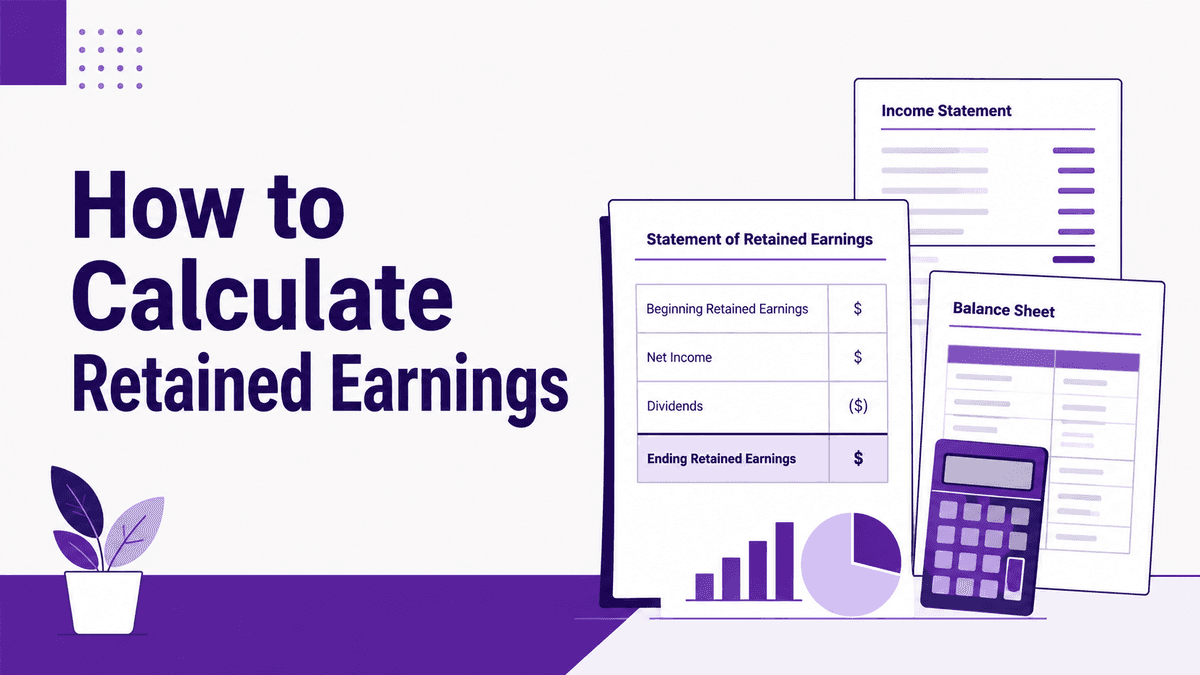
If you've ever stared at your company's balance sheet and wondered where the "retained earnings" figure comes from, here's how the number is built.
Retained earnings are the cumulative profits your company has kept in the business instead of paying out to owners. Here’s how to calculate retained earnings:
Beginning Retained Earnings + Net Income (or − Net Loss) − Dividends = Ending Retained Earnings
It feels harder than it looks because the three inputs behave in ways first-time founders don't expect.
What are retained earnings
Retained earnings represent every dollar of profit your company has earned since day one, minus every dollar it has paid out to owners as dividends or distributions. It's a running total. Each accounting period, you take last period's ending balance and update it with the current period's profit and any payouts.
Retained earnings sit in the equity section of your balance sheet, alongside items like paid-in capital. They are one of the clearest signals of whether a business has been generating and reinvesting profit over time.
Retained earnings are not cash, and they are not the same as net income. They're an accounting measure of accumulated profit that has stayed in the company. That profit may have already been spent on equipment, inventory, hiring, or paying down debt. A company can show healthy retained earnings and still have very little cash in the bank.
Retained earnings vs. net income vs. cash
These three terms get used interchangeably in casual conversation, but they measure different things. Confusing them is how founders misread their own financials.
What it measures | Time frame | Where it lives | |
Net income | Profit earned in a single period, after all expenses and taxes | One period (month, quarter, year) | Income statement (the "bottom line") |
Retained earnings | Accumulated profit kept in the business across all periods | Cumulative, since founding | Balance sheet (equity section) |
Cash | Actual money available in your accounts right now | A single point in time | Balance sheet (assets section) |
Net income feeds into retained earnings each period. Retained earnings can be reinvested in ways that reduce cash. All three matter, and they rarely match.
The 6 steps to calculate retained earnings
Here are the steps that will tell you how to calculate retained earnings. Meet Northlane, a small software company closing the books on its most recent fiscal year.
Step 1: Find your beginning retained earnings balance
Your starting point is the ending retained earnings from your previous period. If you're calculating for this year, use last year's ending balance. If you're calculating for Q2, use Q1's ending balance.
You'll find this figure in the equity section of your prior period's balance sheet, or on your previous statement of retained earnings. If this is your company's very first reporting period, your beginning balance is simply $0.
Let’s look at an example: Northlane's beginning retained earnings (last year's ending balance) is $120,000.
Step 2: Pull net income (or net loss) for the period
Next, find your net income for the current period. This is the "bottom line" of your income statement: total revenue minus all expenses, including operating costs, interest, and taxes.
If your company was profitable, this is a positive number you'll add. If your company lost money, you'll have a net loss, which you subtract. Early-stage companies often run net losses for several years, and that's normal. We'll cover what that does to your retained earnings in Step 6.
Say, Northlane earned a net income of $60,000 this year.
Step 3: Account for dividends and owner distributions
If you paid any profit out to owners or shareholders during the period, subtract it. For a C corporation, these payouts are typically dividends. For an LLC or S corporation, owners more often take distributions (sometimes called draws). Either way, money that leaves the business and goes to owners reduces retained earnings.
If you didn't pay anything out (common for growth-stage companies reinvesting every dollar), this figure is simply $0, and your retained earnings grow by your full net income.
Northlane paid $10,000 in distributions to its two founders this year.
A brief note on dividends vs. distributions: For a C corporation, dividends are paid out of the company's earnings and are generally taxable to shareholders, per IRS Topic 404. For pass-through entities like S corps and LLCs, owner distributions work differently for tax purposes. Both reduce retained earnings in the calculation, but the tax treatment differs by entity type, so it's worth a conversation with your accountant rather than a rule of thumb.
Step 4: Apply the retained earnings formula
Now you have all three inputs. Plug them into the formula:
Beginning Retained Earnings + Net Income − Dividends = Ending Retained Earnings
Working through Northlane:
- Start with beginning retained earnings: $120,000
- Add net income: $120,000 + $60,000 = $180,000
- Subtract distributions: $180,000 − $10,000 = $170,000
Northlane's ending retained earnings for the year: $170,000.
Step 5: Record ending retained earnings on the balance sheet
Your ending figure isn't just a number for a report. It becomes part of your official finances. Record the $170,000 in the equity section of your balance sheet.
Just as importantly, this ending balance becomes the next period's beginning balance. That's what makes retained earnings cumulative: the roll-forward from one period to the next is continuous. Get the ending number wrong this period, and the error follows you into every future calculation until it's caught.
Many companies also prepare a short statement of retained earnings, which lays out the roll-forward (beginning balance, plus net income, minus dividends, equals ending balance) as its own one-page document. It's the same math you just did, formatted for anyone reviewing your books.
Step 6: Review, reconcile, and interpret the result
Before you consider the calculation final, check it. Does the net income figure match your finalized income statement? Did you capture every distribution, including any mid-year draws? Does the beginning balance tie exactly to last period's ending balance?
Then step back and read what the number is telling you.
What your retained earnings number means
The dollar figure is only useful once you interpret it in context.
Positive and growing retained earnings usually signal a company that is consistently profitable and reinvesting in itself. Northlane's climb from $120,000 to $170,000 is a healthy sign.
Flat or slowly growing retained earnings can mean profits are thin, or that most profit is being distributed to owners rather than reinvested.
Negative retained earnings, often called an accumulated deficit, mean the company's cumulative losses and payouts exceed its cumulative profits.
That last case deserves a specific note for founders, because it causes unnecessary panic. A negative retained earnings balance is extremely common for early-stage and venture-backed companies. If you've raised capital and spent years investing ahead of revenue, you may post net losses for several years running, and those losses accumulate into a deficit. This doesn't automatically mean the business is failing. It reflects a deliberate choice to spend on growth before turning a profit. What matters is the trajectory: an accumulated deficit that's shrinking as the company approaches profitability tells a very different story than one that's deepening with no path to reversal.
Common mistakes founders make
A few errors show up again and again when founders run this calculation themselves:
Confusing retained earnings with cash. A strong retained earnings balance doesn't mean money is sitting in your account. It may already be invested in the business.
Forgetting owner distributions. Draws taken throughout the year are easy to overlook, especially in LLCs and S corps where they may not feel like formal "dividends." Miss them, and your retained earnings will be overstated.
Breaking the roll-forward. Using a beginning balance that doesn't match last period's ending balance quietly corrupts every future period.
Ignoring prior-period adjustments. If you correct a material accounting error from a previous period, it may adjust your beginning retained earnings balance directly rather than flowing through current net income. This is an advanced case; if it comes up, it's worth confirming the treatment with your accountant.
See how Niural handles payroll.
See related articles:
Enterprise Payroll Workcenter
Discretionary vs. Non-Discretionary Bonuses
Payroll Taxes in 2026
Frequently asked questions
What is the formula for retained earnings?
Beginning Retained Earnings + Net Income (or − Net Loss) − Dividends = Ending Retained Earnings. You start with the prior period's ending balance, add the current period's profit (or subtract its loss), then subtract any dividends or owner distributions paid out.
Where do I find retained earnings?
Retained earnings appear in the equity section of your balance sheet. The individual inputs come from different places: beginning retained earnings from your prior balance sheet, net income from your current income statement, and dividends from your dividend or distribution records.
Is retained earnings the same as net income?
No, net income is profit from a single period, found on the income statement. Retained earnings are the accumulated total of profits kept in the business across all periods, found on the balance sheet. Net income for the period feeds into retained earnings.
Can retained earnings be negative?
Yes, when cumulative losses and payouts exceed cumulative profits, retained earnings turn negative, a position called an accumulated deficit. It's common for startups and venture-backed companies investing ahead of profitability, and on its own it doesn't mean the business is in trouble.
Are retained earnings the same as cash?
No, retained earnings measure accumulated profit kept in the business, but that profit may already be spent on equipment, hiring, inventory, or debt repayment. A company can have high retained earnings and low cash.
How often should I calculate retained earnings?
Most companies update retained earnings every time they close an accounting period: monthly, quarterly, or annually. Calculating it regularly gives you a clearer read on whether the business is building or eroding value over time.
Disclaimer: This article is for general informational purposes only and does not constitute accounting, tax, or legal advice. Retained earnings treatment, dividends, and owner distributions carry entity-specific tax implications. Consult a qualified CPA or tax professional for guidance specific to your business.
-768x432.webp&w=828&q=75)