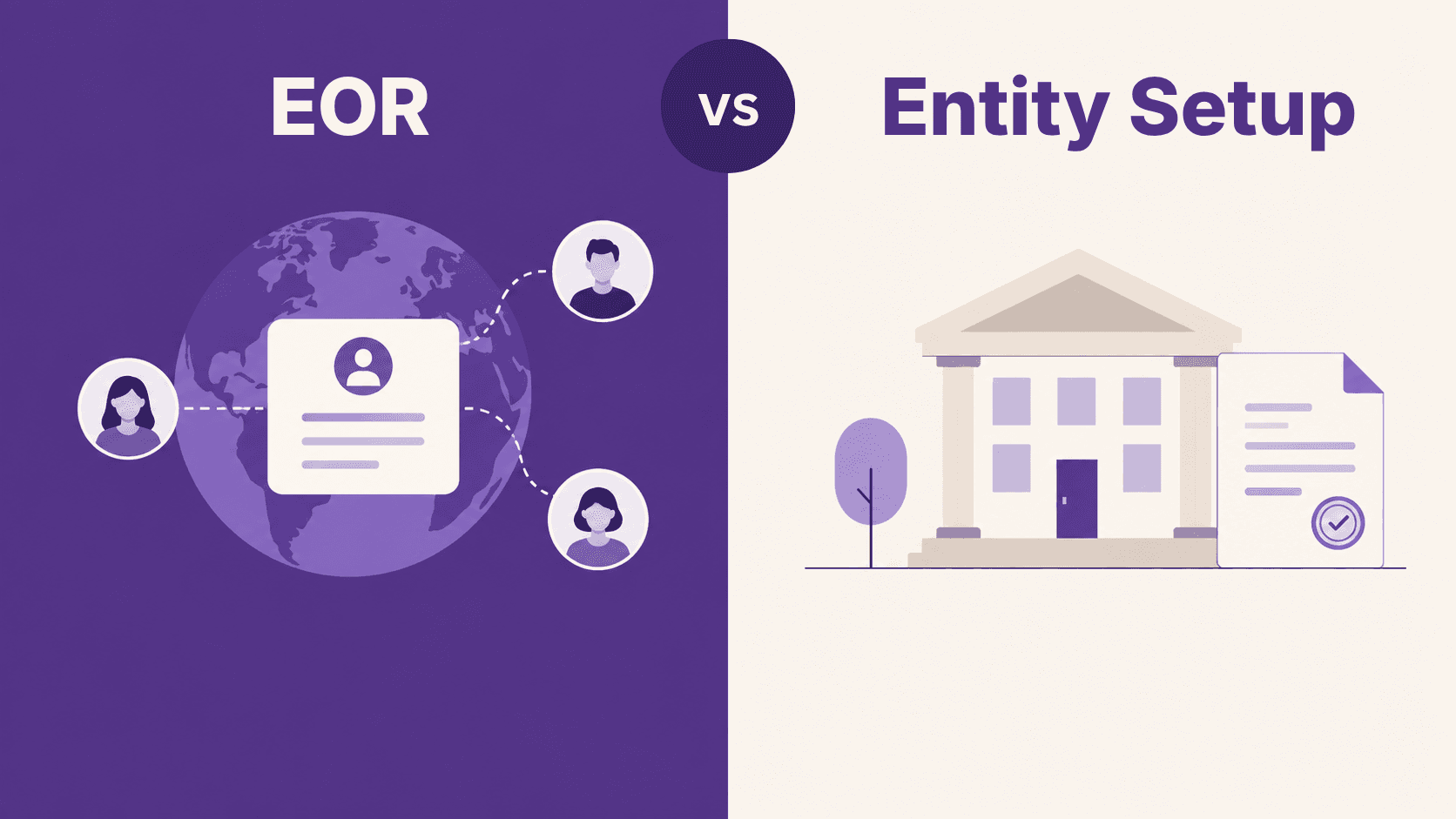
Eva had the offer letter open in one tab and a blank incorporation form in another. Her best engineering candidate lived in Lisbon. Eva's company was eleven months past its Series A and had never employed anyone outside the country. Somewhere between "we should hire her" and "how do we actually pay her," a second question had appeared: does hiring one person in Portugal mean setting up a company in Portugal?
For most founders making an early international hire, an employer of record (EOR) is the right way to start, and building a legal entity is a decision you earn into as headcount, permanence, and tax exposure grow.
EOR vs. entity setup: At a glance
Employer of Record (EOR) | Legal Entity | |
Speed to hire | Days to a few weeks | Months to operational |
Upfront cost | Low; per-employee fee | Higher; setup plus ongoing overhead |
Control | Employment terms within EOR's framework | Full control |
Permanent establishment risk | Reduces employment-compliance risk; does not eliminate PE exposure | You register and manage tax presence directly |
Ongoing burden | Handled by the EOR | Bookkeeping, filings, statutory obligations |
Unwinding | End the arrangement | Formal wind-down; possible severance liability |
Best fit | Entering or testing a market; first hires | Long-term commitment; concentrated headcount |
Why EOR wins early
For one engineer in Lisbon, an entity makes no sense. Registering a subsidiary, opening a local bank account, completing tax registrations, and standing up payroll commonly takes anywhere from a couple of months to the better part of a year depending on the country, and often runs into five figures before a single paycheck goes out.
Instead of building a company to make one hire, Eva can have the EOR employ the engineer, run compliant Portuguese payroll, and handle local benefits and filings, usually in days, not months. If Portugal turns out to be one great hire and nothing more, Eva has committed no capital to a structure she'd later have to unwind. If Portugal becomes a real market, she's learned what employing there actually involves before she's locked in.
This is why the EOR-first default holds for early-stage companies: it matches the reality that your first hire in a country is a test, not yet a commitment.
What an EOR is, and isn't
An EOR handles employment compliance. It does not automatically shield your company from permanent establishment risk.
Permanent establishment, or PE, is a tax concept: if your company's activity in a country becomes substantial enough, tax authorities can decide you have a taxable presence there, even without a registered entity, and levy local corporate tax on income attributed to that activity. Using an EOR does not, by itself, prevent this. If the person you employ through an EOR is generating revenue, closing deals, or otherwise conducting core business on your behalf, that activity can contribute to PE exposure regardless of who signs their paycheck.
In practice, an EOR is a great way to enter a market and stay compliant on employment, but it's not a permanent loophole around ever having a tax presence somewhere. Treating it as one is how founders end up with an unexpected corporate tax question, and sometimes double taxation, a year or two after a hire they thought was fully handled. Some countries reinforce this by capping how long you can use an EOR arrangement at all before you're expected to employ directly.
None of this makes the EOR the wrong choice. It makes it a starting choice with a shelf life that varies by country and by what your people actually do there.
What building an entity costs
When founders price an entity, they usually price incorporation. That's the smallest number.
The real cost of a legal entity is the operating tail that follows it:
- Setup: registration fees, legal counsel, and banking, commonly cited in the mid-five figures in many markets, and higher in complex jurisdictions. (Figures vary widely by country; verify current benchmarks before budgeting.)
- Time to operational: incorporation can be fast, but becoming able to actually run payroll (after banking, tax registrations, and payroll onboarding) commonly takes months.
- Ongoing overhead: local bookkeeping, statutory filings, annual accounts, and often a director or registered office requirement, every year, whether or not you're still hiring there.
- Wind-down liability: closing an entity isn't free either. In most countries, it triggers statutory severance obligations and a formal process that can take months.
An entity buys you control, permanence, and, past a certain scale, better economics. But it's fixed overhead plus the risk of getting local employment, tax, or payroll wrong yourself. That cost only makes sense when the country has earned it.
The crossover signals: when to build
Headcount alone doesn't decide this. A single high-earning revenue role can create more exposure than ten support roles. Instead of a number, watch for the signals that the operating model needs to change:
- Permanence. You're no longer testing the market; you're committed to it for the long term.
- Headcount concentration. Enough people in one country that per-employee EOR fees start to rival the fixed cost of an entity.
- Commercial and revenue activity. Your people there are generating revenue or doing core business, which raises PE exposure regardless of the EOR.
- Control needs. You need to offer local equity, specific benefits, or employment terms an EOR can't accommodate.
- Duration limits. The country caps how long you can use an EOR, forcing the question on its own timeline.
The mature move is to review each country on its own, periodically, and switch before cost or risk forces your hand, not after a tax authority makes the decision for you.
Planning the EOR-to-entity switch
Moving from an EOR to your own entity takes real work. When Eva's Lisbon team eventually grows to the point where an entity makes sense, moving people from the EOR to her own subsidiary means re-issuing employment contracts, re-aligning benefits, and cutting payroll over without a gap or a missed paycheck. Done carelessly, it means downtime, compliance gaps, and employees who suddenly feel like an afterthought. Founders who plan for the transition early, while they're still on the EOR, make it feel close to seamless.
Where a unified system fits
The rent-then-build path has a quiet trap: each stage often lives in a different tool. An EOR here, a local payroll provider there, an entity's own system later, with a founder stitching visibility across all of it.
Niural AI is built to remove that seam. Niural runs EOR and global payroll across 150+ countries inside one system, so hiring your first person in a new country and, later, employing a team through your own entity aren't two separate migrations; they're stages in the same operating model. As you move from renting to building, the workforce data, payroll, and reporting stay in one place instead of fragmenting across vendors, which is exactly what makes the eventual EOR-to-entity transition manageable rather than disruptive. For a founder like Eva, that means the decision to build an entity later doesn't force a re-platform of everything she set up to hire the first engineer.
Explore Niural EOR
See related articles:
AOR vs EOR
PEO vs EOR
PEO vs EOR vs Staffing Agency
Frequently Asked Questions
Is an EOR cheaper than setting up an entity?
For a small number of hires in a country, almost always. An EOR charges a per-employee fee with no setup cost or ongoing statutory overhead. An entity's economics only pull ahead once you have enough concentrated headcount in one country to justify its fixed costs.
Does an EOR protect me from permanent establishment risk?
It reduces employment-compliance risk but does not eliminate PE risk. If your people conduct significant or revenue-generating activity in the country, you can still create a taxable presence. Review PE exposure with a qualified tax advisor as your activity grows.
When should I switch from an EOR to my own entity?
Watch for signals rather than a fixed headcount: long-term commitment to the market, concentrated headcount, revenue-generating activity, control needs an EOR can't meet, or a country that caps EOR duration. Ideally, you switch before cost or risk forces it.
Can I hire in a country before my entity is ready?
Yes, that's a core reason EORs exist. You can employ compliantly through an EOR immediately and stand up your entity in parallel, then migrate employees once it's operational.
Do I need an entity to hire just one person abroad?
Usually not. For a single hire, an EOR is almost always the faster, lower-risk, lower-cost path. An entity becomes worth its overhead as your presence in the country deepens.
Disclaimer: This article is for informational purposes only and does not constitute legal, tax, or accounting advice. Permanent establishment rules, entity requirements, and employment law vary by jurisdiction and change over time. Consult qualified legal, tax, and compliance advisors before making decisions about international hiring or entity setup.

-768x432.webp&w=3840&q=75)