Key takeaways
- A PEO becomes the co-employer for payroll tax purposes, benefits, and filings and runs them under its own state accounts. You retain control of the hiring, the pay, and the day-to-day running of the business.
- For a remote company, each new hire's home state will add a withholding account, an unemployment insurance account, workers' comp rules, and in some states a paid leave program.
- A PEO makes the most sense from the very first out-of-state hire through a few hundred employees, particularly if you've got no full HR team.
- NAPEO research has linked the use of a PEO to twice the growth, 12% lower turnover, and a 27% return from the cost savings alone.
- Remote companies should pick a PEO that they won't outgrow.
A 15-person remote company can easily do payroll in 8 states. Each state will have its own withholding account, its own unemployment insurance account, and its own rules around final paychecks, workers' comp, and paid leave. The founders and CFOs generally learn this one hire at a time as the offer letter goes out.
A PEO for remote workforce does most of the work for you. They co-employ your staff, file your payroll taxes and benefits under their own state accounts, and keep you up to date as the rules change. You're still the one who decides who to hire, what to pay them, and how the work gets done.
For a US-based remote company that has people in multiple states and doesn't have a full HR function in place, a PEO is usually the most sensible route to ensure compliance in all the states where your team resides. The real choice is which PEO you go with, as a remote company will add states to its footprint much more quickly than an office-based company would.
What is a PEO?
A PEO is a Professional Employer Organization that co-employs your team and takes responsibility for payroll, payroll tax, benefits, and HR compliance in every state where your employees work. In the co-employment arrangement, the PEO becomes the employer of record for tax and benefits purposes; you remain the employer of the business and the people.
The PEO takes on | Your company keeps |
Payroll processing and federal, state, and local tax filings | Hiring and firing decisions |
State withholding and unemployment insurance registrations | Compensation and promotion decisions |
Health, dental, vision, and retirement plan access and administration | Day-to-day direction of work |
Workers' comp coverage and claims administration | Company culture, policies, and tools |
Compliance updates, required notices, and HR support | Product, customers, and strategy |
By the end of 2025, 502 PEOs were serving 5.4 million worksite employees at 233,000 businesses. PEO worksite employment has grown at a rate of 7.2% per year since 2008 (NAPEO 2026 Industry Footprint Study).
Why is a remote team harder to employ than an office team?
An office-based company will hire in one or two states. A remote company will hire wherever the best candidate lives, so each new hire will bring a new state of compliance with them.
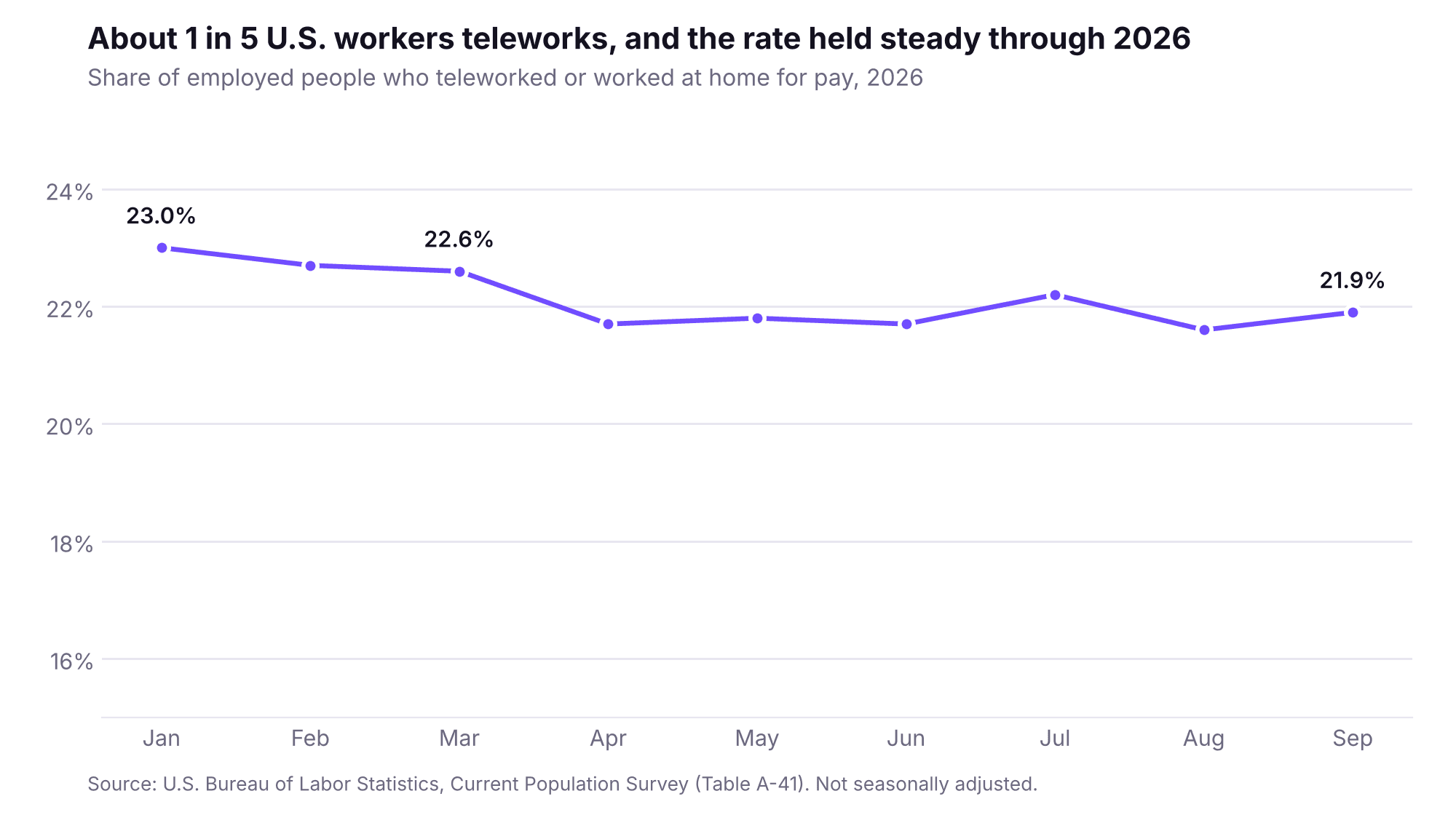
Remote work is a settled part of the U.S. labor market. In March 2026, 22.6% of U.S. workers were teleworking or working at home for pay, and that figure has remained in a very narrow band throughout the year (BLS). In professional and business services, the rate in June 2026 was 41.8%.
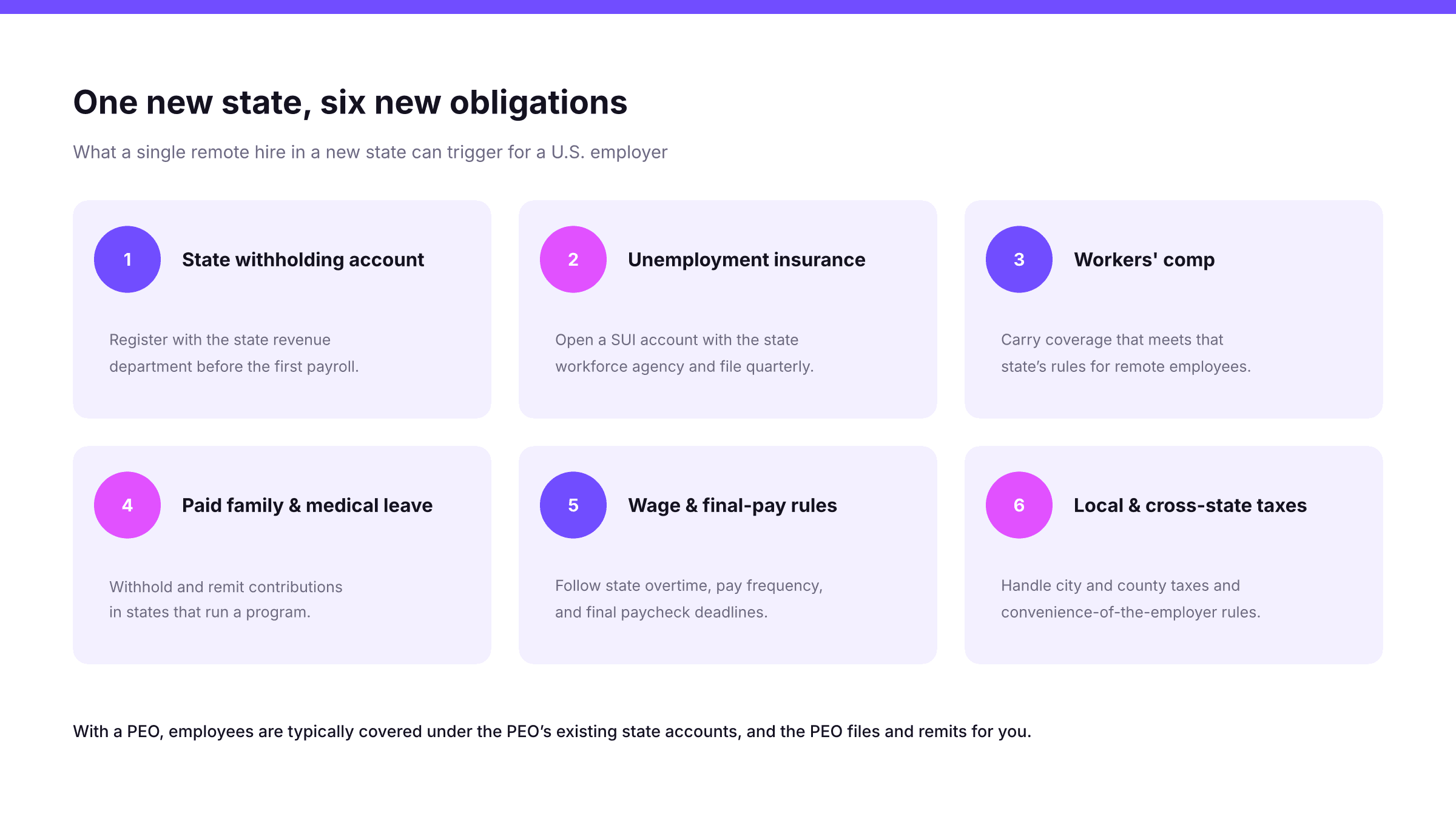
When your first employee in a new state starts, you typically need to handle:
- A State Income Tax Withholding account with the State Revenue Department.
- A state Unemployment Insurance (SUI) account with the State Workforce Agency.
- Workers' comp coverage that meets that state's requirements.
- Paid family and medical leave contributions (where the state runs a program, i.e., Minnesota's program commencing 1/1/26 and Maine's benefits commencing 5/1/26).
- State-specific rules on overtime, pay frequency, and final pay.
- Local taxes in the cities and counties that do so.
Some rules follow the employer's office rather than the employee's home. A number of states (New York being a prime example) have a "convenience of the employer" rule which will treat the remote employee as if they're working in the office and thus will assess their wages accordingly.
How does a PEO for remote team work on a day-to-day basis?
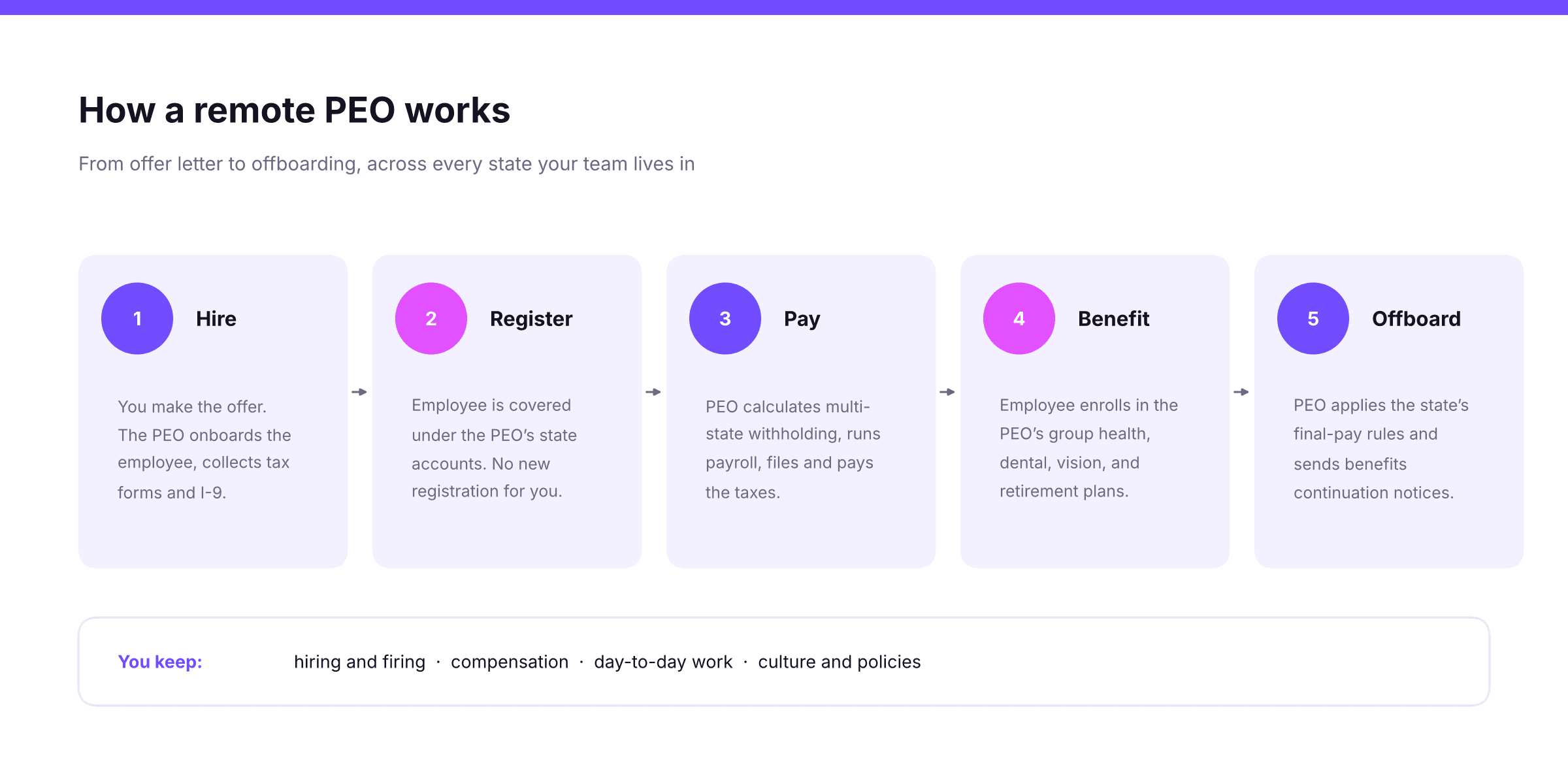
The PEO is underneath your payroll and HR. If you're hiring someone in a new state, the PEO will onboard them, collect their tax forms and I-9s, and add them to payroll. In the co-employment model, the employees are generally covered under the PEO's existing state unemployment accounts, so you normally don't need to register them separately in each state.
Each pay cycle, the PEO will calculate the wages and withholding for each state and locality, file the returns, and pay the taxes. The employees enroll in the PEO's group health, dental, vision, and retirement plans (which are typically better than a small company could obtain on their own). On termination, the PEO will deal with the final pay rules and the benefits continuation notices.
You approve the payroll, you decide on the raises, and you run the team. The PEO just keeps the paperwork up to date.
When would a PEO make sense for a remote company?
The case for a PEO for remote workforce operations gets stronger with each of these signals:
- You're about to make your first hire outside of your home state, or you already have employees in 3 or more states.
- You can't offer health and retirement benefits that compete with larger employers for the same candidates
- Payroll, tax notices, and benefits questions land on a founder, CFO, or office manager instead of an HR team
- You're somewhere in the middle of the scale, between a handful of staff and a few hundred. That's where most PEO clients fall (NAPEO's average is around 23).
- You'd rather spend leadership time on product, customers, and fundraising than on state agency mail
When is a PEO not the right fit?
A PEO is built for W-2 employees in the US. Some of the remote companies will require a different model or a combination.
Your situation | Better fit |
Your remote team lives outside the U.S. | Employer of record (EOR) in each country |
Most of your workers are independent contractors | Contractor management, with classification checks |
You have several hundred employees and want your own benefits plans | Administrative services only (ASO) |
You have one state, a few employees, and no benefits plans yet | Payroll software |
Many of the remote companies will go through more than one of those stages. That's why the platform under the PEO is as important as the PEO itself.
What does a PEO cost and what does it deliver?
PEOs typically charge either a % of total payroll or a flat fee per employee per month, with benefits premiums added on top. Get from each provider an all-in per-employee figure that breaks out the admin fees from the insurance costs so you can properly compare.
NAPEO states that businesses using a PEO grow twice as fast, have 12% less employee turnover, and are 50% less likely to go out of business. The return on cost savings alone is 27%. Of businesses with 10 to 49 employees, 52% of those using a PEO offer a retirement plan compared to 23% of those who don't use a PEO.
Why should remote companies be building on an AI-native PEO from day one?
Remote companies add states, worker types, and eventually countries far faster than their office-based counterparts. Switching PEOs mid-growth is a recipe for disaster in terms of new tax accounts, new benefits enrolment, and a migration project that nobody wants. It's far easier to pick infrastructure that will just keep on working in 10 states and 100 employees at employee number five.
Niural is an AI-native PEO.
AI that checks the work before it ships
Niural runs payroll, benefits, and compliance on an AI-native platform. EMMA (Niural's AI agent) runs the validation prior to the payroll run, flags any missing rate changes, and flags potential misclassification risk so errors are caught before they get to a paycheck or a state filing. EMMA also walks the employee through the benefits enrollment process, explaining the plan options in plain English. Any decisions with real-world consequences (i.e., approving payroll) remain with your team.
Payroll that earns while it waits
Niural Wallet funds your payroll, your contractor payments, and your vendor payments from a single balance. That payroll float earns cash rewards (your payroll prefunding, your security deposit, and your operating balance) so the money you have in the wallet for your future obligations isn't just sitting there.
One platform from first hire to global scale
Niural runs PEO, ASO, and EOR on one platform. You can start on PEO with your first remote hires, progress to ASO as you grow, and then hire internationally via EOR in 150+ countries without having to rebuild your HR and payroll stack every time.
What should you be asking before you go and pick a remote PEO?
Use these questions to compare any provider:
- Which states can you support at the moment, and how quickly can you add a new one when we hire in that state?
- How do you deal with employees who move to another state, work split time between states, or work under a convenience of the employer rule?
- What checks are run prior to payroll going out, and who looks at the exceptions?
- What's the all-in cost per head, with admin and premiums split?
- What happens to the cash that we pre-fund for payroll or that we hold as a deposit?
- If we outgrow PEO or end up hiring internationally, can we stay on the same platform?
If your team is already spread across three or more states (or your next hire will take it to four), a PEO for remote workforce operations is definitely worth you looking at now before the registration, notice, and benefits gaps start to accumulate. Start with infrastructure that will check your payroll before it runs, will put your idle cash to work, and will take you from your first hire to your first international hire.
See how Niural PEO works.
Other related articles:
The Case for a Modern PEO
Top 8 PEO Myths That Are Quietly Costing You
PEO vs ASO: What's the Difference
PEO vs EOR: A CFO's Guide to Global Workforce Strategy
Complete Guide to PEO Renewal
Frequently asked questions
What is a PEO for a remote team?
A PEO for a remote workforce is a Professional Employer Organization that co-employs the remote workforce and takes responsibility for payroll, payroll taxes, benefits, and all HR compliance in every state where the employees work. Your company retains control of the hiring, the pay, and the day-to-day work.
Is a remote PEO any different from a 'normal' PEO?
The model is the same. A remote PEO is one that's able to support employees across multiple states at the same time (multi-state tax withholding, unemployment insurance, workers' comp, and state paid leave).
Do I need to register in every state where a remote employee lives?
Usually yes, if you're running payroll yourself. A new state will generally require a withholding account and an unemployment insurance account. With a PEO the employees are generally covered under the PEO's existing state accounts.
Can a PEO pay employees overseas?
No, a PEO covers U.S. W-2 employees. For international employees, you need an Employer of Record (EOR) in each country or your own local entity.
How much does a PEO cost for a remote team?
Most PEOs will charge you a % of payroll or a flat per-employee monthly fee plus benefits premiums. Ask for an all-in per-employee quote that breaks the admin fees down from the insurance costs.
When should a remote company switch to a PEO?
Common triggers are the first hire in a new state, having employees in 3 or more states, needing competitive benefits, or leadership spending a significant amount of time on payroll and compliance.
Do I lose control of my employees via a PEO?
No, you keep control over the hiring, firing, pay, and day-to-day running of the business. The PEO takes care of the payroll, the tax filings, the benefits, and the compliance.
Does a PEO take care of workers' comp for remote workers?
Yes, a PEO will generally provide workers' comp coverage and claims admin for the employees in each state in which they work.
What is the 'convenience of the employer' rule?
It is a rule in some states, including New York, that can tax a remote employee's wages based on the employer's office location rather than where the employee works. It can create withholding obligations in more than one state.
What is the difference between a PEO and an ASO?
A PEO co-employs your team and gives employees access to its group benefits plans. An ASO handles HR and payroll administration while your company remains the sole employer and sponsors its own benefits.
What is an AI-native PEO?
An AI-native PEO uses AI inside its payroll, benefits, and compliance workflows. For example, it can check payroll for errors before it runs and flag classification risks, while people keep approval of consequential decisions.
Can I earn anything on cash held for payroll?
With Niural Wallet, eligible balances, including payroll prefunding, PEO security deposits, and your operating balance, earn cash rewards. Cash rewards are subject to eligibility and terms.
Disclaimer: This article is for informational purposes only and does not constitute legal, tax, payroll, or benefits advice. State and local requirements change often and depend on your specific facts. Consult qualified advisors before making employment, tax, or benefits decisions. Information is current as of October 2026.
Niural is a financial technology company, not a bank. Banking services are provided by i3 Bank, Member FDIC. Cash rewards are subject to eligibility and terms.