Key takeaways
- A PEO becomes your co-employer in that they run the payroll, file the payroll taxes, provide the benefits, and deal with all the HR compliance. You do the hiring, and you do all the day-to-day stuff.
- Four occasions generally trigger the call: the candidate asks you about benefits, you're hiring out of state, HR takes over your calendar, or you're hiring overseas.
- Fees are typically $40 to $160 per employee per month (i.e., 2% to 12% of payroll) with premiums added on top.
- A U.S. PEO will stop at the border. Any overseas hires will require either a local entity or an employer of record (EOR).
It's Friday night, and you're doing the payroll for six people. There's a withholding form missing, a candidate wants to look at the health plan, and your accountant is asking you if you've got the unemployment insurance in Colorado registered. None of that is product work.
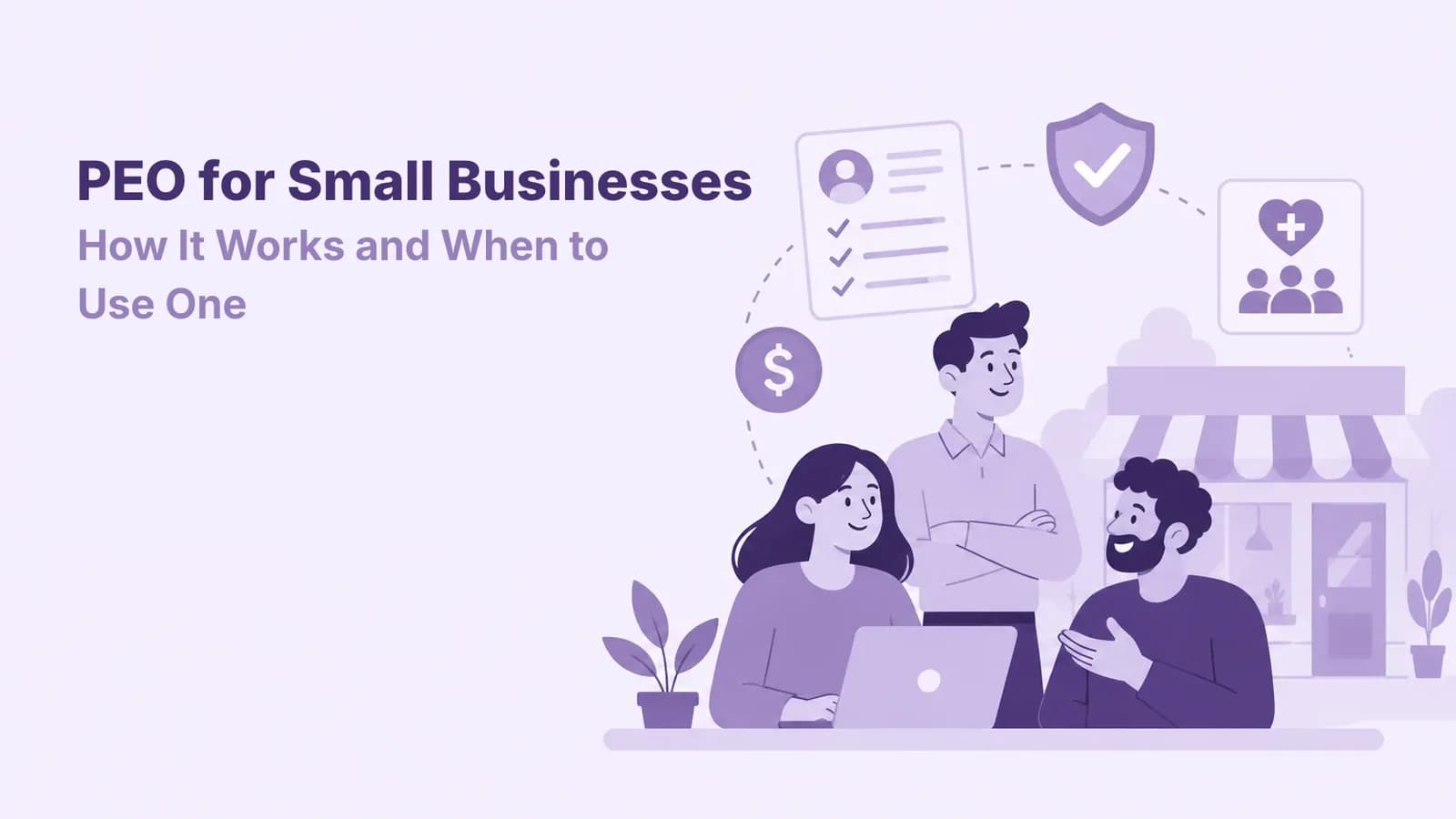
A PEO for small business will take on most of the burden for a small team. A Professional Employer Organization (PEO) is your co-employer for payroll, tax, and benefits. They'll handle the filing of payroll taxes, offer you a large group health and retirement plan, and deal with all the HR compliance issues. You're in charge of who you hire and what they do. For a seed or Series A startup, the right time to go down that route is usually earlier than the founders would think, as the structure you pick at that stage is the one you're going to scale on.
How does a PEO work?
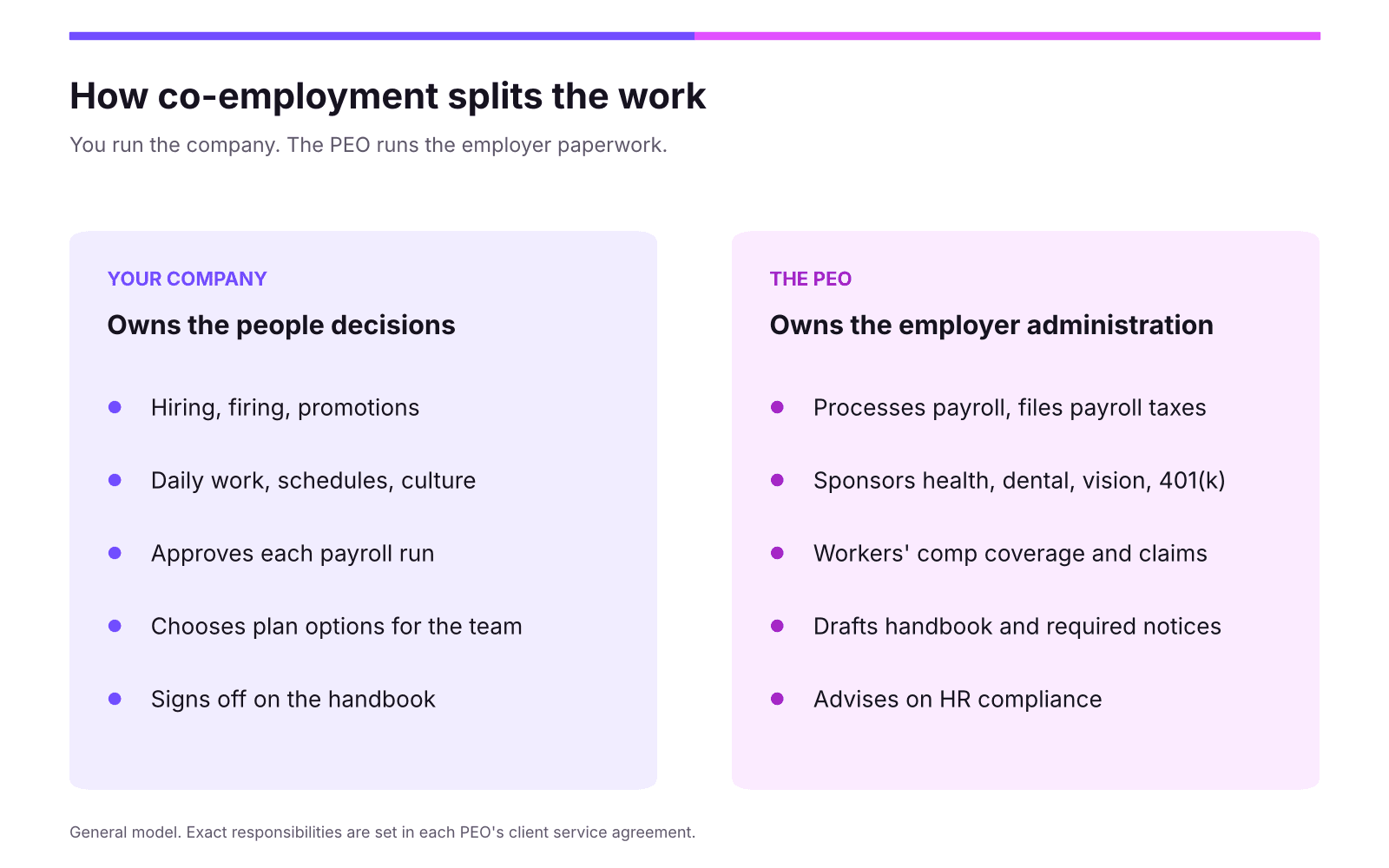
You sign a client service agreement, and the PEO becomes the co-employer of your W-2 employees. Your team still works for you. The PEO pays wages, pays payroll taxes, and enrolls staff in the plans it purchases across its entire client base.
A 15-person company will get insurance as a small group. A PEO will get it for thousands of employees.
Responsibility | Your company | The PEO |
Hiring, firing, promotions | Decides | Advises on compliance |
Daily work, schedules, culture | Owns | No role |
Payroll and payroll tax filing | Approves each run | Processes and files |
Health, dental, vision, 401(k) | Chooses plan options | Sponsors and administers |
Workers' compensation | Reports incidents | Provides coverage and claims support |
Handbook and required notices | Signs off | Drafts and maintains |
What do the PEO services for small business consist of?
- Payroll processing and federal and state payroll tax filings
- Group health, dental, vision, life, and disability coverage
- A 401(k) or other retirement plan
- Workers' compensation coverage and claims support
- Onboarding paperwork (Form I-9, W-4, state forms) and a handbook
- HR guidance when a manager faces a hard call
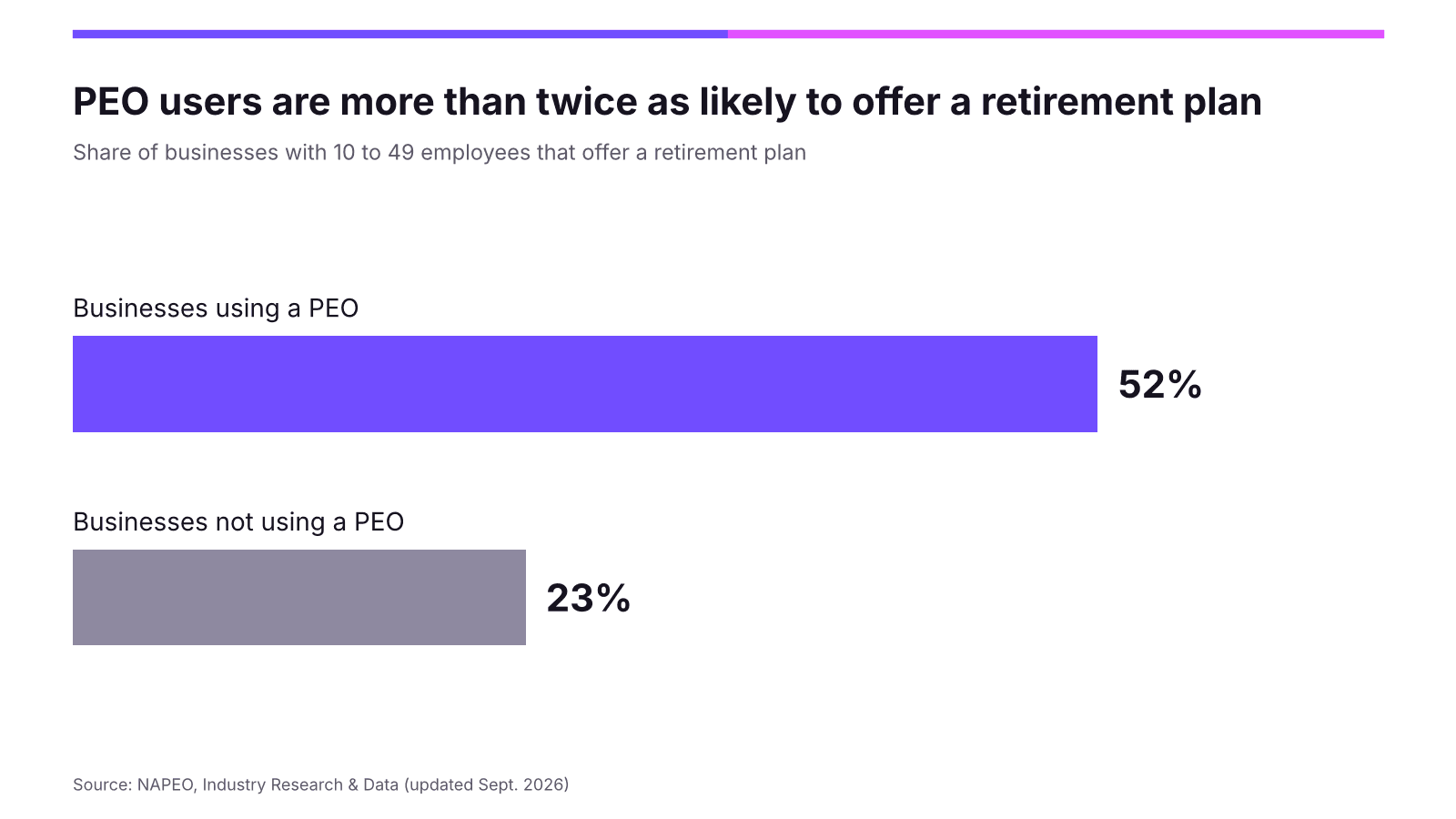
Retirement plans are the clearest indicator of the gap. Of businesses with 10-49 employees, 52% of those using a PEO offer a retirement plan compared to just 23% of those who aren't using a PEO (NAPEO).
When does a startup need a PEO?
The first candidate asks about health insurance
Priya and her co-founder run a two-person fintech in Austin. Two months after their seed, they had an offer from a senior backend engineer at a large bank. He liked the equity. He then asked for a summary of benefits. Priya had a marketplace link and a broker quote for a three-person group.
She signed with a PEO the following week and sent him the large group plan options. He accepted. Benefits cease to be optional the first time a good candidate puts your offer up against a corporate one.
Your first out-of-state hire
Malik's 11-person climate data startup was registered only in NY. In one quarter, he hired a data scientist in Denver and an account exec in Hoboken. Colorado meant a withholding account and registration for the state's paid leave program. New Jersey meant unemployment, disability, and family leave withholding. His payroll tool did the tax calculation but didn't let him know which accounts he still needed to open.
A PEO with multi-state coverage will deal with the majority of the registrations and filings in each state where your people work, so a remote hire doesn't cost you a week trawling through agency websites.
You've become the HR department
John raised a Series A in January and had 26 people by August. By September, his Friday afternoons were spent on the corrections, onboarding forms, and 401ks that he just couldn't answer.
When HR is part of the founder's job, then a PEO for small business operations will hand that function over to a team that does it on a daily basis and gives the employee a platform that doesn't go through the CEO.
Your first hire lives in another state
Jordan's design tools startup in Texas had nine people. His top candidate for head of design turned out to live in California. A PEO co-employs people in U.S. states.
Founders who don't plan for this end up with multiple systems for hiring in different states.
How much does a PEO cost for small companies?
Admin fees are typically 2% to 12% of total payroll (so somewhere between $40 and $160 per employee per month). Insurance premiums are generally billed separately.
Pricing model | How it's billed | Example for 10 employees |
Per employee per month (PEPM) | Flat fee per covered employee | $400 to $1,600 a month |
Percentage of payroll | Share of gross wages | Rises with every raise and bonus |
Before you sign, make sure you ask about setup fees, monthly minimums (particularly if you're a very small team), per-payroll charges, and exit terms. NAPEO calculates the return on using a PEO at 27% in cost savings alone.
How do you pick the right PEO?
The best PEO for small business teams fits the company you'll be in two years. Ask every provider:
- Which carriers and plan tiers are the employees able to select from?
- What's in the fee and what's billed separately?
- Does it cover every state you hire in at the moment and the next three?
- How does it check the payroll prior to running?
- What happens to your payroll history if you leave?
- When you're hiring overseas, do you stay on the same platform?
What does an AI-native PEO bring to a startup?
Niural is an AI-native PEO, so the system checks the work rather than having to wait for a founder to.
- Payroll that's checked prior to running. EMMA (Niural's AI layer) checks the payroll prior to running, picks up any missing rate changes, and flags potential misclassification risk.
- A working balance that earns. You can run your payroll, vendor, and contractor payments out of the Niural Wallet, and the balance you have ahead of each run will then earn cash rewards rather than just sit there.
- One platform from first hire through to global scale. When your candidate is outside the US, Niural's EOR covers 150+ countries on the same platform as your U.S. PEO, payroll, and contractors.
Choosing a PEO for small business growth is an infrastructure decision. It's the cheapest point at which to make that decision, i.e., at hire three before your records are living in four places.
Other related articles:
Top Benefits of PEO for Your Business
Complete Guide to PEO Renewal
Top 5 Compliance Mistakes a PEO Partner Can Eliminate
PEO vs. EOR
Frequently Asked Questions
Do I give up control of the hiring?
You hire, fire, and direct the work. The PEO deals with the payroll, the taxes, and the benefits.
What's the difference between a PEO and an EOR?
A PEO co-employs your U.S. employees with you. An EOR is the sole employer in countries where you have no entity.
Can a PEO employ people outside the U.S.?
A PEO can't. Any international hires would require a local entity or an EOR.
Does a PEO cover independent contractors?
No, the contractors aren't co-employed, and it's your responsibility to get that right.
Who files the payroll taxes when I use a PEO?
The PEO will normally be the one to file the federal and state payroll taxes. Your agreement should specify which of the filings it owns.
What's the state of our current health plan?
The PEO's plans will normally be the ones that take over. Switch at renewal to avoid the mid-year deductible resets.
Can I leave a PEO at a later stage?
Yes, under the contract's notice terms. Ask how payroll history and partial-year filings transfer.
When should I switch from payroll to a PEO?
When benefits join your offer, you hire in a second state, or HR starts eating a founder's week.
Disclaimer: This article is for informational purposes only and isn't legal, tax, or benefits advice. Requirements vary by state. Consult qualified advisors before making employment decisions.
Niural is a financial technology company, not a bank. Banking services are provided by i3 Bank, Member FDIC. Cash rewards are subject to eligibility and terms.