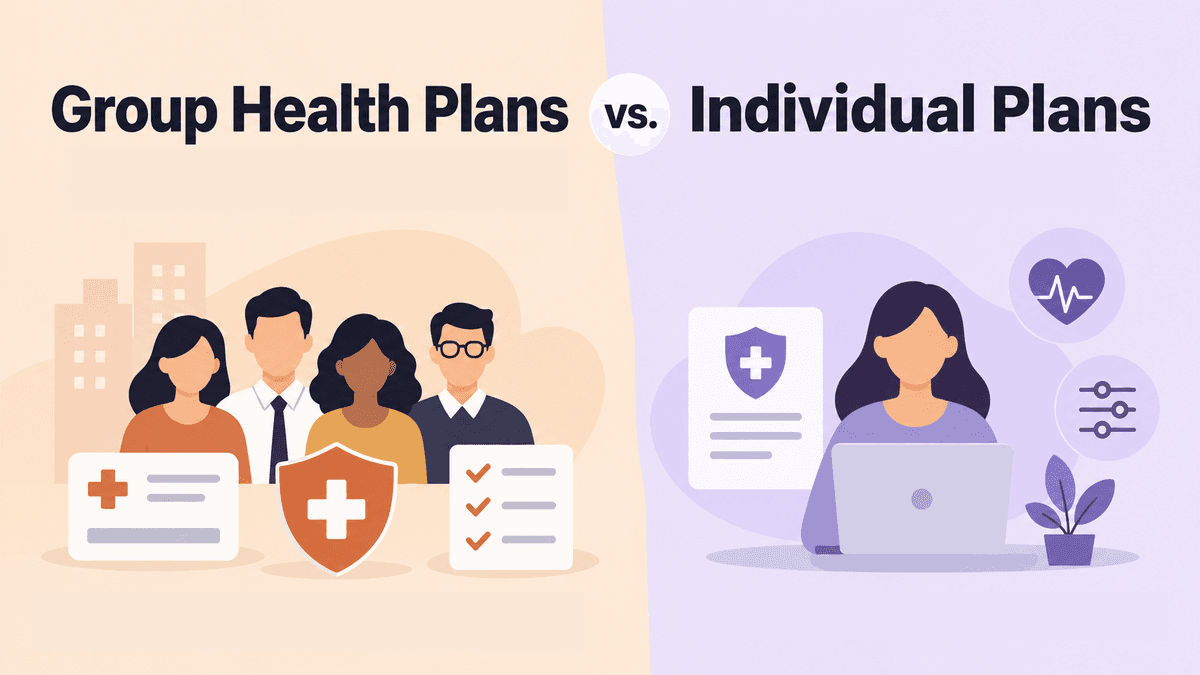
Benefits are the one thing employees notice the moment they go wrong. All of it lands in HR's inbox, not the broker's. So the choice between a group health plan and an individual-plan model shapes the day-to-day experience of every person you employ.
A group health plan means the employer picks one plan, or a short menu, and everyone enrolls in it. An individual-plan model, most often an ICHRA (Individual Coverage Health Reimbursement Arrangement), means the employer gives each employee a tax-free budget, and the employee buys their own plan on the individual market.
For years that tradeoff barely registered, because group coverage was the default and the individual market was small. It registers now. ICHRA adoption roughly doubled between 2025 and 2026 by the HRA Council's count, and the enhanced premium tax credits that had made individual-market plans cheap expired at the end of 2025, changing the math for both employers and employees.
Group vs. individual plans
A group health plan is employer-sponsored coverage. The company (often with a broker or a PEO) selects the plan, negotiates rates as a pool, and pays a share of the premium. Employees choose from whatever the employer offers and enroll during open enrollment.
What this means for employees: the plan is chosen and vetted for them, and they pay a set share of the premium through payroll.
An individual-plan model flips the arrangement. Instead of buying a plan, the employer funds a tax-free allowance and reimburses employees for coverage they buy themselves on the individual market. The two IRS-approved versions are the ICHRA, available to employers of any size with no cap on the allowance, and the QSEHRA (Qualified Small Employer HRA), limited to employers with fewer than 50 full-time-equivalent employees and capped each year by the IRS.
What this means for employees: they shop for and own their plan, and the employer's money offsets the premium.
Group vs. individual plans at a glance
Group health plan | Individual-plan model (ICHRA / QSEHRA) | |
Who chooses the plan | Employer selects one plan or a short menu | Each employee shops the individual market |
Cost model | Employer pays a share of pooled group premiums | Employer sets a fixed tax-free allowance; employee pays the rest |
Budget predictability | Renewals swing with the group's claims and medical trend | Employer sets the allowance, so spend is capped by design |
Company size | Any size; small-group and large-group rules differ | ICHRA: any size. QSEHRA: fewer than 50 FTEs only |
Employer contribution cap | No IRS cap | ICHRA: no cap. QSEHRA (2026): $6,450 self-only / $13,100 family |
Premium tax credit | Not applicable | ICHRA: employee waives the credit if the offer is affordable. QSEHRA: can coordinate, but the allowance reduces the credit |
If the employee leaves | Coverage ends; COBRA may apply | Employee keeps their own plan; it is already in their name |
Employee decision load | Low; the plan is chosen for them | Higher; the employee researches and buys their own coverage |
What a group health plan gives you
The core advantage of group coverage is pooled purchasing. When a company buys as a group, its premiums are spread across the whole pool, and it can reach carriers and networks that an individual buyer or a small employer often cannot.
The second advantage is simplicity, and it is easy to undervalue until you have run the alternative. One plan, one open enrollment, one network for HR to explain. Employees do not have to become insurance shoppers. When someone asks whether their pediatrician is covered, the answer is the same for the whole company. That uniformity is a real part of the employee experience, and it keeps the volume of one-off benefits questions manageable.
The tradeoff is predictability. Group renewals move with the group's claims history and broader medical trend, and a bad claims year or a hard market can produce a double-digit increase that HR and finance have to absorb or pass on.
How ICHRA (and QSEHRA) works
The individual model runs on reimbursement instead of purchasing. The employer sets an allowance, the employee buys a qualifying individual plan (it has to meet minimum essential coverage rules), and the employer reimburses the premium tax-free up to the allowance. The employer's budget is fixed and predictable, because the allowance is a number the company chooses rather than a renewal it receives.
- ICHRA is the flexible version. There is no IRS cap on the allowance, and employers can set different allowances for different employee classes, such as full-time versus part-time or salaried versus hourly. For a company with 50 or more full-time-equivalent employees, the ICHRA can satisfy the ACA employer mandate as long as the allowance makes coverage affordable. For 2026, coverage counts as affordable if an employee's share of the lowest-cost silver plan, after the allowance, does not exceed 9.96% of household income.
- QSEHRA is the small-team version. It is limited to employers with fewer than 50 FTEs that do not offer a group plan, and the IRS caps it every year. For 2026, the caps are $6,450 for self-only coverage and $13,100 for family coverage (per IRS Revenue Procedure 2025-32).
One 2026 wrinkle matters for the employee experience. Employees on an ICHRA cannot also take a premium tax credit on the marketplace. With the enhanced premium tax credits gone after 2025 and individual-market premiums rising, the plan an employee buys with their allowance may cost more out of pocket than it would have a year ago. QSEHRA participants can still use a credit, but the allowance reduces it.
Who should choose a group plan
A group health plan tends to fit companies where the benefit itself is doing recruiting and retention work, and where a low-friction employee experience is worth paying for. Consider group coverage when:
- Benefits are a competitive lever in your talent market, and you want the richest plans and networks you can reach.
- Your workforce is concentrated in places where strong group networks exist.
- You want a uniform, predictable employee experience and a manageable volume of benefits questions.
- Your HR team would rather offload plan administration, enrollment, and compliance than run a reimbursement program.
- Your employees generally want a plan chosen and vetted for them rather than a shopping assignment.
Who should choose an individual plan
The individual model tends to fit companies that value budget control and employee choice over uniformity, and teams willing to support employees through buying their own coverage. Consider ICHRA or QSEHRA when:
- You want a fixed, predictable benefits budget rather than a renewal you cannot control.
- Your workforce is spread across many states or markets, where no single group network fits everyone well.
- You are a small team that has never offered coverage and wants a simple, capped benefit to start with.
- Your employees have genuinely different situations, and some would rather keep their own plan, doctor, or network.
- You are comfortable pushing plan selection to employees and standing up the decision support they will need.
The employee-experience question
Cost usually gets the attention, but the model you pick changes what your employees have to do, and that is the part HR lives with all year.
Under a group plan, employees inherit a decision. The plan was chosen for them, the network is known, and the enrollment path is short. They give up choice, and someone will always wish the company offered a different carrier, but the friction is low, and the questions are predictable.
Under an individual model, employees gain choice and portability and take on the work that comes with both. They have to compare plans, confirm their doctor is in-network, understand what their allowance actually buys, and absorb premium swings on the individual market. In 2026, with enhanced credits expired, those swings are real. HR effectively becomes the decision-support desk during open enrollment, fielding "which plan should I pick" instead of "when does enrollment close."
Neither answer is automatically better. A distributed, independent workforce may love the choice. A team that wants to open the app, see their coverage, and move on may resent it. The right call depends on who your employees are, not on which model looks cheaper on a spreadsheet.
See how Niural's PEO handles benefits, payroll, and compliance in one system.
See related articles:
PEO vs EOR vs Staffing Agency
PEO vs. Employee Leasing
How a PEO Can Improve Your Turnover Rate
Frequently Asked Questions
Can a company offer both a group plan and an ICHRA?
Generally, an employer cannot offer the same employees both a traditional group plan and an ICHRA. Employers can offer different employee classes different options (for example, a group plan for one class and an ICHRA for another) under specific IRS rules. Confirm the class rules with a benefits advisor before designing this.
Is an ICHRA cheaper than a group health plan?
Not automatically. An ICHRA gives the employer a fixed, predictable budget, which is different from guaranteed savings. Whether it costs employees less depends on individual-market premiums where they live.
Do I need 50 employees to offer group coverage?
No, employers of most sizes can offer a group plan; small-group and large-group rules differ. The ACA employer mandate, the requirement to offer affordable coverage, applies once you reach 50 full-time-equivalent employees.
Can employees keep their premium tax credit with an ICHRA?
Usually not. If the ICHRA offer is considered affordable, the employee must waive the marketplace premium tax credit. QSEHRA participants can still use a credit, but the allowance reduces it.
What is the difference between an ICHRA and a QSEHRA?
A QSEHRA is limited to employers with fewer than 50 FTEs and is capped by the IRS each year ($6,450 self-only / $13,100 family for 2026). An ICHRA is available to any employer, has no contribution cap, and allows different allowances by employee class. Their premium-tax-credit treatment also differs.
Which model is better for employee experience?
Group coverage is lower-friction and uniform, since the plan is chosen for employees. The individual model offers more choice and portability but asks employees to shop for and manage their own plan. The better fit depends on how independent and geographically spread your workforce is.
Disclaimer: This article is for general informational purposes only and does not constitute legal, tax, benefits, or compliance advice. Health benefit rules, contribution limits, and affordability thresholds change and vary by situation. Consult qualified legal, tax, and benefits advisors before making plan decisions.