Key takeaways
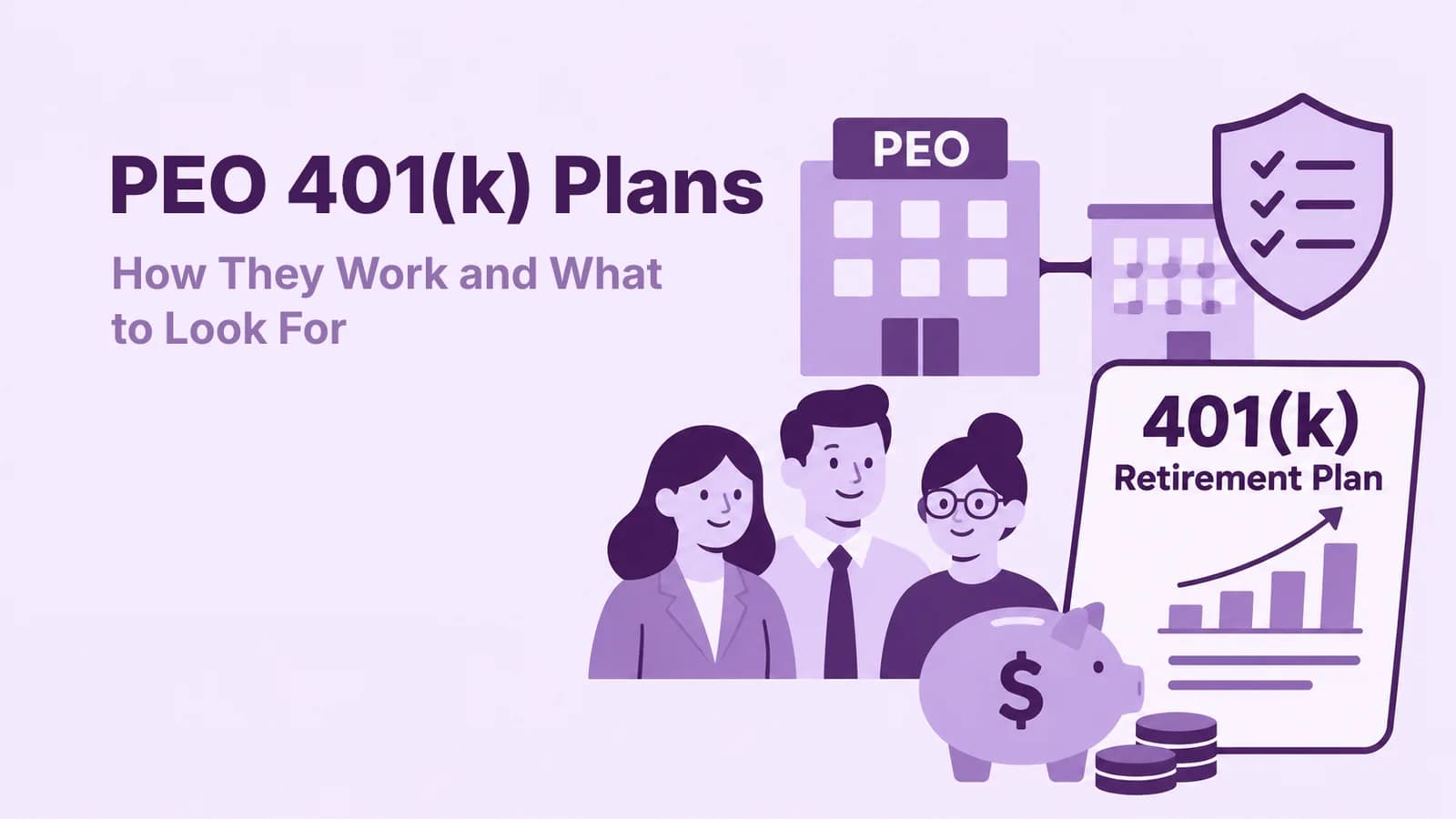
- A PEO 401(k) lets your company join a retirement plan offered through your PEO, either a multiple employer plan (MEP) the PEO sponsors or a pooled employer plan (PEP), so you skip most of the setup, filings, and vendor management a standalone plan requires.
- Waiting costs more than it used to. California fines employers that ignore CalSavers $250 per eligible employee, and new 401(k) plans must auto-enroll workers once a company outgrows the startup exemptions.
- Judge a PEO plan on fees, investment lineup, plan design options, deposit timing, and what happens to the plan if you leave the PEO.
- Most 401(k) errors start in payroll, so running payroll, benefits, and retirement in one system from your first hire prevents most of them.
A 401(k) used to be something companies added around their 50th hire. That timeline does not work anymore. California requires employers with even one employee to offer a retirement plan or register for CalSavers, and the state can fine noncompliant employers $250 per eligible employee, then another $500 per employee if the problem continues. New 401(k) plans now have to auto-enroll employees, and Congress expanded the tax credits that pay for a small company's first years of running one.
For many early-stage companies, the fastest way through all of this is a PEO 401(k): a retirement plan your company joins through its professional employer organization, with the PEO or its plan provider handling most of the plan administration, compliance filings, and recordkeeper relationships. You choose the contribution and match settings the plan allows, your employees get a 401(k) with the same 2026 limits as any other plan, and you avoid building a benefits function before you need one.
What is a PEO-sponsored 401(k)?
A PEO 401(k) is a retirement plan your company joins through its professional employer organization instead of creating its own. Because the PEO is your co-employer for payroll and benefits, it can offer your employees a 401(k) the same way it offers group health insurance.
PEOs offer these plans in one of two structures:
- Multiple employer plan (MEP). One plan document covers every participating company. A PEO that meets the Department of Labor's bona fide PEO criteria can sponsor the plan itself, and it must keep its obligations to plan participants after a client company leaves. If the PEO doesn't meet those criteria, the DOL treats each client company as sponsoring its own plan for ERISA purposes (DOL Advisory Opinion 2012-04A).
- Pooled employer plan (PEP). A registered pooled plan provider runs the plan and serves as its named fiduciary and plan administrator. Some PEOs act as the pooled plan provider for their own PEP. Others partner with an outside provider.
From your employees' side, both look the same: they enroll through the PEO's portal, and deferrals come out of the paycheck the PEO already runs.
How do PEO retirement plans work?
PEO retirement plans work through your payroll. A single dollar takes this path:
- Your employee elects a deferral, say 5% of pay, in the PEO's employee portal (or is auto-enrolled at the plan's default rate).
- Payroll withholds the deferral each pay period. Any employer match is paid by the company in addition to pay, not deducted from paycheck.
- The PEO sends the money to the plan's recordkeeper. Department of Labor rules require deposits as soon as the money can reasonably be separated from company funds. Small plans, those with fewer than 100 participants, get a safe harbor: deposits made within seven business days of withholding count as timely. A MEP or PEP counts participants across every company in the plan, so most PEO plans are too large for the safe harbor and must meet the as-soon-as-reasonable standard.
- The recordkeeper invests it in the funds the employee picked, or in the plan's default fund.
- The PEO and its providers handle the annual work: nondiscrimination testing, Form 5500 filing, required notices, and participant disclosures.
Your company keeps some duties. You choose and monitor the PEO prudently, send accurate payroll data, and fund any employer contributions. Ask the PEO to show you in writing which fiduciary duties it accepts and which stay with you.
Late deposits are the most common way small companies get caught. The DOL treats a late deferral deposit as a prohibited transaction under ERISA: the employer restores participants' lost earnings, may owe an excise tax, and reports the late deposit on Form 5500. Because deposits start in payroll, your payroll system matters as much as your recordkeeper.
How do PEO plans, PEPs, and standalone 401(k)s compare?
A PEP is one of the structures a PEO can use, so the real choice is among three plan structures:
Standalone 401(k) | Multiple employer plan (MEP) | Pooled employer plan (PEP) | |
Who sponsors it | Your company | The PEO, if it meets the DOL's bona fide PEO criteria; otherwise, each client sponsors its own plan for ERISA purposes | A registered pooled plan provider, which can be a PEO, a recordkeeper, or another financial firm |
Who runs daily administration | You, or providers you hire and manage | The PEO and its providers | The pooled plan provider |
Your fiduciary load | Highest; you select and monitor every provider | Lower; you select and monitor the PEO | Lower; you select and monitor the pooled plan provider |
Plan design control | Full control over match, vesting, eligibility, and funds | You choose from the PEO's menu | You choose from the provider's menu |
Tied to another service | No | Usually; participation depends on your PEO relationship | Depends on the provider; some PEPs are open to any employer, others come with a PEO or payroll service |
If you switch providers | Move the plan to a new recordkeeper | Your portion is spun off or transferred | Your portion is spun off or transferred, unless the PEP lets you stay after leaving the PEO |
Usually best for | Larger teams that want custom design | Early-stage teams already in a PEO | Teams that want a pooled plan, with or without a PEO |
The 2019 SECURE Act created PEPs so unrelated companies could share one plan. The pooled plan provider must register with the DOL and the IRS and serve as a named fiduciary and ERISA 3(16) plan administrator. When your PEO is also the PEP's provider, retirement runs through the same system as payroll and health benefits. When the PEO partners with an outside provider, ask how deferral data moves between the two.
Why are founders setting up 401(k)s earlier than they used to?
Three changes moved the decision earlier.
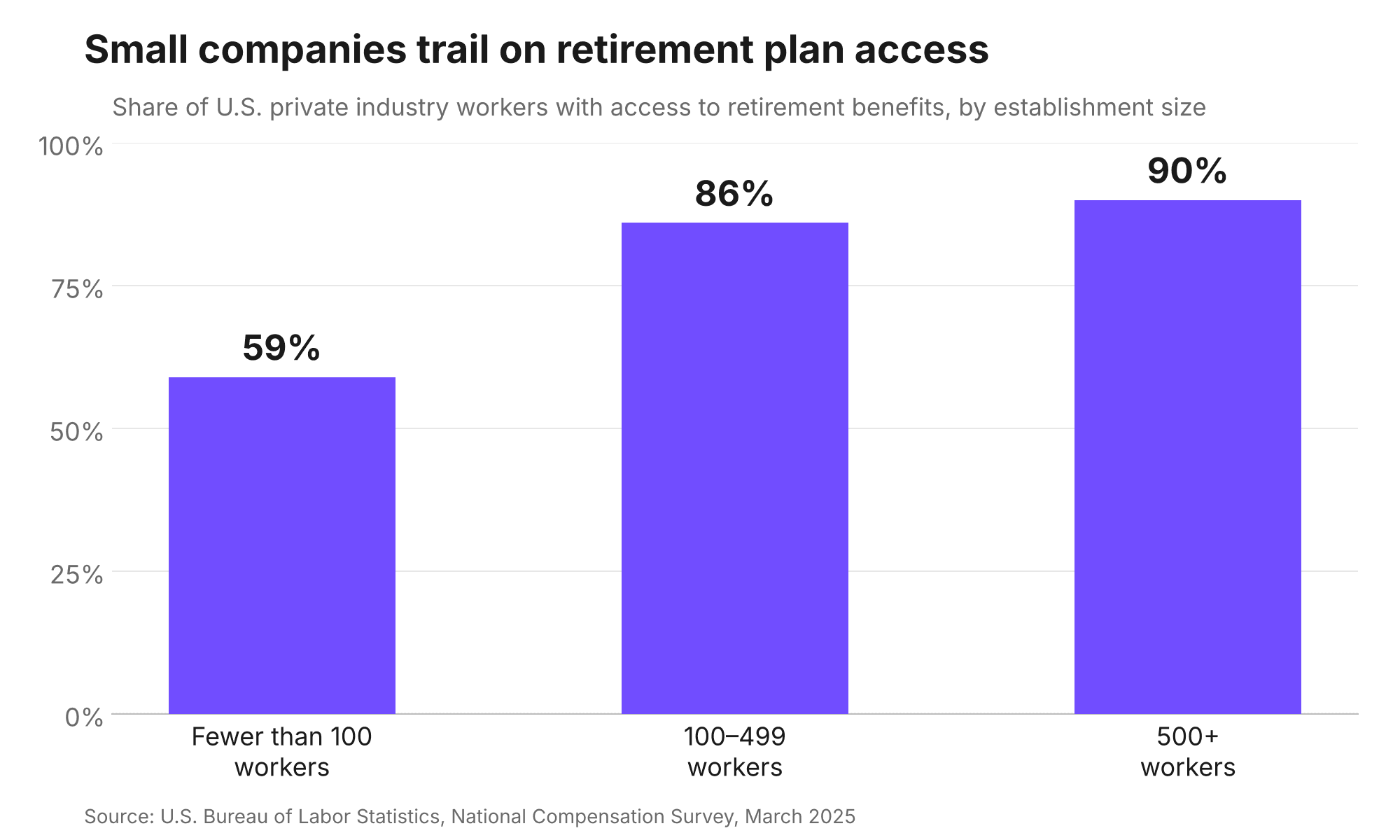
1. Small companies are the gap, and employees notice. In March 2025, 59% of private industry workers at establishments with fewer than 100 employees had access to retirement benefits, compared with 86% at establishments with 100 to 499 workers and 90% at those with 500 or more. Candidates coming from larger companies expect a 401(k) and will compare offers on it.
PEOs narrow that gap. According to NAPEO, 98% of PEOs offer some kind of retirement plan to their clients. The difference is largest at the smallest companies: among businesses with fewer than 10 employees, 40% of PEO clients' employees participate in an employer-provided retirement plan, compared with 13% at similar businesses without a PEO. At 10 to 49 employees, the figures are 52% and 23%.
2. States now require a retirement option. California, Illinois, Oregon, New York, New Jersey, and other states run auto-IRA programs. Employers without a qualified plan must register and send payroll deductions to the state program, and California backs its mandate with per-employee fines. A qualified 401(k), including a MEP or PEP, generally satisfies these mandates, though most states still require you to certify the exemption in their portal.
3. Federal rules changed the economics of starting a plan. SECURE 2.0 requires 401(k) plans established after December 29, 2022, to auto-enroll eligible employees at 3% to 10% of pay, rising 1% a year until at least 10%. Businesses less than three years old and those with 10 or fewer employees are exempt until they grow past those limits. In a multiple employer plan, the exemptions apply to each participating employer separately, so a young company in a PEO plan keeps its exemption even if other clients don't qualify.
What should you look for in PEO 401(k) plans?
Before you commit, get clear answers on these points:
- Total fees and who pays them. Ask for recordkeeping fees, advisory fees, and fund expense ratios in one document. Note which fees come out of employee balances and which your company pays. Ask too whether plan costs are billed separately or bundled into the PEO fee, since that affects the startup credit.
- Investment lineup. Look for low-cost index options and a sensible default fund, usually a target-date series. Ask who chooses the funds and how often they're reviewed.
- Plan design options. Check whether you can set auto-enrollment, a safe harbor match, vesting schedules, eligibility waiting periods, and Roth deferrals for your company, or whether one design applies to everyone.
- Payroll integration and deposit timing. Ask how fast deferrals reach the recordkeeper after each payroll and how the PEO catches deduction errors before money moves.
- Testing support. Ask who runs nondiscrimination testing and what happens if your company fails it. Small teams with highly paid founders fail more often, and a safe harbor design avoids the main tests.
- Employee experience. Have someone on your team log into a demo account and check how easy it is to change a deferral rate, see a balance, or roll in an old 401(k).
- Exit terms. Ask how the PEO handles a client who leaves, what it costs, and how long it takes. The next section covers why this matters.
What happens to your 401(k) if you leave the PEO?
Teams usually face this at Series B, when they outgrow their PEO or move to their own benefits setup.
Your employees' vested balances belong to them no matter what happens to the PEO relationship. What changes is the plan around those balances. Typically, your company's share of the plan is either spun off into a new standalone 401(k) or transferred into a new provider's plan. If the plan is a PEP that doesn't require the PEO relationship, you may be able to stay in it after you leave the PEO. During a move, employees may face a blackout period when they can't change investments or take loans. Under ERISA, a blackout longer than three consecutive business days requires notice to participants at least 30 days in advance, so the transition needs a planned timeline.
Before you sign, ask the PEO:
- What does a spin-off or transfer cost, and who pays?
- How long does the process usually take, and how long is the blackout period?
- Will the plan's records, including contribution history and testing data, transfer cleanly to the next provider?
- Can we stay in the plan, or keep the same recordkeeper, if we leave the PEO?
Getting these answers now prevents a rushed migration when you're in the middle of a fundraise.
Building retirement into your infrastructure from day one
Niural is the AI-native PEO for growing teams. Payroll, benefits, compliance, and the 401(k) run in one employment environment from your first hire, so a change in one place carries through to everything that depends on it. EMMA, Niural's AI layer, validates payroll before the run.
Two more things matter as you grow. Eligible cash balances held in Niural Wallet can earn cash rewards*, subject to program terms. And when you hire outside the U.S., Niural's EOR covers 150+ countries. Employees abroad receive the retirement benefits local law requires instead of a 401(k), such as automatic enrollment in a UK workplace pension or contributions to the Canada Pension Plan. It's the same platform from first hire to global scale.
Other related articles
Top benefits of a PEO for your business
Complete guide to PEO renewal
1099 vs. W-2 classification rules
Payroll deductions explained
Group vs. individual health plans
Top 5 compliance mistakes a PEO can eliminate
Frequently Asked Questions
What is a PEO retirement plan?
A PEO retirement plan is a 401(k) or similar plan your company joins through its professional employer organization. It's structured either as a multiple-employer plan the PEO sponsors or as a pooled employer plan run by a pooled plan provider. Either way, the PEO or the provider handles most of the administration, filings, and provider management.
Is a PEO plan cheaper than a standalone 401(k)?
It can be, because administrative costs are spread across many clients. It isn't guaranteed. Compare the total cost, including recordkeeping fees, advisory fees, and fund expense ratios, against at least one standalone quote before you decide.
Who is the fiduciary in a PEO plan?
It depends on the structure. In a MEP sponsored by a PEO that meets the DOL's bona fide PEO criteria, the PEO is the plan sponsor and takes on most day-to-day administrative duties. In a PEP, the pooled plan provider is the named fiduciary and plan administrator. Either way, your company still has a fiduciary duty to choose and monitor the provider prudently and to send contributions on time. Ask for the fiduciary split in writing.
Does a PEO plan satisfy CalSavers and other state mandates?
Generally, yes. State auto-IRA programs exempt employers that offer a qualified retirement plan, and MEPs and PEPs qualify. Most states still require you to log in and certify the exemption, so confirm the process for each state where you have employees.
Do I have to auto-enroll employees?
New 401(k) plans established after December 29, 2022 must auto-enroll eligible employees unless the business is less than three years old or has 10 or fewer employees. In a multiple employer plan, those exemptions apply to your company individually.
Can I claim the startup tax credit if I join a PEO plan?
SECURE 2.0 extended the startup credit to employers that join an existing multiple employer plan, as long as the company hasn't had a qualified plan recently and meets the other requirements. The credit only covers plan costs your company actually pays, so costs bundled into a PEO fee may not qualify. Confirm eligibility with your tax advisor before filing Form 8881.
What are the 2026 401(k) contribution limits?
Employees can defer up to $24,500 in 2026. Workers 50 and older can add an $8,000 catch-up contribution, and workers aged 60 to 63 can add up to $11,250 instead. Starting in 2026, catch-up contributions must be made as Roth contributions for employees whose prior-year FICA wages exceeded $150,000. Combined employee and employer contributions are capped at $72,000, excluding catch-up contributions.
Can founders and owners participate?
Yes, founders who are W-2 employees of the company can defer and receive employer contributions. Highly paid owners can trigger nondiscrimination testing problems, which a safe harbor plan design avoids.
What happens to employee balances if we leave the PEO?
Vested balances belong to employees and stay protected. Your company's portion of the plan is usually spun off into a new plan or transferred to a new provider, sometimes with a short blackout period. A blackout longer than three business days requires at least 30 days' advance notice.
Can contractors join the company 401(k)?
No, independent contractors aren't employees, so they can't join your company's 401(k). They can save on their own through a SEP IRA or a solo 401(k).
What is a safe harbor 401(k)?
A safe harbor 401(k) requires the employer to make a set contribution, such as a matching contribution or a 3% non-elective contribution for every eligible employee. In exchange, the plan skips the main annual nondiscrimination tests. Traditional safe harbor contributions vest immediately. A qualified automatic contribution arrangement (QACA) safe harbor can use up to two-year cliff vesting instead.
How quickly do 401(k) deductions have to reach the plan?
Deferrals must be deposited as soon as they can reasonably be separated from company funds. Small plans, those with fewer than 100 participants, get a safe harbor: deposits within seven business days of the paycheck count as timely. Participants are counted across the whole plan, so most MEPs and PEPs don't qualify for the safe harbor.
Can employees outside the U.S. join a 401(k)?
Generally, no. Employees hired abroad, including through an employer of record, receive the retirement benefits required in their country, such as a UK workplace pension or Canada Pension Plan contributions.
When should a startup set up a 401(k)?
The practical trigger is your first employee in a state with a retirement mandate, or your first candidate who asks about one. Setting up earlier also means you can claim the federal tax credits sooner.
Disclaimer: *Niural is a financial technology company, not a bank. Banking services are provided by i3 Bank, Member FDIC. Cash rewards are subject to eligibility and terms.
This article is for informational purposes only and does not constitute legal, tax, or investment advice. Retirement plan rules, contribution limits, and tax credit thresholds change; consult qualified legal, tax, and benefits advisors about your company's situation.