Key takeaways
- Confirm the worker is a contractor before you pay them. The IRS, the Department of Labor, and indeed many states have their own tests, and the designation in your contract doesn't determine it.
- Get the U.S. contractors' Form W-9 and the foreign contractors' Form W-8BEN or W-8BEN-E before the first payment.
- For 2026 payments, you'll file a Form 1099-NEC for each U.S. contractor you paid $2,000 or more. The old threshold was $600.
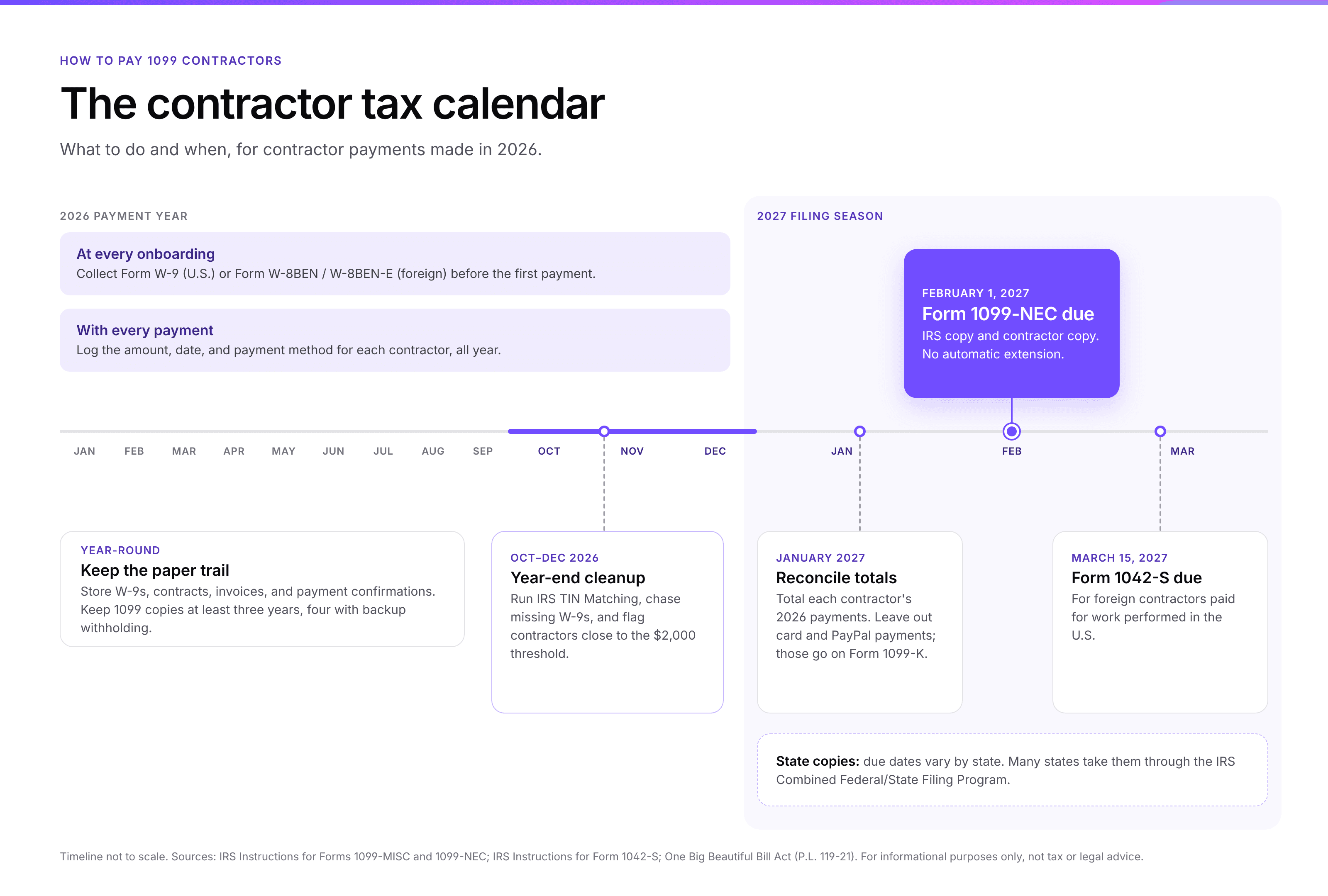
- 2026 Forms 1099-NEC are due February 1st 2027, to both the IRS and the contractor, with no automatic extension.
- A foreign contractor who is entirely outside the U.S. and provides you with a valid W-8BEN will generally receive neither a 1099 nor any U.S. withholding.
Paying a 1099 contractor is straightforward. They send you an invoice, and you send them the money. What trips companies up is the work that has to happen around the payment. You need a tax form prior to the first dollar moving, a contract that reflects the way they work, a payment method that won't double-count the income, and a Form 1099-NEC that's filed on time. The rules have also changed in 2026, so a process that was built on the old $600 threshold now over-reports.
Most people would refer to this as contractor payroll (even though in the strictest sense, contractors aren't on payroll at all). You don't withhold income or payroll taxes, you don't issue a W-2, and you don't pay the employer's share of Social Security and Medicare. The term is a bit of a misnomer in that it covers the entire process of onboarding contractors, paying them, and reporting what you've paid at the end of the year.
The short answer
To pay your 1099 contractors correctly you need to (a) confirm that the worker is in fact a contractor (b) collect a W-9 (or W-8BEN if it's a foreign contractor) prior to the first payment (c) have a written agreement (d) pay against the invoice (e) keep a running total of what you've paid each contractor and (f) file a Form 1099-NEC for every U.S. contractor you paid $2,000 or more in 2026 by February 1st 2027.
What are the steps to pay a 1099 contractor?
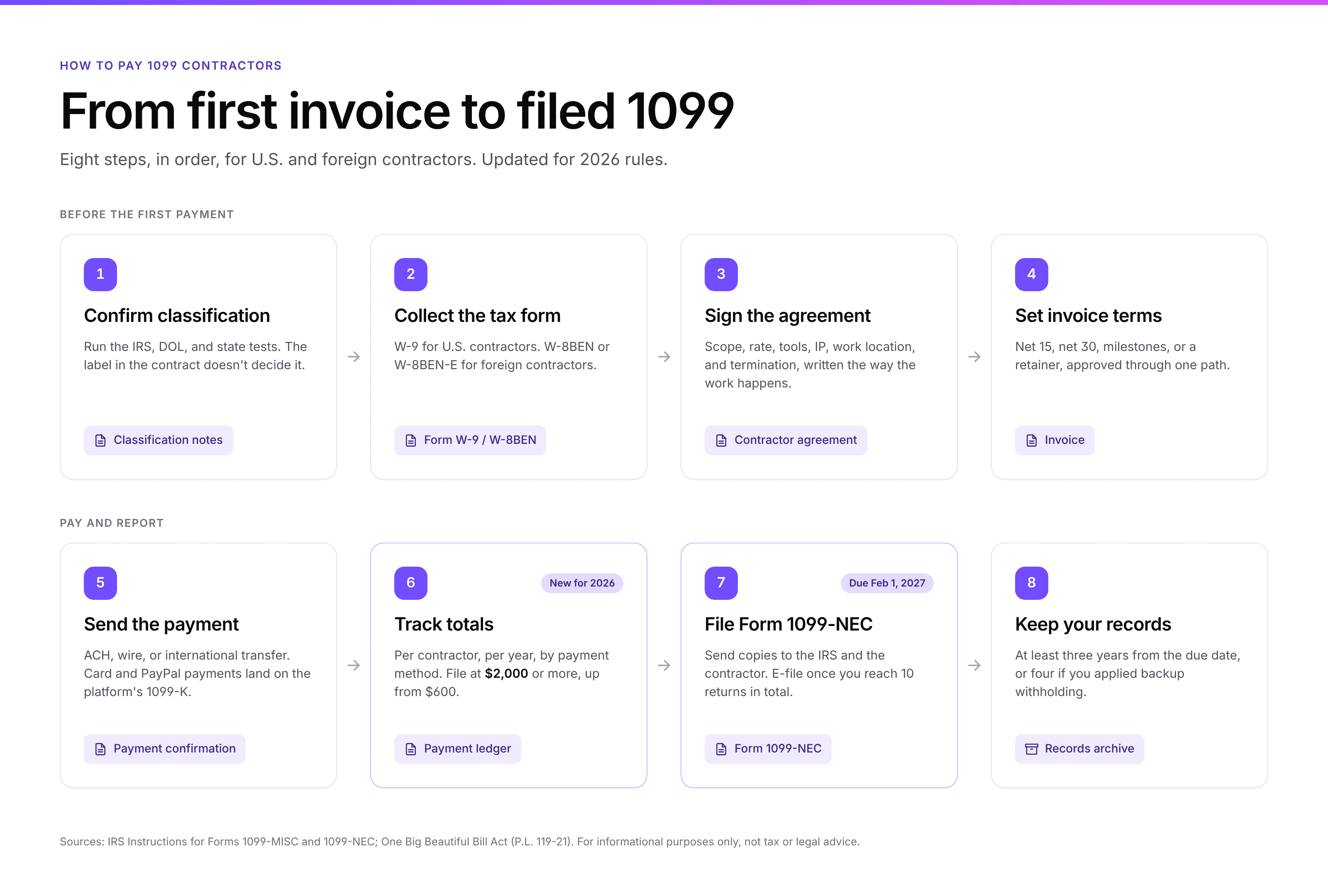
Here's the full process in order. Each step has its own section below.
- Confirm the worker is an independent contractor.
- Get the W-9 (U.S.) or the W-8BEN/W-8BEN-E (foreign) completed prior to the first payment.
- Sign a written contractor agreement that reflects the way the work actually gets done.
- Agree on the invoicing and payment terms.
- Choose a payment method.
- Track every payment made to the contractor throughout the year.
- File the Form 1099-NEC with the IRS and send a copy to the contractor.
- Keep your records.
Step 1: Make sure the person qualifies as a contractor
Every subsequent step is predicated on classification. If the individual in question is a W-2 employee, then clean invoicing won't solve it.
The IRS looks at the entire relationship through three categories of evidence: behavioral control (who controls how the work is done), financial control (who bears the business risk, who provides the tools, and who can make a profit or loss), and the nature of the relationship between the parties (benefits, permanence, and whether the work is central to your business).
The DOL applies its own "economic reality" test under the FLSA. It suspended enforcement of its 2024 rule in May 2025 and, on Feb. 26, 2026, proposed a new rule based on two key factors: the degree of control the worker has over the work and the worker's opportunity for profit or loss. A number of states (CA, MA, NJ, to name a few) use a much more stringent ABC test which starts from the premise that the worker is an employee.
FedEx Ground is a case in point as to what's on the line when the facts don't match the paperwork. The drivers were all signed up as independent contractors, but they drove FedEx-branded trucks, wore FedEx uniforms, and used FedEx scanners. In 2016, they agreed to pay out $240m to some 12,000 drivers across 20 states, in addition to the earlier $226m settlement in California.
What it means for you: set out why each contractor meets the relevant test (the test that applies in the state in which they work).
Step 2: Collect a W-9 or W-8BEN before the first payment
Get the tax form before you do anything. Chasing a W-9 in January after the contractor has moved on often results in late filing or a blank TIN.
Contractor | Form to collect | Year-end reporting |
U.S. individual or single-member LLC | Form W-9 | Form 1099-NEC if paid $2,000+ in 2026 |
U.S. partnership or LLC taxed as a partnership | Form W-9 | Form 1099-NEC if paid $2,000+ in 2026 |
U.S. C or S corporation | Form W-9 | Generally no 1099-NEC, except for reportable payments such as attorney fees |
U.S. citizen or green card holder living abroad | Form W-9 | Generally Form 1099-NEC if paid $2,000 or more in 2026 |
Foreign individual | Form W-8BEN | Generally none if all work is performed outside the U.S. |
Foreign entity | Form W-8BEN-E | Generally none if all work is performed outside the U.S. |
Two habits will prevent the vast majority of problems. First, check each name and TIN against IRS records through the IRS TIN Matching program before filing. Secondly, know when backup withholding applies. If a U.S. contractor is not going to give you a TIN, or the IRS tells you the TIN is wrong, you'll be required to withhold 24% of the payments once the annual total hits the reporting threshold (which is $2,000 in 2026).
Step 3: Put the working relationship in writing
A contractor agreement only protects both parties if it actually sets out how the work is to be done. Microsoft learned that in the 'permatemp' litigation. Thousands of permatemp workers were in exactly the same position as regular employees, under the same supervision, yet their contracts classified them as temporary or independent contractors. The courts were quite clear on that point, and Microsoft eventually settled for $97m in 2000.
A solid contractor agreement covers:
- Scope and deliverables: what the contractor will actually produce rather than the number of hours they'll sit at their desk.
- Rate and invoicing: hourly, per project, per milestone. And how and when to invoice.
- Tools and methods: the contractor provides their own plan and determines how they do the work.
- Intellectual property: who owns the work product once it's paid for.
- Work location: where the work is carried out (this is obviously of significance to foreign contractors).
- Term and termination: how either side brings it to an end.
Step 4: Agree on invoicing and payment terms
Contractors bill you. You don't run a pay cycle for them. You need to agree on the terms up front: net 15 or net 30 for ongoing work, milestone payments for a project, or a monthly retainer for ongoing advisory work.
Ask for the same details on every invoice (legal name as per the W-9, invoice number, dates of service, description of work, and amount). Route all invoices through one approval pathway. If one invoice is approved by a founder in Slack and another by a department head via email, then no one will have any idea what each contractor has been paid.
Step 5: Choose how you’ll send the money
How you pay has an impact on cost, speed, and how the payment is reported.
- ACH or direct deposit is the default for U.S. contractors. It’s cheap and leaves a clean electronic trail.
- Domestic wires are more expensive and are better suited to large or time-sensitive payments.
- Credit cards and third-party platforms (e.g., PayPal) are the ones that will be the ones reporting the payment. The IRS instructions for Forms 1099-MISC and 1099-NEC state that payments made by credit card or via third-party networks won't appear on a Form 1099-NEC, as the platform will report them on a Form 1099-K. If you include them on the 1099-NEC anyway, then the contractor's income will be reported twice.
- International transfers involve currency conversion, transfer fees, and local banking rules. A contractor in Lisbon may want euros in a Portuguese bank account rather than dollars sent by wire.
Step 6: Track every payment by contractor
This step determines whether the contractor's payroll remains clean or turns into a right old scramble in January. Maintain a running total per contractor, per calendar year, broken down by payment method.
The 2026 threshold changes the equation. The One Big Beautiful Bill Act raises the 1099-NEC reporting threshold from $600 to $2,000 for payments made on or after 1st January 2026. It's the first change since the 1950s, and from 2027 onwards the threshold will be adjusted for inflation each year.
If you paid a Denver copywriter $1,800 via ACH in 2026, you don't need to file a 1099-NEC. An Austin developer you paid $2,400 via ACH will get one. A Chicago designer you paid $3,000 to all the way through a card platform will get a 1099-K from the platform, and you file nothing. Your contractors still owe tax on every dollar, whether it's reported or not.
States add their own layer on top of that. Some have their own reporting thresholds or filing requirements that are different from the federal rules, and some will ask you to report new contractors. California has a requirement that businesses report independent contractors to its Employment Development Department on Form DE 542. You'll need to check the rules in each state where your contractors are working.
Step 7: File Form 1099-NEC on time
For the 2026 payments, the 1099-NEC is due February 1st 2027 (January 31st falls on a Sunday). That's the date that applies to the copy you file with the IRS and the copy you send to the contractor. Form 1099-NEC doesn't get the automatic 30-day extension.
If you file 10 or more information returns in total (W-2s and 1099s combined), you must file electronically. The IRS's free Information Returns Intake System (IRIS) will take small volumes, and most payroll services will file on your behalf for independent contractors. Many states will want their own copy (either filed directly with them or via the IRS Combined Federal/State Filing Program). Late penalties get worse the longer you wait, and the IRS can penalize both the IRS copy and the contractor copy.
When the correct return is filed | Penalty per return |
Within 30 days of the due date | $60 |
After 30 days, by August 1 | $130 |
After August 1, or not filed | $340 |
Intentional disregard | $680 minimum, no cap |
Step 8: Keep your records
Store every W-9, W-8BEN, contract, invoice, approval, payment confirmation, and filed 1099 in one place. The IRS requires payers to retain copies of information returns for at least 3 years from the date they are due (or 4 years if you applied backup withholding). That trail is your evidence if an agency ever questions a classification.
How do you pay your foreign contractors?
The steps are the same, just three slight variations in the detail.
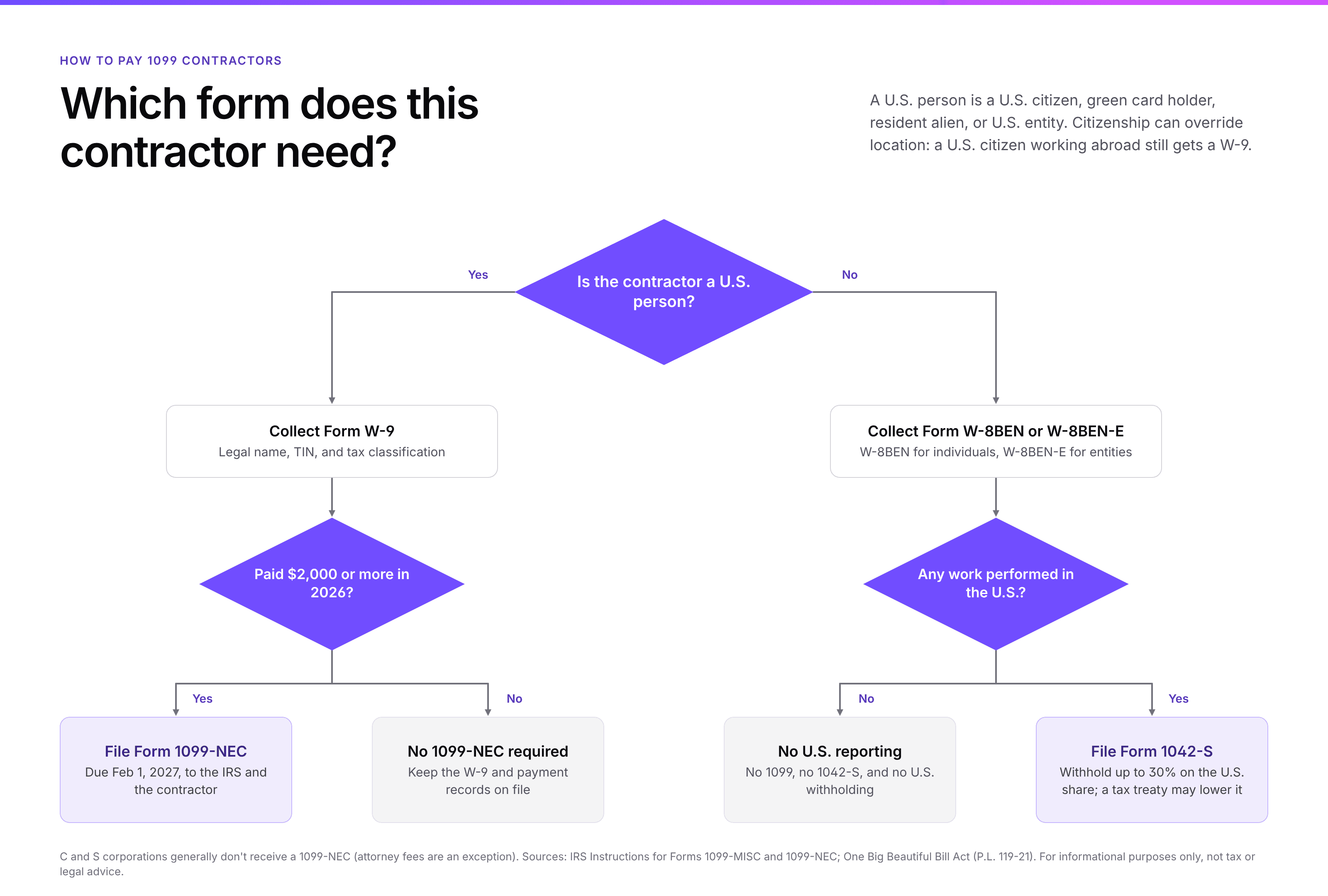
The form changes. A foreign individual will supply you with a Form W-8BEN and a foreign entity will supply you with a Form W-8BEN-E. They supply it to you, not to the IRS, and you hold onto it.
Where the work takes place determines the reporting. A non-U.S. person who does all their work outside the U.S. earns foreign-source income. You generally file no 1099-NEC, no Form 1042-S, and make no withholding. If any of the work is done on U.S. soil, then that portion becomes U.S. source income, which may require 30% withholding (which may be reduced by a tax treaty) and a Form 1042-S. If your Toronto consultant flies out to your New York office for a two-week sprint, then those two weeks are a separate issue.
Citizenship trumps location. A U.S. citizen working remotely from Mexico City is still a U.S. person. Just collect the W-9 and issue the 1099-NEC as normal.
Foreign contractors are also subject to their home country's labor laws, including their own local misclassification rules. If someone is working full-time for you on your schedule and has no other clients, then an Employer of Record (EOR) would be worth considering. That would be an EOR who would employ that person locally on your behalf, without you having to set up a foreign entity.
Which independent contractor payroll solution is right for you at your stage?
Setup | Works for | Gaps to watch |
Spreadsheet plus bank transfers | A few U.S. contractors | Manual W-9 tracking, no year-end totals, easy to miss the deadline |
Accounting software AP module | Contractors treated like vendors | Weak on tax forms, classification, and international payments |
Standalone payroll for contractors | Growing U.S. contractor base | Separate from employee payroll, often limited country coverage |
Unified workforce platform | Mixed teams of contractors and employees, U.S. and abroad | Requires a single implementation up front |
Most companies will outgrow the spreadsheet at some point, especially when they start paying contractors in more than one state or country, or when they start hiring W-2 employees in addition to contractors. If you have contractor payroll in one system and employee payroll in another, you don't have a view of the total workforce cost anywhere. A contractor who converts to an employee is effectively re-entered from scratch.
Paying contractors and employees from one platform
Niural is an AI-native platform for employment and business payments, designed so that a company can start with its first contractor and then use the same platform as it hires employees both in the U.S. and overseas.
For contractors, Niural takes care of onboarding, tax form collection, contracts, invoice-based payments, and year-end reporting. Contractor payments are available in 150+ countries. EMMA, Niural's AI layer, flags potential misclassification risk so your team can review the relationship before it becomes a problem. All of your payroll, contractor, and vendor payments come out of one wallet with shared approvals and one ledger, so finance sees all obligations on one ledger.
When you hire your first W-2 employee or your first employee in another country via Niural's EOR, they go on the same platform as your contractors. Niural supports you from first hire right through to global scale, so the contractor payroll setup you do today can absolutely be the one that carries your whole workforce later on.
Book a demo to see how Niural pays contractors and employees in one system.
Other related articles:
How to Convert a Contractor to an Employee
How to Offer Contractor Benefits
How to Hire an Independent Contractor
EOR vs. Contractor
Independent Contractor vs. Part-Time Employee
Frequently Asked Questions
Do I withhold tax from payments to my 1099 contractors?
No, in most cases. Contractors pay their own income and self-employment tax. The only exception is backup withholding (you'd withhold 24%) if the contractor doesn't provide a TIN or the IRS has notified you that the TIN is incorrect.
What's the 1099-NEC threshold for 2026?
$2,000 per contractor for payments made in the calendar year 2026 (up from $600). From 2027, the threshold will be adjusted for inflation each year.
When is the Form 1099-NEC due for 2026 payments?
Feb 1st 2027, for both the IRS copy and the contractor's copy. Jan 31st 2027, is a Sunday, so that moves the deadline to the following business day.
Do I issue a 1099 to a foreign contractor?
Generally no. If the contractor is a non-U.S. person who does all of their work outside the U.S. and provides you with a valid Form W-8BEN or W-8BEN-E, then you don't issue a 1099-NEC. Work performed within the U.S. may require Form 1042-S and withholding.
What should I do if a contractor won't provide me with a W-9?
Don't make the payment until you have it. If you've already paid, you are required to apply 24% backup withholding once the contractor's payments reach the reporting threshold.
Do I issue a 1099-NEC if I paid the contractor by PayPal or credit card?
No, payments made by card or via third-party payment networks are reported by the platform on Form 1099-K. Omit them from the 1099-NEC; otherwise, the income would be reported twice.
Do we need to issue a 1099 to an LLC?
Usually yes, for a single-member LLC or one taxed as a partnership. An LLC that elects to be taxed as a C or S corporation won't normally get one. The W-9 will tell you which it is.
Is contractor pay the same as employee pay?
No, employee payroll is the process of withholding, paying employer payroll taxes, and issuing a Form W-2. Contractor payroll is the process of paying the invoices and reporting the total on a Form 1099-NEC.
What do payroll services for the independent contractor actually do?
They collect the W-9s and W-8BENs, hold the payment details, pay the approved invoices via ACH or international wire, track the totals by contractor, and file the 1099-NEC at year-end.
How often should you pay your 1099 contractors?
Whenever your agreement states it (commonly net 15 or net 30 after an invoice, per milestone, or on a monthly retainer). The contractor is the one that's billing you, so there's no fixed pay cycle.
What if I've got the wrong classification of an employee as a contractor?
You can owe back payroll taxes, back unpaid overtime, back benefits, back state unemployment contributions, back penalties, and back interest.
How long should I keep contractor payment records?
At least three years from the 1099 due date, or four years if you applied backup withholding. Many companies keep W-9s, contracts, and payment records longer.
Disclaimer: This article is for informational purposes only and does not constitute legal, tax, or accounting advice. Worker classification and reporting obligations depend on the facts of each relationship and the jurisdictions involved. Consult qualified legal, tax, or payroll professionals before acting. Information is current as of November 2026.