Key takeaways
- A PEO runs the payroll, the tax filings, the benefits, and the HR compliance under a co-employment arrangement. You retain control of the hiring, the pay, and the day-to-day running of the business.
- Health benefit costs per employee are projected to be up 8.2% in 2027. A PEO gives small companies access to the benefits of large group plans.
- Set up the employment infrastructure at the first hire so that errors and vendors don't accumulate.
Most early-stage founders will find themselves doing the payroll as well as running the company. They'll typically be in that phase between the first hire and the 20th. Each thing in isolation is manageable. The problem is the sheer volume of it: tax deposits, state registrations, enrollment deadlines, and contractor agreements, each one of which will be the responsibility of whoever first spotted it.
There are many PEO benefits growing companies can look forward to. A PEO takes on that work, gives a small company access to large group health plans, and keeps the filings up to date as the team goes state by state. The bigger decision is timing. Founders who start on an AI native foundation at hire one will have avoided the need to rebuild at hire 30.
What is a PEO and how does it work?
A PEO enters into a co-employment arrangement with your business. They deal with the payroll processing, payroll tax filing, benefits administration, and all the associated compliance. You retain full control over hiring, firing, and pay as well as how the work is done. As the PEO will be pooling the employees of many of your clients, they will be in a position to offer health plans on terms very similar to those available to the large employer.
Over 230,000 U.S. businesses work with a PEO (some 15% of all employers with between 10 and 499 employees), according to NAPEO's October 2025 client report. The report also states that PEO clients achieve a 27% ROI from cost savings alone, grow 2x faster, and have 12% lower turnover than their peers.
Area | Without a PEO | Traditional PEO | AI-native Niural PEO |
Payroll accuracy | Errors found after the run | Service team reviews on request | Payroll validated before the run |
Health benefits | Small-group market on your own | Large-group plans through the PEO | Large-group plans through the PEO |
New-state compliance | You register and file | PEO handles registrations and filings | PEO handles registrations and filings |
Contractor classification | Founder judgment | Advisory support on request | Potential misclassification risk flagged at setup |
Payroll float | Idle in an operating account | Varies by provider | Can earn cash rewards |
International hiring | New vendor per country | Often a separate EOR | Same platform extends to EOR |
The 7 advantages of a PEO for growing businesses
1. A 10-person team can offer large-group health plans
A seed-stage climate startup is offering a senior engineer a $ 500-a-month health stipend. The Series C company is offering group medical, dental, and vision, and that's the one that gets the hire.
Small businesses are at a disadvantage when it comes to purchasing coverage. KFF's 2025 Employer Health Benefits Survey shows the average annual premium for family coverage is $26,993. Mercer has forecast an 8.2% increase in total health benefit cost per employee in 2027 (the largest increase since 2003).
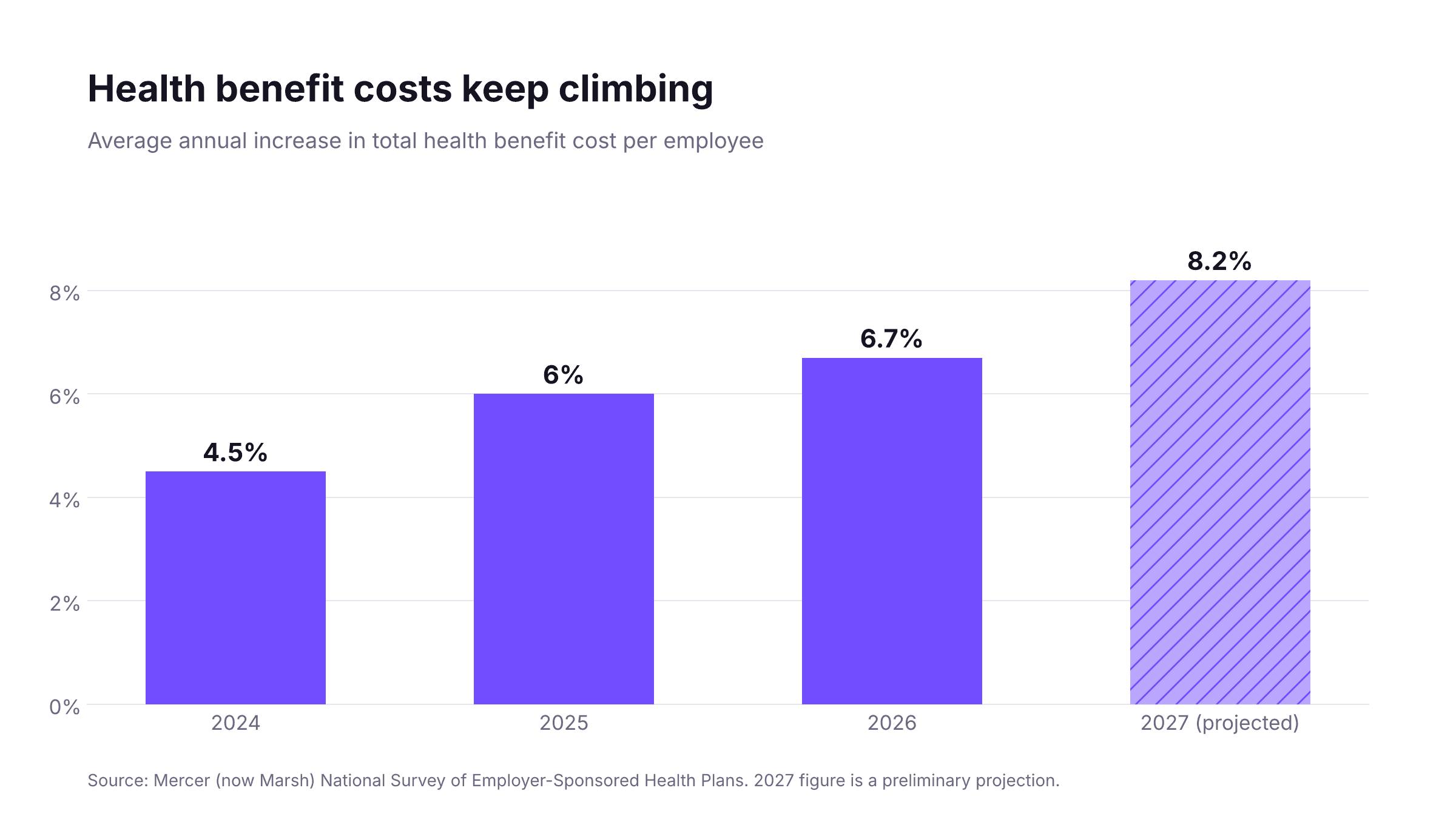
A PEO pools the employees from the various client companies so that a 10-person team can go in and buy a large group plan. For the employee, it's the most obvious of the PEO benefits.
2. Payroll taxes get filed on time, in every state
An Austin company's 5th employee moves to Colorado. No one realizes that the move requires a new state withholding account and a new state unemployment insurance registration. The first state notice comes two quarters later.
The failure-to-deposit penalty with the IRS is 2% of the unpaid deposit if the deposit is 1 to 5 days late, 5% if it's 6 to 15 days late, and 10% if it's more than 15 days late. It increases to 15% if the tax is still outstanding more than 10 days after the first notice from the IRS. On a $40,000 deposit that is one week late, the penalty would be $2,000.
Compliance coverage is one of the benefits of a PEO that founders tend to notice the least, as you simply get no notices from a working system at all. The PEO takes care of the deposits, the quarterly filings, and the state registrations wherever you have people working.
3. Classification questions get answered before they become audits
A 15-person e-commerce brand has three 'contractors' doing customer support. They work 9 to 5, they use the company laptops, they attend the morning standup, and they report to the head of ops. Under the IRS and DoL tests (the ones that look at the level of control and economic dependence), those three are employees.
Misclassification can result in back payroll taxes, unpaid overtime, and penalties (all of which are typically found in an audit). A PEO gives you access to HR professionals who can go through those tests with you prior to you even signing the contract.
4. Workers' compensation stops being a separate project
A home services startup sends its first field engineer out on jobs in week 2. The founder thought his general liability policy covered him. It didn't, and the first sprained ankle quickly became a policy hunt.
Workers' comp is required for employees in pretty much every state, with Texas being the only major exception. PEOs will generally have their own policy in place to cover their employees, will deal with the claims, and will bill the premiums with each payroll.
5. Onboarding and offboarding follow a checklist
A new hire starts on Monday. Her Form I-9 (due within 3 business days of the start date) remains incomplete until Thursday. A month later, we have an employee leaving without a COBRA notice.
A PEO runs these steps in order, every time:
- I-9 and W-4 collection at onboarding
- Benefits enrollment within plan deadlines
- Final pay according to state rules
- COBRA notices and benefits termination at offboarding
6. Founder hours go back to building the company
A founder blocks their Friday afternoons for 'admin' (chasing documents, answering enrolment queries, checking the state filing for the last quarter). That's over 200 hours a year at 4 hours a week.
NAPEO says their PEO clients are seeing a 27% ROI from cost savings alone. You keep on hiring, you keep on paying, you keep on managing performance and culture. The Friday block is all back to product, customers, and fundraising.
7. Teams stay longer, and companies grow faster
Two 30-person companies are advertising the same engineering role. One has group health, a 401(k), and paychecks that have never been late. The other has a stipend. The first one retains its people far longer.
The data is unequivocal. NAPEO finds PEO clients grow 2x faster, have 12% lower turnover, and are 50% less likely to go out of business than their non-PEO peers.
When is the right time to establish a PEO?
Three situations make the case on their own:
- You don't have an HR team, do you? Payroll, tax filings, and compliance all end up on the founder or the office manager. A PEO provides you with that function without the need for a full-time hire.
- You want better benefits. If applicants are rejecting offers over the health benefits, then a PEO's group plans (as a large employer) close the gap.
- You're hiring in a new state. Each state has its own withholding, its own unemployment insurance, and its own employment rules. A PEO will deal with the registrations and filings as you expand.
Why set up a PEO before you need one?
Retrofitting payroll, benefits, and compliance at 40 employees involves migrating the records, re-enrolling the employees mid-year, and untangling the filings across the various states. Setting it up at hire one means none of that. The PEO benefits kick in with the very first payroll run and accumulate with every hire thereafter.
Other related articles:
Complete guide to PEO renewal
1099 vs. W-2 classification rules
Group vs. individual health plans
Frequently asked questions
Is a PEO worthwhile for a company with fewer than 10 employees?
Often yes, particularly if you're looking at group health or if you have people working in more than one state. NAPEO's 2025 client data indicates that around one-third of their PEO clients have fewer than 10 employees.
What does a PEO cost?
Typically a monthly fee per employee or a percentage of payroll plus benefits premiums. Compare that to your current payroll software, broker, and benefits spend.
Do I lose control of my employees under co-employment?
You keep the hiring, the firing, the pay, and the day-to-day direction. The PEO takes on the payroll, the tax filings, and the benefits administration.
What does AI-native PEO mean?
An AI-native PEO builds the AI into the payroll and compliance workflow from day one. At Niural, EMMA validates the payroll prior to the run and flags any potential misclassification risk.
Can a PEO manage contractors?
Lots of PEOs only cover their W-2 employees. Some of the platforms (Niural, for example) will do contractor onboarding and payments as well within the same system.
Can a PEO assist with international hiring?
A U.S. PEO covers U.S. employees. International hires (where there is no local entity) go through an Employer of Record. Niural provides both options on one platform.
Do PEOs get better health insurance rates?
Pooling will often give small companies access to the large group plans and pricing. The results will vary from location to location, depending on the workforce and the claims history.
When do PEO plans renew?
The vast majority renew on 1st January, with the notices and open enrolment running October through to December. That's also the period in which the companies will be comparing providers.
Can I leave a PEO at a later stage?
Yes, your client service agreement sets the notice terms. Leaving mid-year can disrupt deductibles and tax filings, so most companies switch at renewal.
Disclaimer: This article is for informational purposes only and does not constitute legal, tax, benefits, or compliance advice. Scenarios are illustrative composites, not real companies. Consult qualified advisors about your specific situation.
Niural is a financial technology company, not a bank. Banking services are provided by i3 Bank, Member FDIC. Cash rewards are subject to eligibility and terms.