Jessica had signed plenty of contracts by the time her company hit 40 people. This one stopped her.
She was reviewing a PEO proposal, the outsourced HR partner her head of ops had spent two weeks vetting, and buried in the agreement was a phrase she didn't expect: employee leasing. She read it twice. Was she about to hand her engineers over to a staffing agency? Would a third party technically employ her team? She flagged the clause, told her ops lead to pause, and nearly walked away from a deal that would have solved half her back-office problems.
A lot of founders freeze at the exact same moment, over the exact same word. So here's the short answer before we go deeper: a PEO does not lease you workers and does not take ownership of your team. It enters a co-employment arrangement, sharing specific administrative and tax responsibilities for the people you already hired. Employee leasing is a different, older model in which a separate firm supplies workers who are its employees, not yours.
This article walks through PEO vs. employee leasing, why the confusion refuses to die, and what you should check before you put your name on anything.
Is a PEO just employee leasing? Of course not
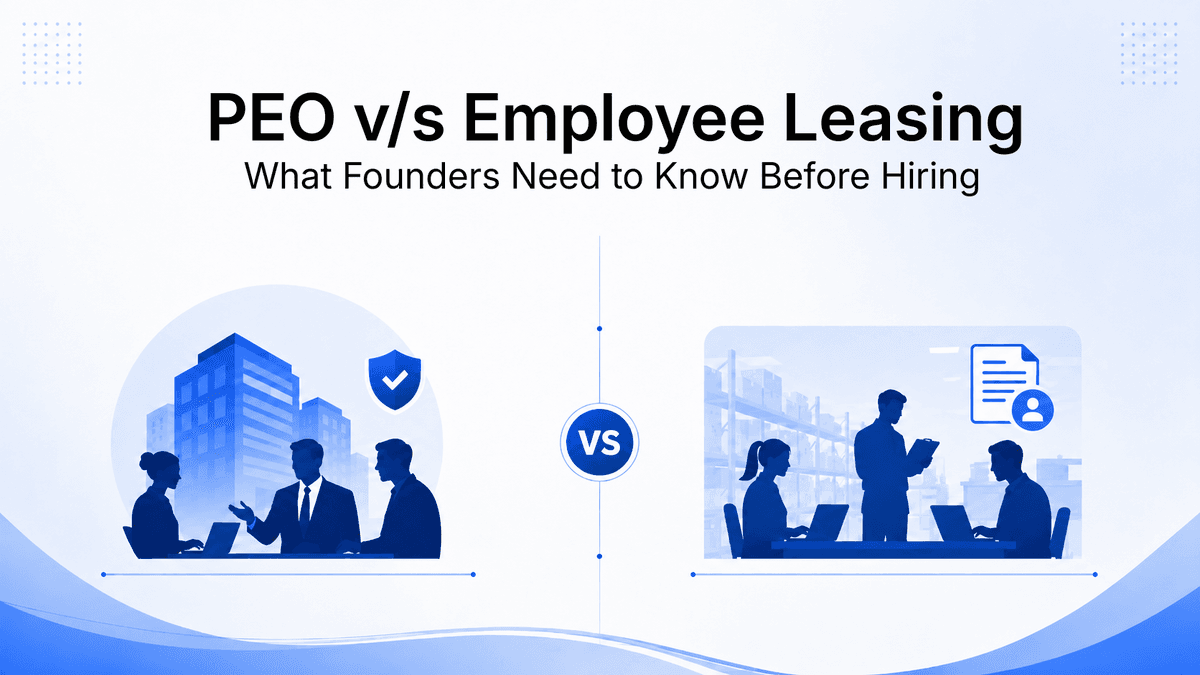
The difference between a PEO and employee leasing comes down to a single fact: where your people are employed.
A Professional Employer Organization (PEO) works through co-employment. You keep your team. You hired them, you manage them, you decide who stays and who goes. The PEO becomes a co-employer for a defined set of responsibilities: running payroll, filing employment taxes under its own tax ID, administering benefits, and helping you stay compliant. Your employees receive a W-2 issued under the PEO's Employer Identification Number, but they still work for you and answer to you.
Employee leasing is a supply arrangement. A leasing or staffing firm sources, hires, and places workers with your business, usually for a set project or period. Those workers are the leasing company's employees. When the contract ends, they go back to the firm. You direct their day-to-day work while they're with you, but you never employed them.
The distinction is not academic. It changes who carries employer liability, who owns the employment relationship, and what happens when the arrangement ends. Confusing the two is how a founder like Jessica talks herself out of the right decision for the wrong reason.
The question that settles it: who employs your people?
When the terminology gets muddy, one question cuts through it: who employed these people, and who employs them now?
- PEO / co-employment: You did, and you still do. The PEO shares tax and administrative employer duties. You retain hiring, firing, supervision, and every operational decision.
- Employee leasing: The leasing firm did. The workers are theirs, placed with you temporarily. You supervise the work; they own the employment relationship.
If you hired the person and they're staying, you're looking at co-employment. If a firm is supplying the person and will reclaim them, you're looking at leasing. Everything else, benefits, payroll, liability- flows from that one answer.
What you keep, and what you hand off under a PEO
Founders worry about co-employment because "co" sounds like shared control over their people. It isn't. Under a PEO relationship, the split is clean and predictable.
You keep:
- Hiring and firing decisions
- Day-to-day management, direction, and supervision
- Compensation levels, roles, and org design
- Company culture and how work gets done
The PEO handles:
- Payroll processing and employment tax filing under its EIN
- Benefits administration and access to pooled plans
- Compliance support across payroll, benefits, and HR
- Employer-side administrative paperwork and reporting
The employment relationship stays yours. What leaves your plate is the administrative machinery around it, the part most founders never wanted to run in the first place.
Why this trips up founders at exactly the wrong moment
The PEO-versus-leasing question tends to land right when a founder can least afford to stall.
It usually surfaces at 20 to 50 employees, the stretch where manual payroll starts breaking, benefits get too complex to run out of a spreadsheet, and multi-state hiring introduces compliance exposure the founder didn't know existed. That's the point where a PEO becomes useful, and also the point where a founder is least equipped to parse employment-law nuance between board meetings.
For context on how common this move is: NAPEO reported in October 2025 that more than 230,000 U.S. businesses partner with a PEO, roughly 15 percent of all employers with 10 to 499 employees, with the heaviest concentrations in Florida, Texas, California, and New York. This is a mainstream operating decision for growing companies, not a fringe one. The risk isn't signing with a PEO; it's mistaking a PEO for a leasing arrangement and either walking away or, worse, picking the wrong model entirely.
PEO vs. employee leasing, side by side
PEO (Co-Employment) | Employee Leasing | |
Who employs the workers | You do; the PEO is a co-employer for tax and admin | The leasing firm employs and supplies them |
Who sources the workers | You hire your own team | The leasing firm sources and places them |
Control and direction | You retain full day-to-day control | You direct the work; firm owns the relationship |
Duration | Ongoing partnership | Often project- or period-based |
Who issues the W-2 | PEO, under its own EIN | The leasing firm |
Benefits | Access to pooled, enterprise-grade plans | Provided by the leasing firm, if at all |
Best fit | Growing companies scaling their own team | Temporary or specialized staffing needs |
What to check before you sign anything
Once you know you're evaluating a genuine PEO, the vetting gets practical. Before signing, confirm:
- The contract language. If the agreement says "employee leasing," ask the provider to explain it. In most cases, it's stale statutory terminology, not a description of the actual relationship, but you want that confirmed in writing.
- EIN and W-2 clarity. Understand whose EIN your payroll runs under and how tax filings are handled.
- Technology and reporting. Ask how you'll get real-time visibility into headcount, payroll, and workforce costs, not just a monthly export.
- Exit terms. Know what happens to benefits, data, and records if you leave, including access to prior claims history.
Where a platform like Niural fits
Part of what made the old leasing model feel risky was opacity: you handed work to a third party and lost sight of it. Modern PEO platforms are built to remove that tradeoff, so offloading administration never means offloading visibility.
Platforms like Niural consolidate payroll, benefits, HR, and compliance into one system, giving founders a single source of truth across their workforce instead of a stack of disconnected tools. Niural's PEO is designed so that handing off the administrative load doesn't cost you insight into your team; you keep real-time visibility into who you employ and what they cost, while the compliance and payroll machinery runs underneath. For a founder like Jessica, that's the reassurance the word "leasing" failed to give: the people are still hers, the control is still hers, and the busywork is finally someone else's problem.
The takeaway for founders
PEO vs. employee leasing is not a technicality; it decides who employs your people and who carries the risk. A PEO shares the administrative and tax load while you keep full control of your team. Employee leasing supplies workers who belong to someone else. The confusion is mostly a language problem inherited from a decades-old industry, and it shouldn't cost you the right decision.
If you're at the stage where payroll, benefits, and multi-state compliance are pulling you away from building the company, a modern PEO is worth a serious look, with the terminology understood, not feared.
See how Niural's PEO handles this → Explore Niural's PEO
Other Related articles:
Frequently Asked Questions
Is a PEO the same as employee leasing?
No, a PEO co-employs the workers you already hired, sharing tax and administrative duties while you keep control. Employee leasing means a separate firm supplies workers who are its employees, not yours.
Does a PEO own my employees?
No, under co-employment, you retain hiring, firing, and day-to-day management. The PEO handles payroll, tax filing, benefits, and compliance support. The employment relationship stays with you.
What is co-employment?
Co-employment is a contractual sharing of specific employer responsibilities between your company and a PEO. You manage the people and the business; the PEO administers payroll, taxes, and benefits.
Disclaimer: This article is for informational purposes only and does not constitute legal, tax, benefits, or compliance advice. Consult qualified advisors for guidance specific to your business.