At 4:52 on a Friday, Nadia's phone lit up. She is the Head of People at a 120-person company that had been 40 people eighteen months earlier, and the message was from a new engineer in Colorado: "Hey! My first paycheck looks about $600 short?"
Nadia already knew what happened. The engineer had been onboarded in the HR platform, but Colorado had never been set up in the payroll tool. The two systems didn't talk. Somewhere in the handoff, a new state fell through a crack that nobody could see until money moved.
Two floors down, Sam, the Controller, was looking at a different symptom of the same disease: a notice that a federal payroll tax deposit had posted late. Sam had spent the afternoon reconciling payroll against the ledger by hand, because the numbers in finance never quite matched the numbers in HR.
Two people, each holding one half of a problem, neither able to see the other half. That seam, between the people who own the workforce data and the people who own the money, is where payroll management lives, and it's where payroll management fails.
So what is payroll management?
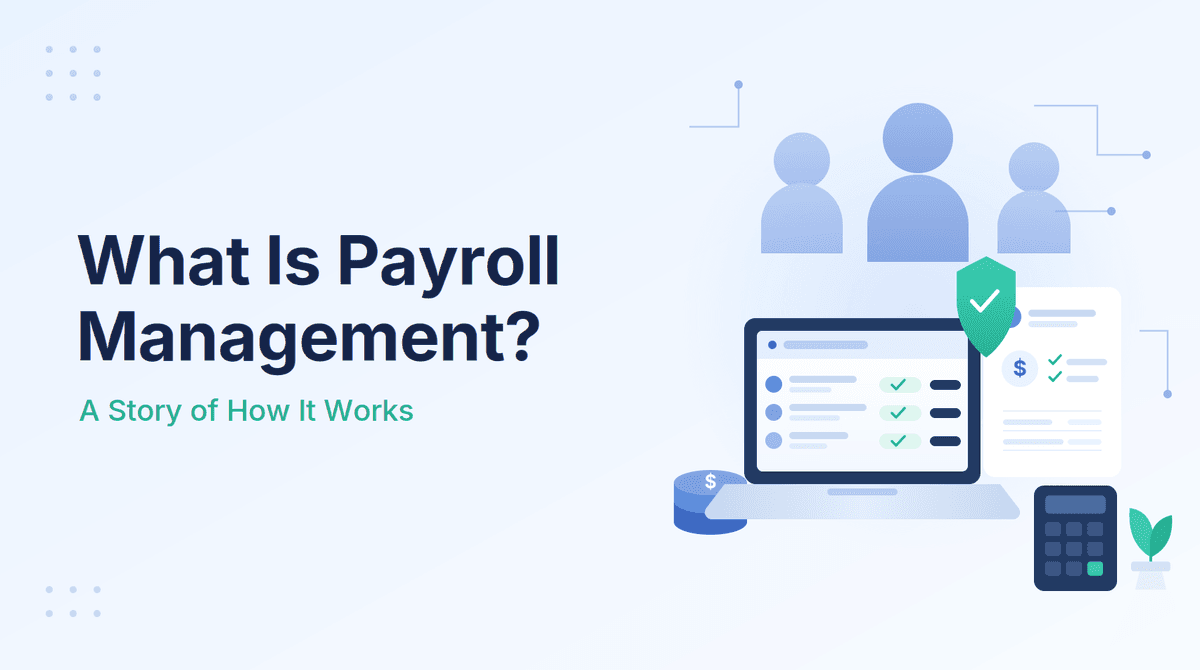
Payroll management is the end-to-end process of paying a company's workforce correctly and on time: calculating wages, withholding and remitting taxes, applying deductions, disbursing pay, and keeping the records that prove it was all done right. It also refers to the system, software, a service, or both, used to run that process.
For Nadia and Sam, that definition has two faces. Nadia sees payroll as the last mile of the employee experience: onboarding, benefits, state setup, and offboarding all pour into it, and when they pour in wrong, employees don't email the vendor; they email her. Sam sees payroll as the largest recurring cash outflow in the business and one of its biggest compliance liabilities: it drives the close, feeds cost reporting, and turns small timing mistakes into penalties.
Neither of them is wrong. That's the point. Payroll is one process wearing two job descriptions, and the trouble starts when the two descriptions run on two different systems.
Why a short paycheck is a bigger deal than it looks
The Colorado engineer's $600 was fixable by Monday. But the same gap that missed one state can miss a tax deposit, a garnishment, or a classification, and those don't stay small.
The IRS failure-to-deposit penalty starts at 2% for a deposit one to five days late, rises to 5% at six to fifteen days, and 10% beyond fifteen days, reaching 15% once the deposit remains unpaid more than ten days after the IRS's first notice (or the day a demand for immediate payment is issued), with interest accruing on top. IRS reporting cited by industry sources indicates roughly 40% of small businesses pay a payroll tax penalty each year, at an average cost of $850 to $1,000.
The time cost is just as real. The National Small Business Association's 2025 Small Business Taxation Survey found that half of small businesses spend more than three hours a month just administering payroll taxes, and about a quarter had been fined for payroll tax mistakes.
For Nadia, the stakes are trust; an employee who couldn't cover a prescription because their coverage didn't sync doesn't care whose system failed. For Sam, the stakes are money and audit exposure. The reason payroll management matters is that a single break hits both at once, and the two people responsible usually can't see the same data.
The four ways companies run payroll
That Monday, Nadia and Sam sat down and asked how they should be running this. There are, broadly, four methods, and a fifth that's emerging.
- Manual, in-house (spreadsheets). Calculating pay, taxes, and deductions by hand. Cheapest at five employees, dangerous at fifty. This is roughly where their company started, and it's what they'd quietly never fully left behind.
- A bookkeeper or accountant. Handing payroll to a finance professional. Adds expertise, but leans on one person and doesn't scale cleanly across states or countries.
- Payroll software. A platform that automates calculation, withholding, direct deposit, and often filings. The common growth-stage choice. The catch: quality varies enormously on multi-state depth and on whether it syncs with HR and accounting.
- Full-service or outsourced payroll, including PEOs. A provider runs payroll, remits taxes, and often assumes part of the compliance load. A PEO goes further as a co-employer for tax and benefits. Strong for offloading admin; fit depends on flexibility and service.
The fifth category is what Nadia and Sam were really missing: an AI-native unified platform that combines software's automation with a full-service provider's compliance depth, then adds error validation and one shared view across HR and finance.
Method | Best for | Automation | Compliance handling | Scales across states/countries |
Manual / spreadsheets | 1–5 employees, tight budget | None | Fully on the business | Poorly |
Bookkeeper/accountant | Small teams wanting expertise | Low | Shared with the professional | Limited |
Payroll software | Growing companies | High | Mostly automated, business reviews | Varies by platform |
Full-service / PEO | Teams offloading admin | High | Largely handled by provider | Domestic strength; global varies |
AI-native unified platform | Multi-state or global teams | High, with validation | Automated with error checks and audit trail | Designed for it |
Walking the cycle that broke
To see where Colorado slipped through, follow a single pay run through the stages every payroll cycle moves through, no matter which method runs it.
- Setup and configuration. Tax accounts, pay schedules, rates, deductions, and worker classification. This is where payroll in Colorado broke. The state was never registered in the payroll tool, so stage one was quietly incomplete before the cycle even began.
- Data collection. Hours, salaries, new hires, departures, bonuses, adjustments. The engineer existed here, in the HR system, which is exactly why the gap was invisible.
- Calculation. Gross pay, deductions, withholdings, net pay. The math ran perfectly on the wrong setup, which is the most dangerous kind of correct.
- Review and approval. The one stage that could have caught it: a pre-run check flagging "new employee, no state tax profile." No such check existed. The run was approved because nothing told anyone not to.
- Disbursement. Pay and tax obligations go out. The short paycheck landed. So did the late deposit Sam was staring at.
- Filing and remittance. Depositing withheld taxes on schedule and filing returns like Form 941, W-2s, and 1099s. Miss the schedule, and stage six is where the penalty clock starts.
- Recordkeeping and reconciliation. Retaining auditable records and matching payroll to the ledger. This is Sam's Friday afternoon, done by hand, because the two systems produced two versions of the truth.
What this reveals: almost every payroll failure traces to stage one (misconfigured setup) or stage four (no real review). The money moving in stage five is just when the earlier mistake becomes visible and expensive.
What a payroll system is supposed to do
When Nadia and Sam listed what they actually needed, they were really describing the functions of a payroll management system:
- Wage and salary calculation, including overtime and multiple pay types
- Federal, state, and local tax withholding and remittance
- Deduction management: benefits, retirement, garnishments
- Direct deposit and other disbursement methods
- Tax form generation and filing (Form 941, W-2, 1099)
- Multi-state and, increasingly, multi-country payroll
- Employee self-service for pay stubs and tax forms
- Integration with HRIS, time tracking, and accounting
- Audit-ready recordkeeping and reporting
- Error detection and validation before pay runs
The version where payroll never breaks
Picture the same Friday on a modern setup. The engineer is onboarded once, in one system. Because HR and payroll aren't two platforms bridged by hope, adding the employee automatically raises the question their old tools never asked: this person works in Colorado, and Colorado isn't configured; set it up now. At the review stage, the run pauses on its own: new employee, missing state tax profile, do you want to proceed? Nobody discovers the problem after the money moves, because the money never moves on a broken record.
This is the direction the market is heading, away from stitched-together stacks that rely on people to reconcile them, and toward one source of truth with intelligence that acts on the data instead of just displaying it.
Platforms like Niural are built for exactly this seam. Niural runs on owned tax and payment rails rather than middleware bridged between vendors, which is what makes real-time visibility and faster settlement possible. Its executional AI layer, EMMA, validates payroll before it runs and surfaces classification and state-setup errors early, the stage-four check Nadia and Sam never had. And because it unifies HR, payroll, compliance, and payments in one place, the Head of People and the Controller finally read from the same record instead of arguing over which system is right.
Where Niural fits
Niural is built for the moment Nadia and Sam hit: a company that has outgrown a basic payroll tool but doesn't want to babysit a stack of disconnected systems. It consolidates U.S. payroll, PEO, global payroll, EOR, contractor management, and AP/AR into one platform, with EMMA handling validation and error prevention across the workflow. The practical result is fewer surprises reaching employees, cleaner data feeding the close, and a single source of truth that ends the HR-versus-finance standoff over whose numbers are correct.
The takeaway
Nadia and Sam didn't have a payroll problem. They had a seam problem, two systems, two owners, one process, and no shared view of the truth. That's what payroll management actually is: not the moment pay hits an account, but everything that has to line up beforehand, across two teams, every single cycle. The companies that run it well aren't the ones that catch mistakes fastest. They're the ones whose systems catch mistakes before the money moves.
If your team keeps colliding at that same seam as it scales across states or borders, see how a unified, AI-native approach handles it on the Niural payroll platform.
Check out Niural Payroll
Other related articles:
Building a Payroll Infrastructure
8 Common Payroll Problems
Global Payroll 101
The Importance of Payroll Automation
Frequently asked questions
What is payroll management in simple terms?
It's the process of paying employees correctly and on time: calculating wages, withholding and remitting taxes, applying deductions, disbursing pay, and keeping compliant records, plus the system used to run it.
What are the methods of payroll management?
Four traditional methods: manual/in-house, a bookkeeper or accountant, payroll software, and full-service or outsourced payroll including PEOs. A fifth, the AI-native unified platform, adds error validation and one shared HR/finance view.
What are the stages of the payroll process?
Setup and configuration, data collection, calculation, review and approval, disbursement, filing and remittance, and recordkeeping and reconciliation.
Why is payroll management important?
A single error hits both employee trust and company finances. Federal deposit penalties escalate from 2% to 15% plus interest.
What does a payroll management system do? It calculates pay, withholds and remits taxes, manages deductions, disburses payments, generates tax forms, integrates with HR and accounting, and, in modern platforms, validates runs and catches errors before payroll processes.
Is payroll HR's job or finance's job? Both. HR owns the people data and employee experience; finance owns the cash, compliance, and close. Failures appear in the handoff between them, which is why unified systems reduce risk.
Disclaimer: This article is for informational purposes only and does not constitute legal, tax, accounting, or compliance advice. Penalty rates, thresholds, and filing requirements change; verify current requirements with the IRS, applicable state agencies, and qualified advisors before acting.