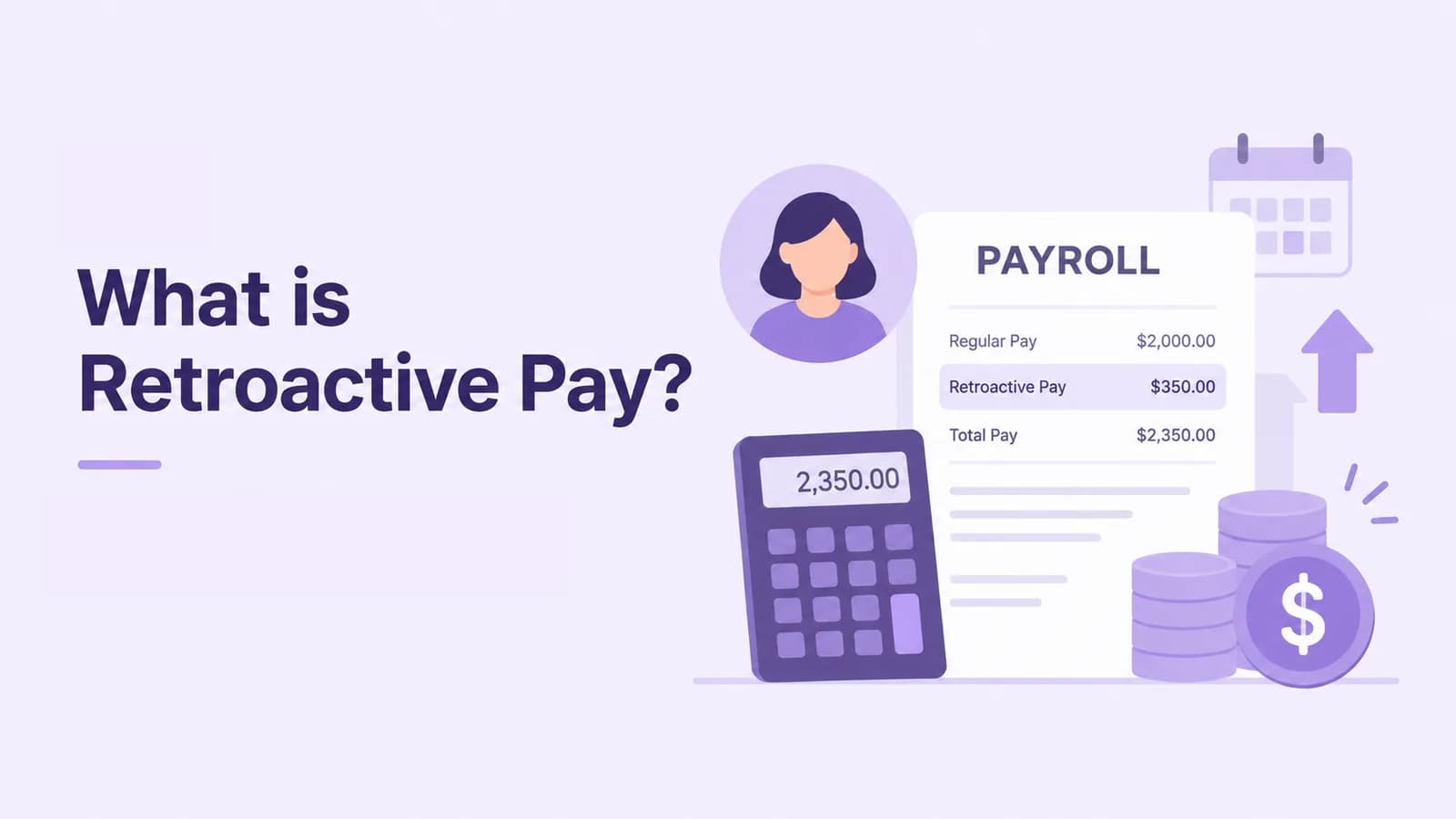
Hank runs People Ops at a 180-person company, but he did not discover a problem until an employee flagged it. A senior designer had been promoted six weeks earlier, but her paychecks still showed the old number. Somewhere between the approval in the HR system and the actual payroll run, the new rate never carried over. She'd been underpaid for three pay periods. That gap is retroactive pay. And if you manage payroll or people, you will run into it, usually at the least convenient moment.
What is retroactive pay?
Retroactive pay, often shortened to "retro pay," is the difference between what an employee was actually paid and what they should have been paid for work they already performed. It's a correction.
Hank's designer is a textbook case. She did the work at her new title. The company just paid her at the old rate. The money owed for those weeks is retro pay.
Retro pay vs. back pay
Retro pay corrects an amount that was paid at the wrong rate. The employee got a check; it was just too small. Back pay covers wages that were never paid at all, and it usually shows up in more serious contexts: a missed final paycheck, an unpaid overtime claim, or a wage dispute settled by a court or a regulator.
A quick way to keep them straight:
- Retro pay means the employee was paid, but not enough. Common cause: a raise that landed late.
- Back pay means the employee wasn't paid for work they did. Common cause: a wage violation or a paycheck that never went out.
Both are wages owed for work already done, and both have to be corrected. Back pay tends to carry higher legal stakes because the wages were never issued in the first place. For Hank, this was retro pay: the checks went out, they were just short.
What sets it off
Retro pay is almost always a symptom of something upstream that didn't update in time. The usual triggers:
- A raise or promotion approved but not applied to the next payroll run
- Overtime paid at the regular rate instead of time-and-a-half
- A shift differential, commission, or bonus calculated on an outdated number
- A straightforward keying error, like the wrong hourly rate entered at onboarding
In each case, a decision was made in one place (a manager approves a raise, an employee works overtime) and didn't reach payroll accurately before the run.
Running the numbers for an hourly employee
For hourly workers, retro pay is the difference between the two rates, multiplied by the hours worked at the wrong rate.
Say one of Hank's warehouse leads was bumped from $22 to $24 an hour, effective at the start of the month, but the raise didn't hit payroll for two weeks. He worked 80 hours in that window.
- Rate difference: $24 − $22 = $2 per hour
- Hours affected: 80
- Retro pay owed: $2 × 80 = $160
Overtime makes it slightly more involved. If any of those 80 hours were overtime, the correction has to reflect the higher overtime rate, not the base rate, for those specific hours. A missed raise that also touched an overtime week means you're correcting time-and-a-half on the affected hours, not just straight time.
Running the numbers for someone on salary
For salaried employees, calculate the per-pay-period difference between the old and new salary, then multiply by the number of affected pay periods.
Back to the promoted designer. Her salary went from $78,000 to $90,000, and the company pays biweekly (26 pay periods a year). Three pay periods went by at the old number.
- Old salary per period: $78,000 ÷ 26 = $3,000
- New salary per period: $90,000 ÷ 26 = $3,461.54
- Difference per period: $461.54
- Periods affected: 3
- Retro pay owed: $461.54 × 3 = $1,384.62
If the raise took effect partway through a pay period rather than at a clean period boundary, you prorate that first period by the number of days at the new rate. The principle holds: find the gap for one period, then account for every period the employee was underpaid.
How it gets taxed
Retroactive pay is ordinary taxable income. It's subject to federal income tax, Social Security, and Medicare, plus any state and local taxes, exactly like the rest of the employee's wages.
What changes is the withholding method, not the tax owed. The IRS treats retro pay as supplemental wages, the same bucket as bonuses, commissions, and overtime. When supplemental wages are paid separately or identified separately from regular wages, an employer can withhold federal income tax at the flat supplemental rate of 22% (rising to a mandatory 37% on supplemental wages above $1 million in a calendar year). Alternatively, the employer can fold the retro amount in with regular wages and withhold using the aggregate method based on the employee's Form W-4.
The important nuance for your team, and for the employee who emails you confused: a different withholding rate on the pay stub doesn't mean the money is "taxed more." Withholding is a prepayment. Actual tax owed is settled when the employee files their return, based on total income for the year. If timing pushes the correction into a different tax year than the one the work was performed in, that can affect year-end tax documents, so it's worth flagging for finance.
How fast do you have to pay it?
Once you've found underpaid wages, you're generally expected to correct them promptly. Under the Fair Labor Standards Act, the Department of Labor's general expectation is that wage errors are made right by the next regular payday after the error is discovered. Many states set stricter timelines or add their own requirements, so multi-state employers should confirm the rules in each state where they have workers.
Practically, Hank had two options: add the correction to the designer's next regular paycheck, or run an off-cycle payroll to get her the money sooner. For a sizable correction or a frustrated employee, the off-cycle route is often worth it.
Most retro pay is a systems problem
Look back at Hank's two cases. The calculations took a few minutes each. The real cost was everything around them: the employee noticing before HR did, the trust dinged when a promotion doesn't show up in someone's pay, the scramble to reconcile which periods were affected, and the quiet worry about what else slipped through.
That's where a connected payroll system earns its place. Niural runs HR and payroll on one platform, so an approved raise or promotion carries into the payroll run instead of waiting on a manual handoff. Its executional AI layer, EMMA, validates payroll before the run and flags missing rate changes, so the kind of miss that cost Hank three pay periods is flagged before the run. Retro pay doesn't disappear entirely; some corrections are genuinely unavoidable. But the routine ones, the late raises and mis-rated overtime, are the ones worth engineering out.
See how Niural handles payroll.
See related articles:
Unified Payroll vs. Integrated Payroll
Top 8 Payroll Problems
How to Choose a Global Payroll Provider
Global Payroll 101
Frequently asked questions
Is retroactive pay the same as back pay?
Not quite. Retro pay corrects wages that were paid at the wrong rate. Back pay covers wages that weren't paid at all. The terms are often used interchangeably, but back pay usually involves higher legal stakes because the money was never issued.
Is retroactive pay taxed differently?
It's taxed as ordinary income, like regular wages. It is treated as supplemental wages for withholding purposes, which means an employer may withhold federal income tax at the flat 22% supplemental rate when it's paid separately, or use the aggregate method. The withholding method doesn't change the actual tax the employee owes for the year.
How do I calculate retro pay for an hourly employee?
Subtract the rate the employee was paid from the rate they should have received, then multiply by the number of hours worked at the wrong rate. Adjust for overtime where it applies.
How do I calculate retro pay for a salaried employee?
Divide both the old and new annual salary by the number of pay periods to get the per-period amounts. Take the difference, then multiply by the number of pay periods the employee was underpaid.
How quickly does retro pay have to be issued?
The Department of Labor generally expects wage errors to be corrected by the next regular payday after they're found, and many states impose stricter timelines. You can add the correction to the next paycheck or run an off-cycle payroll to pay it sooner.
What usually causes retro pay?
Most cases trace back to a change that didn't reach payroll in time: a late raise or promotion, missed overtime, an outdated rate on a bonus or commission, or a data-entry error.
Disclaimer: This article is for informational purposes only and does not constitute legal, tax, payroll, or accounting advice. Withholding rates, wage-payment timelines, and correction requirements vary by jurisdiction and change over time. Consult qualified legal, tax, or payroll professionals for guidance specific to your business.
-768x432.webp&w=3840&q=75)